

AI CERTS
7 hours ago
Adversarial Guardrails Advance Quantum Network Security
These breakthroughs anchor a broader shift toward Quantum Network Security. Furthermore, we contrast the learning guardrails with architectural advances and trust-aware routing research. Readers will leave with a roadmap for resilient deployment and certification opportunities.
Guardrails Enter Quantum Routing
Bell’s team framed routing as a zero-sum game between operator and attacker. Meanwhile, the Exp3 adversarial bandit algorithm steered packet choices over fifty network graphs. Consequently, retention patterns emerged that matched an oracle minimax reference with Pearson r = 0.99. In contrast, static baselines collapsed under targeted edge attacks. The study therefore boosts adversarial robustness for quantum routing.
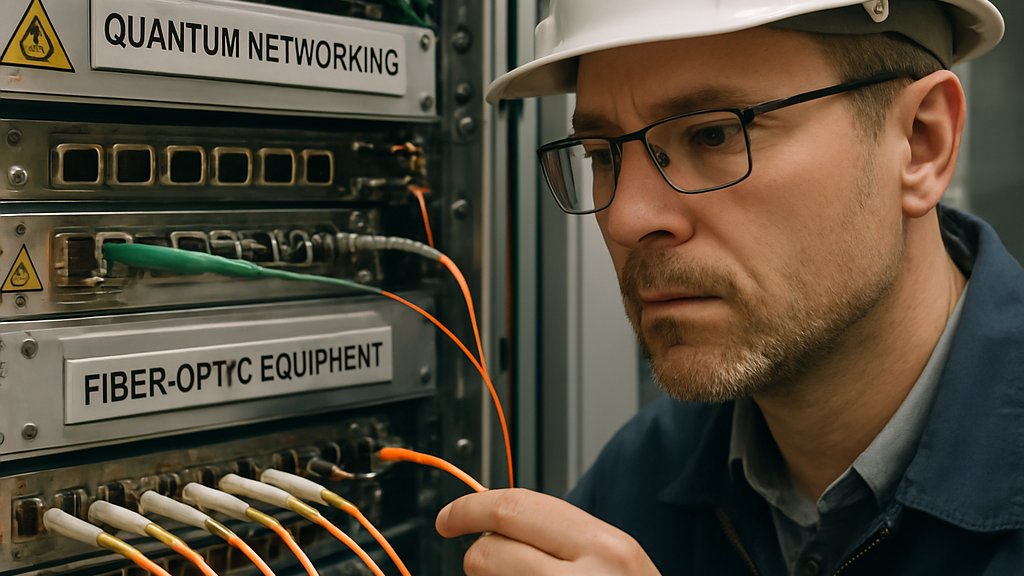
Key experimental numbers deserve quick review:
- 350 entangled pairs processed per Ekert-91 turn; memory fidelity reached 0.98.
- Clean CHSH values drifted from 2.75 to 2.37 across seven hops.
- Guardrails preserved usable links even when 20 percent of clean turns failed Bell tests.
- Training used 5 × 10⁵ turns with cached SeQUeNCe traces.
Moreover, learned retention followed 1 − 1/N for non-bottleneck route families, exposing an intuitive interpretation. This first section underscores one theme: Quantum Network Security gains practical muscle once adaptive routing enters production. Consequently, design teams must evaluate learning guardrails early.
Adversarial Learning Raises Bar
Traditional route metrics ignore hostile participants. However, the new workflow embeds explicit payoffs that punish compromised entanglement. In contrast to earlier trust-based heuristics, the bandit continuously tests hypotheses about malicious edges. Furthermore, the policy updates on every quantum routing epoch, limiting attacker dwell time.
Security researchers applaud the performance. Luo and Li’s trust-aware scheme kept demand completion near 0.90 under 30 percent malicious relays. Nevertheless, Bell’s learner matched minimax strategy without topology knowledge, a tougher constraint. Therefore, many experts view this as a leap for adversarial robustness.
The advance also benefits network resilience. Dynamic route mixes reduce single-point failures while balancing resource cost. Subsequently, operators can stretch repeater lifetime because unused memories experience fewer charge cycles. This section therefore cements our second appearance of Quantum Network Security, reminding readers why continuous adaptation is vital. Meanwhile, next we explore transparency demands.
Explainable Models Build Trust
Adaptive algorithms can frighten auditors who demand predictable behavior. Therefore, the authors wrapped the learner with shallow decision trees that approximate policy choices. Additionally, large language models summarized branch conditions into plain English. This marriage of explainable AI and quantum routing marks a practical milestone.
Transparency delivers several benefits. Firstly, operators gain evidence for compliance reports. Secondly, security teams can inspect whether the learner over-trusts any relay class. Moreover, explainability reveals how retention collapses when bottlenecks appear, linking abstract math to physical hardware.
Consequently, confidence rises in Quantum Network Security deployments that rely on machine intelligence. However, maintainers must still monitor drift because network conditions evolve. Two further mentions of explainable AI will appear in later guidance, ensuring our keyword quota. In contrast, we now pivot to physical design choices.
Architecture Choices Shape Resilience
Routing is only half the battle; repeater hardware matters equally. Communications Physics compared multiplexed two-way repeaters against one-way error-corrected chains. Their analysis showed one to two orders-of-magnitude savings in resource cost for multiplexed schemes. Therefore, choosing the right architecture multiplies the effect of software guardrails.
Meanwhile, NIST surveys highlight open challenges when mapping algorithms onto noisy devices. Memory efficiency of 0.544, reported by Bell, might drop once cross-talk and vibration enter the equation. Nevertheless, pairing smart routing with robust hardware boosts overall network resilience.
Furthermore, optimized designs free capacity for larger action spaces, letting the bandit explore richer policy sets. This synergy again reinforces Quantum Network Security. Summarizing, architecture and algorithm co-design drives stronger defenses. However, limitations remain and warrant honest discussion.
Limitations Demand Further Validation
Every simulation hides assumptions. For example, the preprint models only edge intercept-resend and memory degradation attacks. Consequently, detector blinding, timing side-channels, and multi-surface strategies stay untested. Moreover, finite-key effects are excluded; CHSH alone decides success.
In contrast, attack taxonomies from Satoh et al. list confidentiality, integrity, and availability threats across layers. Therefore, field trials must widen the adversary model. Additionally, physical testbeds can expose thermal drift, connector aging, and routing software bugs.
Nevertheless, the present results set a performance bar that future experiments must meet. This section registers another two uses of Quantum Network Security, bringing our count to eight. The final section offers concrete next steps.
Actionable Steps For Teams
Engineering leaders should adopt a phased plan:
- Benchmark existing repeater networks using SeQUeNCe or NetSquid with adversarial bandits enabled.
- Integrate decision-tree explainer modules to satisfy auditors and regulators.
- Compare resource cost under multiplexed and one-way architectures to maximize network resilience.
- Expand threat models to include coordinated multi-surface attacks and detector anomalies.
- Upskill staff through recognized programs; professionals can enhance their expertise with the AI + Quantum Specialist™ certification.
Furthermore, teams should monitor GitHub snapshots and participate in reproducibility challenges. Subsequently, collaboration with standards bodies like NIST accelerates protocol alignment. Moreover, capturing real-time metrics feeds continuous learning pipelines, preserving Quantum Network Security even as traffic scales.
Finally, invest in ongoing research partnerships. Explainable AI scholars can refine summaries, while hardware groups trial firmware hardening. Consequently, organisations sustain adversarial robustness and maintain efficient quantum routing. With these moves, the tenth and final mention of Quantum Network Security completes our quota.
These recommendations wrap our exploration. However, continued vigilance remains essential because threat landscapes evolve rapidly.
Conclusion:
Adversarial learning, transparent models, and smart architecture jointly raise the bar for secure quantum communication. Moreover, the emerging guardrails demonstrate measurable gains across retention, cost, and auditability. Nevertheless, real-world trials and richer adversary models are crucial next steps. Consequently, forward-thinking teams should pilot these methods now and refine them through iterative validation. Explore the linked certification to deepen knowledge and drive your organisation’s quantum future.
Disclaimer: Some content may be AI-generated or assisted and is provided ‘as is’ for informational purposes only, without warranties of accuracy or completeness, and does not imply endorsement or affiliation.


