

AI CERTS
1 day ago
BaFCo Pushes Bangla AI Testing Frontiers
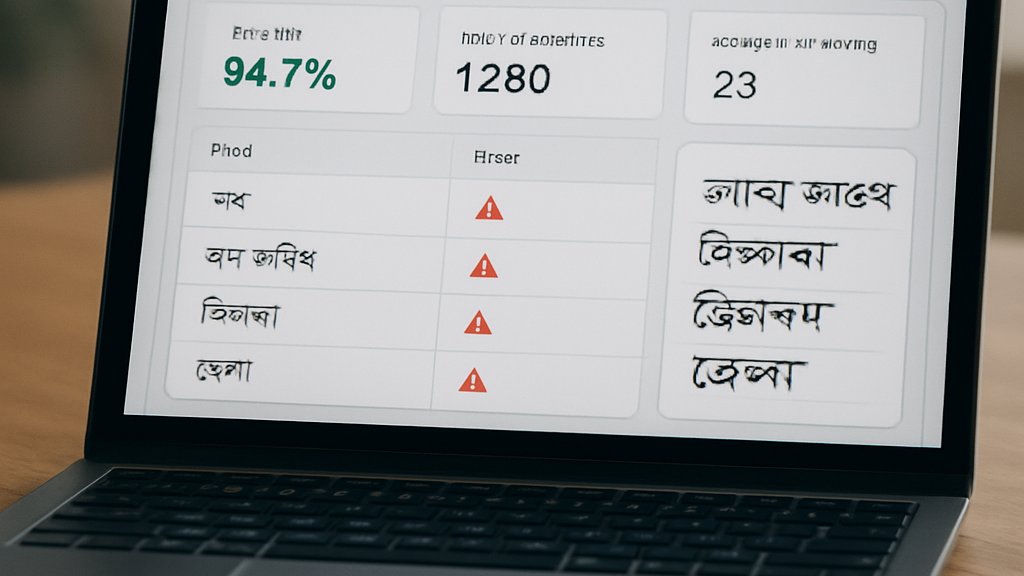
In this article, we dissect the dataset, evaluation results, and business implications for AI builders. Additionally, we outline strategic steps for deploying solutions while mitigating privacy and hallucination risks. Therefore, read on to grasp how BaFCo reshapes expectations around Bangla AI Testing performance.
Bangla Forms Benchmark Arrives
BaFCo brings 200 distinct Bangladeshi government forms covering agriculture, banking, education, and land records. Consequently, the benchmark dataset reflects genuine bureaucratic complexity rather than synthetic templates. Each form spans one to five pages, producing 316 total pages for analysis. Annotations capture 26 fine-grained entity types and five coarse categories.
Furthermore, annotators mapped 16,382 entities to 8,771 relationships, enabling robust document layout analysis metrics. Key information extraction labels add 1,926 key-value pairs across 156 forms. These figures demonstrate unprecedented scale for Bangla form comprehension research. Therefore, BaFCo directly strengthens Bangla AI Testing across government workflows.
- 200 multi-page forms, 316 pages total
- 26 fine-grained entities, five coarse classes
- 16,382 entities, 8,771 relationships
- 1,926 key-value pairs, 156 annotated forms
In summary, BaFCo offers depth and authenticity lacking in earlier corpora. However, scale alone cannot guarantee reliable evaluation.
The following section explores dataset composition details to contextualize those numbers.
Dataset Composition And Scope
The dataset draws documents from fifteen public domains, including agriculture subsidies and voter registration. Consequently, practitioners can benchmark models across varied layouts and terminology. Images originate from scanned PDFs, preserving challenges like faded ink and skewed alignment.
Low-resource language issues remain central. Moreover, BaFCo supplies bilingual headers, yet handwritten Bangla entries dominate content. Such traits stress OCR workflows that must separate printed keys from cursive values.
Licensing uses a research-friendly CC-BY-NC clause, with sensitive identifiers synthetically masked. Nevertheless, developers targeting production must secure independent consent and compliance checks.
These design choices ensure realistic noise while respecting privacy obligations. Therefore, results remain meaningful for real deployments.
We now examine how leading models performed on BaFCo’s tasks.
Evaluation Results Reveal Gaps
Researchers evaluated flagship multimodal large language models using zero-shot and chain-of-thought prompting. Models included GPT-5.2, Gemini-3, Claude Opus, Qwen, and Kimi. For document layout analysis, granular mean average precision peaked at 0.1177. In contrast, coarse categories scored 0.2646, revealing modest spatial grounding.
Key information extraction performance looked stronger. Best micro F1 reached 0.848 on Bangla values, outperforming English baselines near 0.800. Moreover, bilingual headers aided models during alignment. These scores recalibrate expectations for Bangla AI Testing in production dashboards.
Nevertheless, qualitative analysis showed hallucinated dates and positional bias. Models sometimes predicted entities inside blank margins when confidence faltered. Such errors threaten any automated workflow handling citizen data.
Overall, BaFCo exposes localisation weakness despite acceptable extraction scores. However, fine-tuned vision encoders could close the gap.
The next section unpacks technical and ethical hurdles uncovered by these experiments.
Challenges Facing Document AI
Low-resource language complexity tops the list. Bangla script includes conjunct characters that confuse segmentation algorithms. Consequently, OCR workflows often deliver broken glyph clusters, reducing downstream accuracy.
Spatial grounding also remains immature. Current MLLMs embed vision tokens coarsely, limiting page-level coordinate resolution. Furthermore, chain-of-thought reasoning can add hallucinated fields when prompts mention date formats.
Privacy represents an equally serious barrier. Government forms may contain national IDs, tax details, or health conditions. Therefore, developers must couple BaFCo with redaction pipelines and differential access controls. Without spatial fixes, Bangla AI Testing will remain limited to high-level summaries.
Technical, spatial, and ethical issues intertwine to hinder reliable deployments. Nevertheless, they create space for innovation.
Industry stakeholders can still extract value, as discussed in the following section.
Opportunities For Industry Adoption
Banks, land registries, and schools process thousands of Bangla forms daily. Consequently, incremental automation promises measurable savings and faster public services. Enterprises can pilot Bangla AI Testing to benchmark vendors before scaling rollouts.
Moreover, embedding form comprehension modules inside existing OCR workflows reduces integration complexity. Vendors may fine-tune vision encoders locally, retaining data sovereignty. Meanwhile, high F1 extraction indicates immediate value for metadata cataloging.
Professionals can deepen skills through the AI Data Robotics™ certification. Furthermore, certified teams translate benchmark insights into audited production pipelines.
Adopters should start with controlled pilots and staff training. Consequently, early wins will build executive confidence.
Such pilot programs mature Bangla AI Testing ecosystems.
Next, we outline recommended implementation practices.
Best Practices Moving Forward
Begin with baseline runs from BaFCo’s reference scripts. In contrast, blindly deploying vendor APIs risks hidden costs. Subsequently, evaluate document AI outputs against entity coordinates and extraction F1s.
Fine-tune only after measuring zero-shot baselines to avoid over-fitting scarce data. Moreover, incorporate adversarial samples with blank fields to monitor hallucinations. Finally, embed human review loops until precision surpasses regulatory thresholds.
Teams should document privacy controls within data protection impact assessments. Therefore, auditors can trace every processing step when citizen complaints emerge. Adhering to these routines elevates Bangla AI Testing maturity.
Following these practices mitigates common deployment pitfalls. Nevertheless, ongoing benchmarking remains essential.
Ongoing Bangla AI Testing cycles ensure accountability.
The next section distills broader lessons from BaFCo’s release.
Key Takeaways And Outlook
BaFCo signals growing momentum for research on low-resource language document AI. Community engagement surfaced quickly through Scirate and similar feeds. Consequently, replication studies will likely appear before ECCV presentations conclude.
Vendors should monitor subsequent leaderboard updates and integrate lessons into model roadmaps. Moreover, policy makers could allocate grants for Bangla AI Testing across additional administrative form sets. Such investment nurtures local expertise while boosting digital governance. Consequently, the benchmark dataset may soon include health or tax domains.
Momentum, funding, and shared metrics will accelerate innovation. However, continuous vigilance against hallucinations remains vital.
The conclusion below recaps essential insights and invites further exploration.
BaFCo establishes an unprecedented yardstick for Bangla AI Testing and form comprehension work. Consequently, researchers now have reliable baselines covering layout and extraction. Models perform reasonably on keys, yet struggle with granular localization, especially within noisy scans. Moreover, privacy and hallucination hazards remind teams to embed oversight from day one. Industry pilots can start small, leverage benchmark dataset insights, and capitalise on improving OCR workflows. Professionals pursuing the AI Data Robotics™ credential will stand out in this evolving market. Therefore, begin experimenting, publish your findings, and contribute patches that drive trustworthy Bangla AI Testing forward.
Disclaimer: Some content may be AI-generated or assisted and is provided ‘as is’ for informational purposes only, without warranties of accuracy or completeness, and does not imply endorsement or affiliation.


