

AI CERTS
3 hours ago
Materials Discovery AI Transforms Inorganic Research
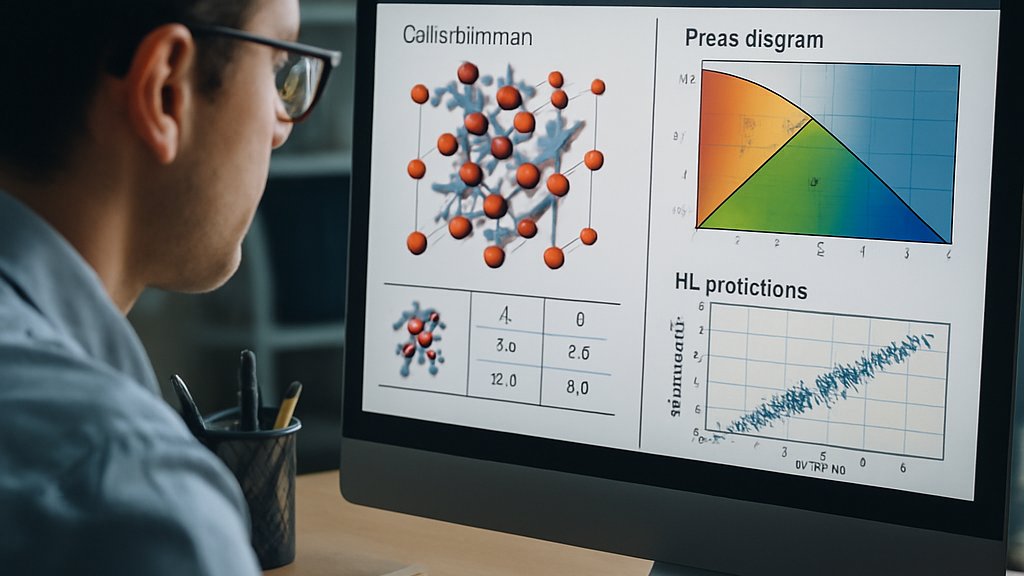
Moreover, new pipelines blend language models, physics simulation, and autonomous labs to propose not only structures but also recipes.
DeepMind’s GNoME, Microsoft’s MatterGen, and Toyota’s CAMD illustrate this tectonic shift.
Meanwhile, community benchmarks track accuracy and flag hidden pitfalls such as false positives near stability boundaries.
This article analyzes leading approaches, key metrics, and open challenges across the rapidly consolidating scientific AI field.
Industry strategists will learn where to invest, and scientists will see how the pieces connect.
Consequently, readers can position themselves for next-generation breakthroughs.
Scaling Crystal Screening Speed
DeepMind’s GNoME pipeline scanned 2.2 million hypothetical crystals using graph neural networks and ML potentials.
Consequently, about 380,000 candidates were flagged as thermodynamically stable.
Subsequently, 736 structures have been independently synthesized, validating the screening methodology.
Materials Discovery AI thus demonstrated orders-of-magnitude acceleration over brute-force DFT sweeps.
Furthermore, Toyota’s CAMD trimmed millions of options to mere thousands through agentic selection strategies.
- ML DFT emulators deliver up to 1,500× acceleration in Microsoft experiments.
- Self-optimizing ML workflows report 10⁴× speedups for complex relaxations.
- National supercomputers still spend tens of percent on DFT, revealing efficiency potential.
Meanwhile, automated retraining loops refine ML potentials as fresh DFT or experimental data arrive.
These statistics confirm dramatic computational gains for Materials Discovery AI workflows.
However, stability is only the first hurdle toward deployable materials.
Practical inorganic synthesis still demands experimental nuance beyond numerical stability flags.
Therefore, attention shifts toward planning practical synthesis routes.
Graph Networks Drive Breakthroughs
Graph neural networks capture local chemistry and long-range topology in a single differentiable representation.
Moreover, training on crystallographic databases teaches symmetry, valence, and bonding patterns.
The resulting models serve as fast surrogates for energy and force calculations within Materials Discovery AI pipelines.
In contrast, earlier handcrafted descriptors missed subtle geometric correlations.
Microsoft’s MatterGen further uses generative graph networks to propose stoichiometries lying outside historic datasets.
Nevertheless, researchers still post-process candidates with rigorous physics checks to ensure realism.
These hybrid evaluations balance speed and accuracy.
Graph networks supply expressive priors.
Consequently, downstream modules can focus compute on truly promising Materials Discovery AI leads for inorganic synthesis.
Next, we examine how planners convert structural ideas into feasible lab procedures.
Hybrid Planning Pipeline Rise
Johns Hopkins researchers coupled language models with thermodynamic solvers for stepwise inorganic synthesis planning.
Additionally, the system queried literature to retrieve temperature, pressure, and precursor heuristics.
Physics simulation then refined each proposed step, rejecting conditions that violate phase equilibria.
This closed-loop reasoning exemplifies Materials Discovery AI moving beyond prediction toward actionable guidance.
Furthermore, multi-fidelity optimization schedules expensive DFT calculations only when surrogate uncertainty peaks.
Researchers reported successful demonstrations in the Nb–O chemical space.
Such modular workflows are reproducible and auditable, satisfying industrial compliance requirements.
Coupled planners translate abstract designs into bench-ready instructions.
Consequently, experimental throughput rises without inflating resource budgets.
Yet, autonomous execution needs coordinated digital agents.
Agentic Discovery Systems Advance
Multi-agent frameworks like SparksMatter allocate specialized agents to retrieval, reasoning, and robotic execution tasks.
Moreover, each agent maintains a shared memory, enabling iterative improvement over televised episodes.
The orchestrator monitors metrics and assigns budgets, mirroring enterprise project management software.
Such architectures embed Materials Discovery AI principles within broader scientific AI ecosystems.
In contrast, monolithic scripts often collapse when facing unexpected phase behavior.
Subsequently, robotic platforms execute powder handling, sintering, and characterization without human intervention.
Nevertheless, governance models, data lineage, and security remain active research topics.
Agentic systems democratize discovery tasks.
Therefore, even small labs can harness cloud robotics and scale efforts.
Despite progress, rigorous benchmarking warns against premature optimism.
Benchmarking Reveals Current Gaps
Nature Machine Intelligence introduced Matbench Discovery to evaluate stability classifiers prospectively.
Consequently, studies found low mean absolute error yet high false positive rates near the convex hull.
Language models sometimes hallucinate feasible routes, reinforcing the necessity for physics simulation verification.
Materials Discovery AI practitioners therefore integrate uncertainty quantification and active learning to cut wasted experiments.
Additionally, crystallographers flagged duplicates within large predicted datasets, urging stricter canonicalization.
Prospective leaderboards will track time-to-validation and material cost, not solely numerical accuracy.
Benchmark authors recommend reporting retrieval precision, inorganic synthesis accessibility, and cost metrics side by side.
Proper evaluation reduces hype and focuses resources.
However, talent shortages still constrain adoption.
Upskilling initiatives aim to close that gap.
Upskilling For AI Innovators
Professionals can deepen skills through targeted certifications and cross-disciplinary workshops.
For example, candidates enhance credibility with the AI Researcher™ credential.
Hands-on labs teach dataset curation and uncertainty analysis using open-source toolkits.
The syllabus spans language models, physics simulation, and data governance for scientific AI projects.
Materials Discovery AI appears throughout the coursework, grounding theory in industrial case studies.
Moreover, graduates join a network that shares reproducible pipelines and benchmark datasets.
Structured learning accelerates workforce readiness.
Consequently, enterprises avoid reinventing methodology basics.
The final section distills overarching trends.
Conclusion And Future Outlook
Materials Discovery AI has shifted from promise to production, scanning millions of crystals at unprecedented speed.
However, synthesis planning, benchmarking, and talent remain decisive bottlenecks.
Hybrid pipelines blending language models, physics simulation, and agentic orchestration already mitigate several issues.
Moreover, open datasets such as GNoME empower communal validation and iterative refinement.
Consequently, stakeholders that invest in skills and governance will capture early mover advantages.
Nevertheless, ethical sourcing, sustainability, and lifecycle assessment should guide every new material launch.
Readers should explore advanced certifications, adopt multi-fidelity workflows, and contribute to transparent benchmarks.
Take the next step and turn accelerated discovery into market leadership today.
Disclaimer: Some content may be AI-generated or assisted and is provided ‘as is’ for informational purposes only, without warranties of accuracy or completeness, and does not imply endorsement or affiliation.


