

AI CERTS
3 hours ago
Robust Shielding Fuels Safe Reinforcement Learning
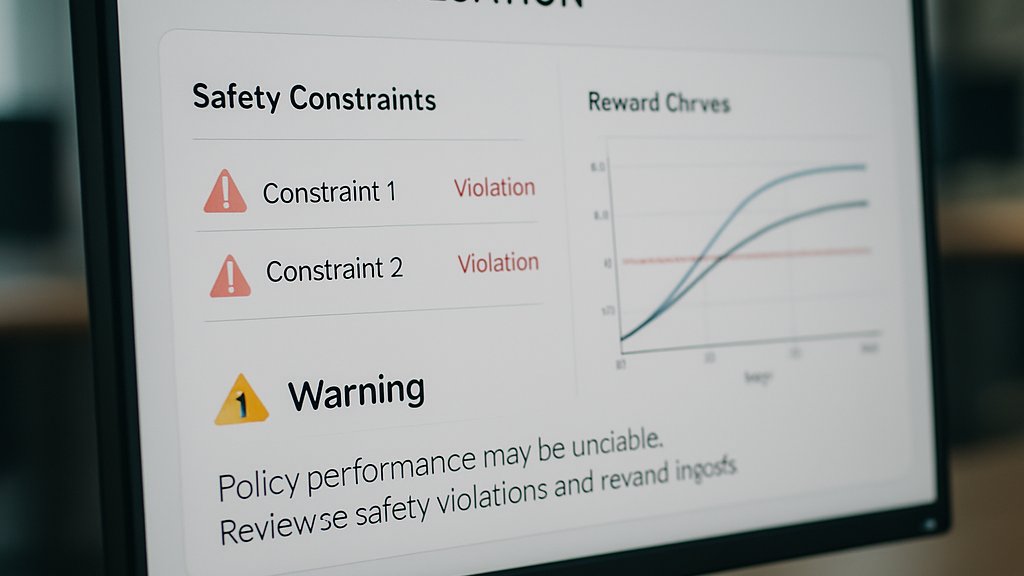
Moreover, new robust shielding frameworks promise worst-case protection even when environment models remain highly uncertain. This article dissects recent papers, emerging tools, and lingering obstacles, guiding industry leaders toward informed adoption.
Safe Reinforcement Learning Advances
The May 2026 paper by Hamel-De le Court and colleagues pushed shielding beyond deterministic assumptions. Meanwhile, their robust framework treats transition probabilities as intervals, a concept long studied in robust control. Consequently, the shield guarantees Linear Temporal Logic safety under every plausible model in the set.
Galesloot’s offline study complemented this idea with probabilistic methods. Furthermore, they showed that shielded policy improvement enhances average returns and tail risk when data is scarce. Nevertheless, practitioners still group these papers under the larger banner of Safe Reinforcement Learning progress. These empirical wins attracted attention across the AI safety community.
In summary, fresh advances prove that shielding can scale beyond idealized simulations. The story, however, extends deeper into core theory and engineering. Let us examine the fundamental concept next.
Shielding Concept Overview Explained
Shielding acts as a runtime guardian that intercepts unsafe actions before the agent executes them. In contrast to soft policy constraints, the shield rejects any action that violates the formal specification. Therefore, safety remains separate from the reward objective, simplifying audits. Moreover, it remains central to Safe Reinforcement Learning deployments in safety-critical sectors.
Classical designs rely on a precise Markov Decision Process model. However, model mismatch can erode guarantees, prompting interest in interval or robust variants. Consequently, engineers often pair shielding with robust control backups to handle surprises.
Overall, shielding provides a crisp, compositional layer for AI safety engineers. Yet, recent research strengthens its theoretical core. The next section reviews those formal guarantees.
Robust Frameworks And Guarantees
Robust frameworks expand shielding by optimizing over worst-case transitions within specified uncertainty sets. Subsequently, Hamel-De le Court proves two landmark properties. Soundness ensures every filtered policy satisfies the safety logic under all models.
Optimality guarantees that the shield never blocks any policy that is already safe. Additionally, sampled models can receive Probably Approximately Correct bounds that converge with data.
- Formal soundness across interval MDPs
- Optimality relative to safe policy space
- PAC sampling bounds for learned dynamics
Consequently, industry teams gain mathematical confidence before field deployment. These guarantees anchor the credibility of Safe Reinforcement Learning in regulated domains. Tooling, however, must translate math into practice, as the following section explains.
Tooling Lowers Adoption Barriers
TempestPy now synthesizes shields directly from Python specifications and integrates with Gymnasium. Moreover, the library bundles model checkers, interval solvers, and reinforcement learning interfaces within a single notebook workflow. Consequently, researchers can prototype a shielded agent in minutes. This ease accelerates Safe Reinforcement Learning pilots within startups and established labs.
Model-predictive shielding tools also grow mature, with adaptive variants updating models online. Meanwhile, chemical process engineers already test such systems on continuous reactors. These cases illustrate how robust control techniques support runtime certificates.
Tooling therefore narrows the gap between theory and operations. Adoption still depends on performance, especially when data remain limited. The next section explores empirical results under data scarcity.
Performance Under Data Scarcity
Offline experiments reveal how shields rescue agents trained on small datasets. Galesloot reports higher average returns and markedly better one-percent Conditional Value at Risk. Furthermore, shielded policy improvement yields smoother learning curves across random seeds.
AI safety analysts value such robustness because it aligns with regulatory expectations. Standard reinforcement learning baselines lacked comparable stability in identical tests. In contrast, unshielded agents chase noisy cues and violate policy constraints early. Consequently, business stakeholders see improved risk profiles without excessive additional data.
Empirical studies thus confirm the promise of Safe Reinforcement Learning when data are scarce. Yet, important challenges persist beyond sample size. We now examine those obstacles.
Challenges Limit Current Scalability
Despite progress, classical shields struggle in huge or continuous state spaces. Moreover, formal model checking can explode computationally as dimensions grow. Adaptive heuristics help, nevertheless they sometimes sacrifice strict guarantees.
Model dependence remains another pain point. Tight policy constraints can also depress peak rewards until models improve. If learned dynamics shift, robust control backups may soften, yet proofs can break. Therefore, research now blends Hamilton–Jacobi reachability with data-driven updates.
These limitations remind us that Safe Reinforcement Learning is no silver bullet. Still, actionable steps exist for practitioners. The final section outlines a pragmatic roadmap.
Roadmap For Keen Practitioners
Start by defining explicit Linear Temporal Logic specifications and measurable risk thresholds. Next, choose a shielding variant aligned with system dynamics and available data. Consequently, small pilots should validate safety metrics before optimizing performance.
Teams should integrate continuous testing, since policy constraints may evolve with retraining. Additionally, linking shield synthesis to CI pipelines preserves AI safety culture. Professionals can deepen expertise through the AI Ethics certification, which contextualizes governance for Safe Reinforcement Learning projects.
By following these steps, organisations bridge theory and deployment. Therefore, the journey becomes manageable even for resource-constrained teams.
Conclusion And Outlook
Shielding research progressed quickly, blending formal proofs with empirical validation. Robust frameworks now deliver soundness and optimality across uncertain models. Furthermore, TempestPy and adaptive MPC libraries lower the engineering bar. However, scalability and model accuracy still require focused investment and rigorous monitoring. By adopting interval models, maintaining clear policy constraints, and integrating robust control backups, teams can unlock reliable reinforcement learning applications. Consequently, early movers will gain competitive edges while upholding strong AI safety principles. Begin exploring shields today and share your field results to accelerate collective progress.
Disclaimer: Some content may be AI-generated or assisted and is provided ‘as is’ for informational purposes only, without warranties of accuracy or completeness, and does not imply endorsement or affiliation.


