

AI CERTS
3 hours ago
Citrini’s Edge AI Prediction Highlights Why AI Training Is Becoming Essential for Future-Ready Professionals
According to recent industry analysis, rising AI usage costs are forcing organizations to rethink how they deploy and scale artificial intelligence. As companies process increasing volumes of AI-generated content and automate more business functions, the economics of token consumption are becoming a critical consideration. Experts predict that this trend will accelerate the adoption of edge AI, where AI models run directly on devices such as smartphones, laptops, industrial equipment, and IoT systems rather than relying entirely on cloud infrastructure.
Understanding the Shift from Cloud-Centric AI to Edge AI
The AI revolution has largely been powered by centralized cloud computing. Businesses send data to remote data centers where large AI models perform calculations and return results. While this approach has enabled rapid innovation, it also creates growing costs as AI adoption expands.
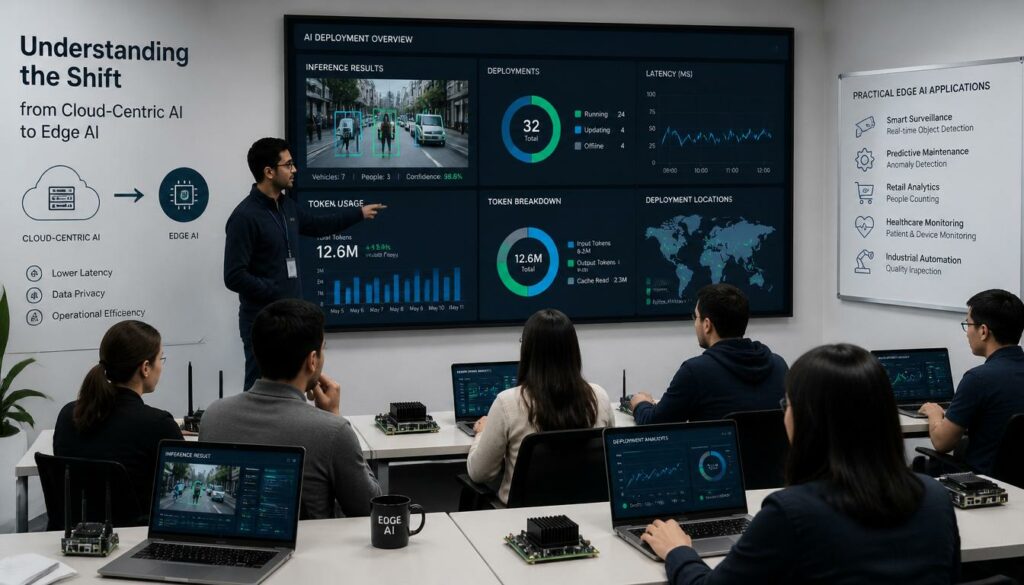
The concept of tokenomics is now gaining prominence because AI providers charge based on the number of tokens processed. Tokens represent the units of text, code, or data consumed and generated by AI systems. As organizations scale AI usage, token consumption becomes directly tied to operational expenses. This has led many technology leaders to focus on efficiency, optimization, and smarter AI architectures rather than simply increasing usage.
Edge AI addresses this challenge by moving certain AI workloads closer to users and devices. Instead of sending every request to a distant cloud server, AI models can perform inference locally. This reduces latency, lowers infrastructure costs, enhances privacy, and improves real-time decision-making capabilities. Industry analysts increasingly view edge AI as a complementary force that will work alongside cloud AI rather than replace it.
What This Means for Businesses
The transition toward edge AI signals a broader change in how organizations think about technology investments. Success will depend not only on having access to powerful AI models but also on understanding deployment strategies, infrastructure optimization, cybersecurity considerations, governance frameworks, and cost management.
Organizations that understand AI economics will be better positioned to achieve sustainable returns on investment. Businesses will need professionals who can evaluate when cloud-based AI is appropriate, when edge AI offers advantages, and how to build hybrid architectures that maximize performance while controlling costs.
This shift also highlights an important reality: AI adoption is moving beyond experimentation and into operational execution. Companies are looking for professionals who can connect technical knowledge with business outcomes and strategic decision-making.
The Growing Importance of AI Training
As edge AI becomes more prevalent, the demand for AI-skilled professionals will continue to rise. Traditional technology skills alone are no longer sufficient. Professionals must understand machine learning concepts, AI deployment models, data governance, prompt engineering, AI ethics, automation strategies, and emerging trends such as edge intelligence.
AI training helps bridge the gap between technological innovation and practical implementation. It enables professionals to understand not only how AI works but also how to apply it effectively within business environments. This knowledge becomes especially valuable as organizations seek to optimize costs, improve productivity, and build scalable AI ecosystems.
For business leaders, AI education provides the strategic perspective needed to make informed investment decisions. For technical professionals, it offers the expertise required to design, deploy, and manage next-generation AI solutions. For non-technical employees, AI literacy helps improve collaboration, productivity, and adaptability in increasingly AI-driven workplaces.
Key Lessons from the Edge AI Movement
The rise of edge AI offers several important lessons for organizations and professionals. First, technological advancement alone does not guarantee success; understanding the economics behind technology adoption is equally important. Second, efficiency and optimization are becoming competitive advantages in AI deployment. Third, the workforce must evolve alongside technology, making continuous learning a business necessity rather than an optional investment.
Most importantly, the shift toward edge AI demonstrates that the future of artificial intelligence will be defined by intelligent implementation rather than simply greater computational power. Organizations that invest in AI education today will be better prepared to navigate tomorrow's technological changes.
Conclusion
As tokenomics reshapes AI economics and edge AI gains momentum, the need for AI-skilled professionals will only continue to grow. Businesses require talent that can understand both the technical and strategic dimensions of artificial intelligence. Through the Authorized Training Partner (ATP) network from AI CERTs™, professionals and organizations can access industry-relevant AI training programs designed to build practical skills, strengthen AI readiness, and prepare teams for the next phase of AI-driven transformation.
Learn more at https://www.aicerts.ai/authorized-training-partner/.
Frequently Asked Questions
What is edge AI?
Edge AI refers to running artificial intelligence models directly on devices such as smartphones, laptops, sensors, and industrial equipment instead of relying solely on cloud-based processing.
Why is tokenomics important in AI?
Tokenomics focuses on the cost and consumption of AI tokens, which are the units of data processed by AI models. Understanding token usage helps organizations manage AI expenses and improve efficiency.
How does edge AI benefit businesses?
Edge AI can reduce latency, improve privacy, lower operational costs, and enable real-time decision-making by processing data closer to where it is generated.
Why is AI training important for professionals today?
AI training helps professionals understand emerging technologies, improve productivity, support business innovation, and remain competitive in an increasingly AI-driven job market.
How can organizations prepare for the rise of edge AI?
Organizations can prepare by investing in AI education, developing AI governance frameworks, building internal AI expertise, and training teams to manage both cloud and edge AI environments.
Disclaimer: Some content may be AI-generated or assisted and is provided ‘as is’ for informational purposes only, without warranties of accuracy or completeness, and does not imply endorsement or affiliation.


