

AI CERTS
2 days ago
CMU World2Rules Boosts Aviation Safety AI
However, questions persist about performance, deployment, and transparency. This article dissects the research, metrics, benefits, and challenges for airport stakeholders. Additionally, it charts next steps for turning lab code into operational confidence. Readers will also discover certifications that strengthen professional skills for this evolving space.
Runway Risk Context Today
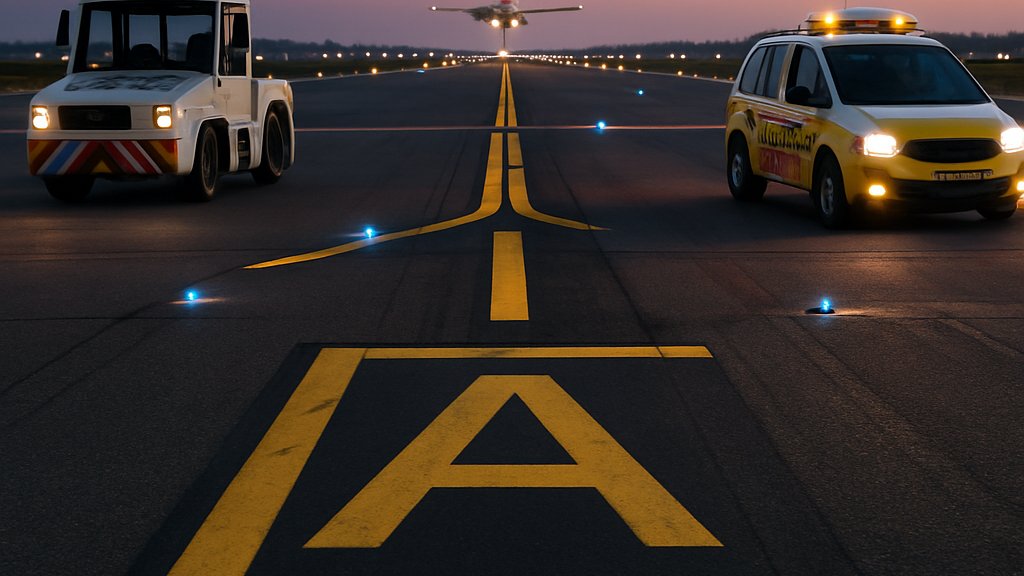
Runway incursions have trended upward since 2020, according to FAA statistics. Meanwhile, each Airport Collision scenario can trigger cascading delays and huge insurance exposure. In contrast, conventional alerting systems rely on hand-crafted Safety Rules with limited adaptability. Controllers face information overload, making subtle trajectory conflicts hard to spot early. Therefore, researchers argue that machine learning must complement procedural defenses. CMU teams began mining surface-movement logs to tackle this gap. Subsequently, they created an enormous Amelia-42 dataset covering 42 major airports. The corpus totals roughly nine terabytes, dwarfing earlier academic resources. These factors justify exploring more adaptive Aviation Safety AI capable of scaling with traffic.
Runway data volume and risk intensity demand fresh analytic tactics. Consequently, the next section unpacks how World2Rules addresses that demand.
Inside World2Rules Core Framework
World2Rules follows a neuro-symbolic pipeline with three layers. First, neural extractors transform raw radar traces into candidate relational facts. Next, inductive logic programming synthesizes compact Safety Rules explaining normal and unsafe behaviors. Finally, reflective reasoning validates rules against temporal consistency constraints. Moreover, the design produces human-readable clauses like "Taxiing aircraft must yield to departures".
Transparency separates this framework from opaque deep models. Controllers can inspect which precise rule triggers an alert. Therefore, trust improves because explanations align with familiar operational language. CMU researchers stress that clarity speeds regulatory auditing and certification. Such qualities position the tool as transformational Aviation Safety AI for controllers and pilots.
World2Rules fuses pattern recognition with logic to produce inspectable policies. Next, the numbers reveal whether that fusion actually works.
Performance Metrics Explained Clearly
The team benchmarked results on historical incident data within Amelia-42. World2Rules achieved a 23.6 percent F1 gain over a purely neural baseline. Furthermore, the system improved 43.2 percent against a single-pass neuro-symbolic comparator. Precision and recall both rose, indicating fewer missed Airport Collision threats and reduced false alarms.
- Dataset scale: 9.19 TB across 42 airports
- Compute: Bridges-2 supercomputer allocation
- F1 uplift: +23.6% versus neural baseline
- Rule readability: first-order logic clauses
- Presentation: NASA Formal Methods Symposium 2026
- Use case: transparent Aviation Safety AI alerts
Therefore, the evaluation provides rare quantitative proof for Aviation Safety AI effectiveness. Moreover, experiments confirmed robustness even when failure examples were extremely sparse. CMU authors credit consistency filters for that resilience. Consequently, they describe the work as a decisive step for Aviation Safety AI validation.
Empirical gains suggest meaningful operational promise. However, benefits only matter if stakeholders can convert them into day-to-day value.
Benefits For ATC Controllers
Interpretable warnings help controllers prioritize urgent conflicts. Additionally, explicit Safety Rules simplify training for new tower staff. Pilots could receive cockpit advisories that cite the violated rule, reducing confusion. Therefore, communication loops tighten, and reaction time shrinks.
Beyond airports, the same architecture might govern autonomous ports or rail yards. Sebastian Scherer notes that any structured traffic domain can benefit. Professionals can boost expertise through the AI Engineer certification. Such credentials complement Aviation Safety AI literacy and regulatory knowledge.
Explainable alerts and certified staff together raise safety margins. Nevertheless, serious hurdles still block runway deployment.
Deployment Hurdles Ahead Now
Integrating research code into live ATC stacks requires stringent latency guarantees. Moreover, national regulators must approve algorithmic decision aids before operational use. Trust issues may flare if false positives create alert fatigue during peak traffic. In contrast, under-sensitivity would let Airport Collision risks slip through.
Data scarcity also limits learning because severe incidents are inherently rare. Therefore, teams explore simulation and domain adaptation to enrich dangerous scenarios. CMU engineers plan larger studies with real-time tower feedback. Subsequently, they expect refined Safety Rules and better calibration. Successful integration would mark a watershed for global Aviation Safety AI adoption.
Operational approval depends on latency, trust, and richer validation. The broader potential nonetheless keeps investors attentive.
Broader Safety Horizons Emerging
World2Rules may extend to maritime navigation, warehouse robotics, and autonomous trucking. The underlying logic extraction scales across sensor domains with minimal re-engineering. Consequently, Aviation Safety AI becomes a template for other critical industries.
Industries adopting the framework will still need domain tailored rule sets. However, inductive pipelines shorten that design cycle. World2Rules already demonstrates cross-domain feasibility during initial lab trials.
Consequently, training programs and certifications will rise in importance. Stakeholders eager to lead should monitor CMU spin-offs and FAA pilot programs.
Cross-industry adoption could compound safety gains worldwide. The conclusion distills actionable insights and next moves.
World2Rules showcases how neuro-symbolic design advances operational transparency. Its measurable gains over baselines underline technical traction. However, certification, latency, and human factors still loom large. Nevertheless, momentum is building, aided by growing datasets and compute grants. Consequently, professionals should track coming field trials and refine their skills proactively. Investing in targeted learning, such as the linked AI Engineer certification, strengthens competitive positioning. Explore the emerging ecosystem, contribute feedback, and help shape next-generation Aviation Safety AI standards.
Disclaimer: Some content may be AI-generated or assisted and is provided ‘as is’ for informational purposes only, without warranties of accuracy or completeness, and does not imply endorsement or affiliation.


