

AI CERTS
5 days ago
Midjourney’s AI Prompt Ban Alters Political Image Generation
Bloomberg first signaled the plan in February 2024; Associated Press later confirmed active blocking. Consequently, watchdog researchers rushed to test the guardrails. Their findings showed filters missed the mark almost half the time, allowing misleading renders to circulate before moderators reacted. Meanwhile, rival platforms signed a voluntary industry accord, yet the platform stayed independent. Therefore, questions about consistency, transparency, and free expression intensified. This article unpacks the timeline, technology, and metrics behind the decision. It also offers actionable insights for product, legal, and policy leaders.
AI Prompt Ban Context
Bloomberg revealed the platform's executives were debating an AI Prompt Ban early in February 2024. Subsequently, mounting concern about campaign deepfakes pushed the discussion forward. Associated Press verified active blocking on March 13 2024, displaying "Banned Prompt Detected" warnings in Discord. Meanwhile, CEO David Holz told users he preferred to "put some foots down" rather than police endless political prompts.
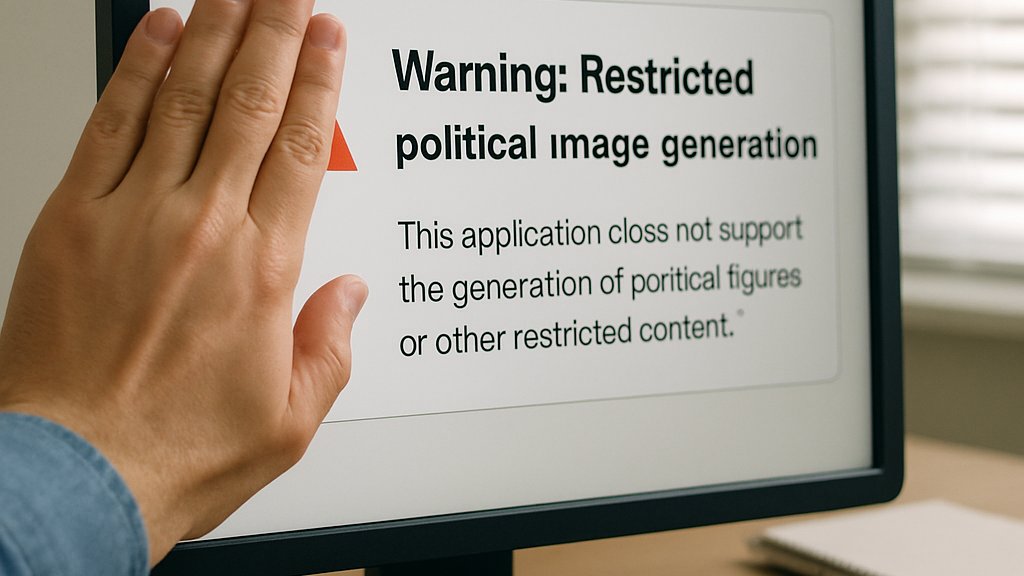
The ban covers any direct mention of Biden or Trump. However, the platform's broader Community Guidelines already discourage content that could sway Election outcomes. In contrast, larger rivals opted for watermarking or disclosure labels instead of outright blocking. Consequently, observers wondered whether the focused restriction marked a new industry precedent or an isolated experiment.
These developments set the stage for rapid policy analysis. Nevertheless, understanding technical enforcement is essential before judging effectiveness.
The policy emerged from campaign-year pressure and resource limits. However, its real strength depends on filter mechanics, explored next.
Blocking Mechanics And Loopholes
The platform relies on string matching and classifier checks to enforce the AI Prompt Ban. Consequently, users who type "Donald Trump rally" see an abuse alert instead of artwork. However, watchdogs from the Center for Countering Digital Hate discovered simple jailbreak methods. For example, inserting a backslash or describing "the current U.S. president" often bypassed filters.
The June 2024 CCDH report stated that despite the AI Prompt Ban, the block failed in half the tests. Moreover, the tool produced convincing Election deepfakes in 40% of scenarios. In contrast, some competing Image Generation platforms displayed lower failure rates than Midjourney, partly due to heavier watermarking.
Therefore, the company faces a cat-and-mouse cycle. Every patch appears days before inventive prompt engineers sidestep it again.
Technical safeguards remain fragile and reactive. Subsequently, industry comparisons reveal why coordination matters.
Industry Context And Comparisons
February 2024 saw Microsoft, Google, Meta, and others sign a voluntary Tech Accord aimed at curbing Election misinformation. Nevertheless, Midjourney declined to join the pledge. Consequently, analysts compared formal commitments with ad-hoc platform rules.
Other Image Generation apps like DALL·E and Adobe Firefly served political prompts but layered disclosure badges across global Politics. Moreover, OpenAI’s systems record metadata to aid provenance checks. Therefore, leaders debated whether a targeted AI Prompt Ban or transparent labeling better preserves public trust.
These contrasting tactics illustrate a fragmented regulatory landscape. However, the data behind risk exposure offers clearer guidance, discussed next.
Stakeholder Reactions And Concerns
Campaign lawyers voiced alarm that a private company can mute candidate imagery while trolls still exploit loopholes. Furthermore, free-speech advocates fear slippery precedent for broader Politics censorship. Meanwhile, journalists welcomed any tool that reduces polling-day misinformation floods.
CEO Holz framed the AI Prompt Ban as temporary pragmatism, noting his eleven-person staff cannot monitor global campaigns. In contrast, Callum Hood at CCDH called the ban "ineffective theater" because skilled users still generate persuasive fakes. Moreover, some academics argue blanket bans drive bad actors to smaller, unregulated tools.
These viewpoints illustrate competing values: expression, safety, and resource realism. Nevertheless, quantitative evidence sharpens the debate, as the next section shows.
Risk Metrics And Data
Numbers clarify risk beyond rhetoric. CCDH testing across platforms produced alarming figures:
- Election deepfake prompts saw a 41% success rate across major Image Generation systems.
- Midjourney filters failed in 65% of March 2024 trials, worst among peers.
- Despite the AI Prompt Ban, June retesting still showed 50% bypass success.
- The Discord community now exceeds 19 million users, amplifying potential reach.
Additionally, Associated Press documented that the company employs only eleven employees, highlighting moderation scale limits. Consequently, risk per staff member dwarfs that of big tech rivals.
These statistics expose sizable governance gaps. However, ethical frameworks and certifications can guide improvements, addressed in the final section.
Ethical Paths Moving Forward
Regulators, vendors, and users now weigh several responses. Moreover, some propose a standardized provenance watermark across every Image Generation model. Others advocate extending the AI Prompt Ban to additional high-risk public figures during Election cycles. Nevertheless, critics warn such expansions could stifle legitimate satire and art.
Therefore, governance must blend technical, legal, and educational tools. Professionals can enhance their expertise with the AI Ethics for Business™ certification. Furthermore, product teams should publish clear transparency reports, while civil society audits real-world prompt abuse.
This multi-layered strategy encourages trust without suppressing free Politics discourse. Consequently, leadership focus should shift from reactive bans toward holistic risk management.
Balanced frameworks promise resilience and innovation. However, decision makers still need concise guidance, summarized below.
Key Takeaways For Leaders
The case shows one fact: technical blocks alone rarely defeat determined actors. Moreover, volunteers and watchdogs repeatedly bypass the AI Prompt Ban. Consequently, data transparency, cross-platform standards, and continuous audits emerge as indispensable pillars against misinformation. Additionally, leadership should prioritize watermark adoption, public disclosure, and staff training before peak campaign periods.
These measures tighten guardrails without silencing creativity. Therefore, proactive strategy beats reactive crisis control.
The bold blocking experiment underscores the complexity of safeguarding digital campaigns. Furthermore, empirical results reveal that filter accuracy lags behind creative adversaries. Nevertheless, coordinated standards, robust watermarking, and ethical training can mitigate looming campaign misinformation storms. Leaders should benchmark their Image Generation pipelines, publish impact reports, and engage independent auditors before November.
Additionally, professionals can deepen governance skills through the AI Ethics for Business™ course. Acting now positions organizations to support democratic integrity while protecting brand trust. Consequently, the window for proactive risk reduction is closing fast. Seize the moment and build resilient, transparent AI practices today.
Disclaimer: Some content may be AI-generated or assisted and is provided ‘as is’ for informational purposes only, without warranties of accuracy or completeness, and does not imply endorsement or affiliation.


