

AI CERTS
6 days ago
AI Power Demand to Quadruple: Grid Risks and Emerging Solutions
Renewable energy procurement, grid reforms, and next-generation chips all compete to shape outcomes. Meanwhile, utilities scramble to model gigawatt-scale requests from hyperscale data centers. Nevertheless, efficiency gains offer hope, yet uncertainty remains wide. This article distils authoritative forecasts, explores grid challenges, and highlights emerging solutions. Ultimately, readers will gain a clear, data-driven view of the coming electricity surge.
Why AI Demand Surges
Training frontier models grabs headlines, yet inference workloads create the enduring load. Additionally, accelerated GPUs push rack densities toward 100 kilowatts or more. Consequently, facility electricity rises faster than historical efficiency gains.
IEA data show global data centers used roughly 460 TWh in 2022. Therefore, total AI Power Demand could match Japan’s present consumption within five years. These fundamentals illustrate why planners must anticipate exponential growth. However, understanding regional variations requires drilling into the numbers.
Rising compute intensity and scale drive the surge. However, local impacts depend on regional deployment patterns. The next section examines those pressure points on the grid.
Key Global Forecast Numbers
- IEA, April 2025: AI Power Demand could quadruple to 945 TWh by 2030.
- That figure equals today’s entire Japanese electricity consumption, according to the IEA.
- BloombergNEF high scenario pushes global demand above 1,200 TWh by 2030 if efficiency stalls.
- EPRI notes data centers already represent 4% of U.S. load as of 2023.
Collectively, these numbers confirm explosive trajectories. Consequently, utilities must prepare their networks for unprecedented stress. Grid risks appear first where clusters dominate local demand, as the following analysis shows.
Grid Risks And Strain
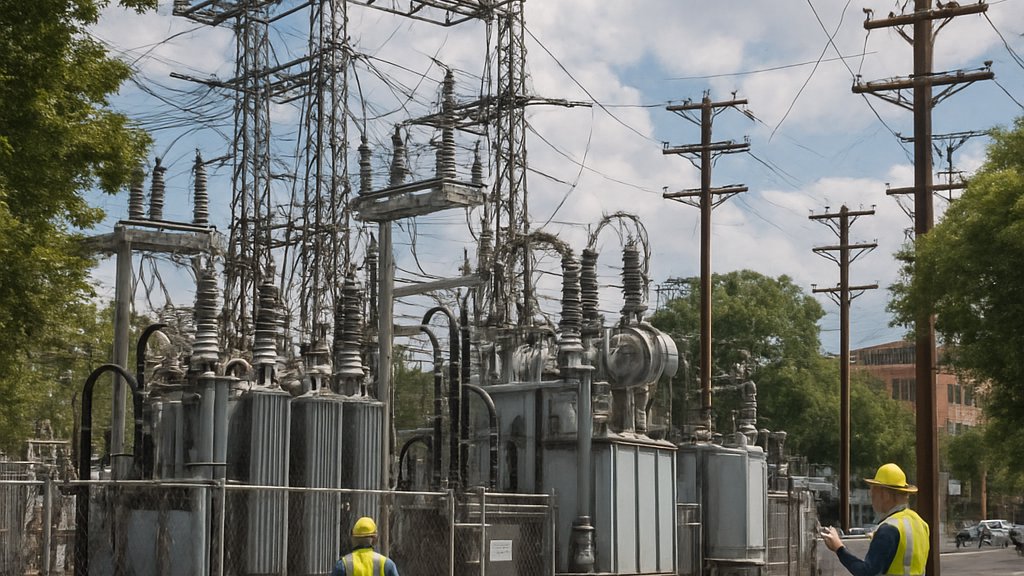
Virginia’s “data center alley” already draws more than 2.5 GW continuously. Furthermore, DOE studies warn about substation backlogs delaying new capacity. Large point loads compress transmission planning cycles from decades to months.
In contrast, western states confront water limits for evaporative cooling. Berkeley Lab projects U.S. demand could reach 580 TWh by 2028 under aggressive AI adoption. Such growth would place AI Power Demand above 10% of national load.
These figures raise reliability, affordability, and emissions questions. Therefore, stakeholders push for faster permitting and novel financing structures. Efficiency improvements may ease some pressure, as the next section details.
United States Scenario Ranges
EPRI presents three scenarios for 2030. Low adoption keeps data centers at 4.6% of U.S. electricity. High adoption elevates the share to 9.1%. Moreover, the gap equates to roughly 150 TWh, equal to Nevada’s annual consumption. Consequently, state regulators seek granular forecasts rather than national averages.
Scenario spreads underscore uncertainty. Subsequently, companies invest heavily in efficiency research to narrow that spread. Those efficiency levers span hardware, software, and facility design, considered next.
Efficiency Trends And Uncertainty
Google claims it cut inference energy per query thirty-three fold within one year. Meanwhile, Microsoft touts liquid immersion cooling that lowers facility PUE below 1.05.
However, absolute electricity can still rise if usage accelerates faster than efficiency improves. Analysts therefore treat efficiency as a moderation factor, not a fix. AI Power Demand remains sensitive to GPU roadmaps and model sizes.
Efficiency advances introduce optimism. Nevertheless, planners cannot bank on best-case numbers alone. Clean power procurement strategies now move to center stage.
Clean Power Solutions Emerging
Hyperscalers contract gigawatts of solar, wind, and small modular nuclear to cover rising loads. Renewable energy purchase agreements increasingly bundle storage to match 24×7 demand. Consequently, corporate buyers influence regional generation mixes.
Utilities explore new tariff structures that reward flexible dispatchable capacity supporting AI clusters. Moreover, regulators test performance-based ratemaking to speed grid investments.
DOE’s Speed-to-Power initiative co-funds transmission expansions serving large data centers near rural renewables. In contrast, some communities oppose new lines, citing land use concerns.
Clean sourcing remains vital for climate goals. Therefore, strategic workforce skills become essential, as the next section explains.
Policy And Industry Responses
Federal agencies coordinate permitting reforms, tax credits, and research grants targeting AI Power Demand challenges.
Meanwhile, utilities publish integrated resource plans that incorporate AI scenarios for the first time. Berkeley Lab guidance encourages transparent modeling assumptions.
Moreover, states such as Georgia and Ohio offer economic incentives for data center campuses tied to Renewable energy milestones.
Professionals can enhance expertise through the AI Supply-Chain Strategist™ certification.
Coordinated action will shape investment pace and location. Subsequently, the industry must monitor metrics carefully.
Certification Upskilling Opportunity Ahead
Energy managers now require combined knowledge of AI workloads, power markets, and asset finance. Additionally, certified professionals command premium salaries amid talent shortages.
Upskilling feeds better planning. Consequently, grids can integrate new capacity with fewer delays.
Many utilities model AI Power Demand using five-year rolling forecasts rather than decade horizons.
Conclusion And Outlook
AI Power Demand stands poised to redefine global electricity growth trajectories. Moreover, authoritative forecasts show potential quadrupling within this decade. Grid planners face concentrated strain, while efficiency gains provide only partial relief. Renewable energy commitments and innovative tariffs demonstrate promising mitigation paths. Nevertheless, wide scenario ranges demand adaptable strategies.
Consequently, executives, regulators, and engineers must collaborate, invest, and upskill. Explore the referenced certification to deepen expertise and lead the transition toward reliable, low-carbon digital infrastructure.
Disclaimer: Some content may be AI-generated or assisted and is provided ‘as is’ for informational purposes only, without warranties of accuracy or completeness, and does not imply endorsement or affiliation.


