

AI CERTS
2 months ago
Unikie AI Navigates Physical AI Investment Surge
Consequently, market participants must grasp capital flows, technology enablers, and strategic risks shaping the next decade. This article distills the latest data, expert quotes, and practitioner guidance into an actionable investment briefing. Additionally, it highlights certifications that help professionals validate skills for emerging robotics deployments. Read on to understand where capital is heading, why technology barriers are falling, and how incumbents will respond. The following sections maintain strict focus on measurable facts while meeting the demands of seasoned technical readers.
Market Momentum Builds Up
Funding announcements illustrate the pace. Eclipse Ventures locked $1.3 billion across two funds dedicated to physical AI in April 2026. Microsoft, NVIDIA, and several hyperscalers meanwhile opened multimodal model libraries to spur developer adoption. Deloitte records show robotics startups collected $10.3 billion during the first eleven months of 2025, a 61% jump. Moreover, Bank of America frames the addressable market as potentially multi-trillion across sectors. These macro numbers confirm rising confidence.
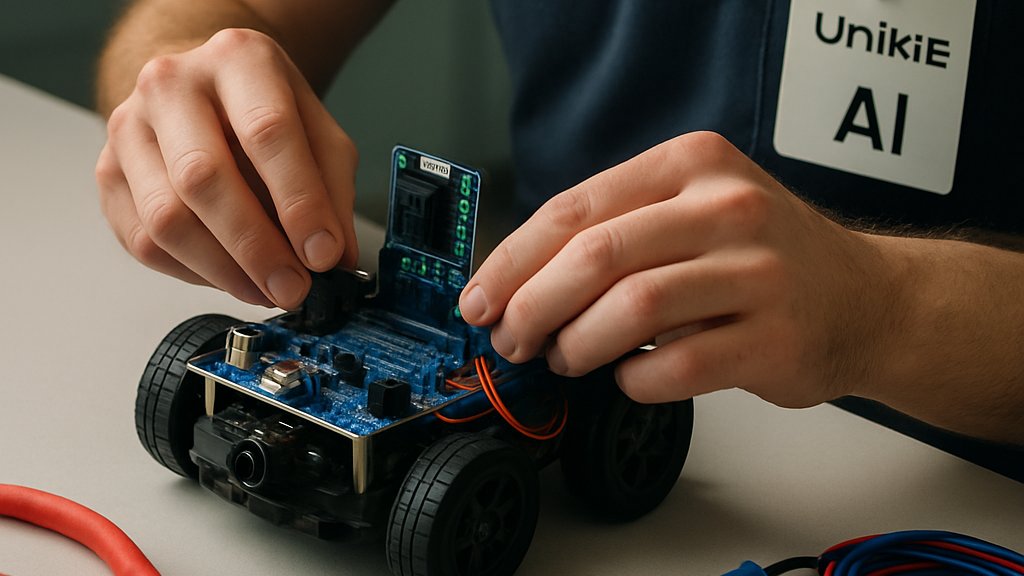
Unikie AI positions itself to capture contracts from logistics, construction, and energy clients seeking operational resilience. Consequently, analysts expect growing demand for nimble suppliers that integrate software with rugged hardware. Embedded intelligence lowers latency and reduces cloud dependence, widening deployment scenarios. However, capital efficiency remains paramount as projects involve sensors, actuators, and supply-chain complexity. Investors therefore monitor unit economics closely before scaling pilots into thousands of field Machines. This momentum sets the baseline for deeper analysis ahead.
Capital is accelerating into embodied systems with record fund raises and market forecasts. Early movers like Unikie AI benefit from this confidence. Next, examine how technology advances reinforce that investment logic.
Technology Stack Evolves Rapidly
Hardware, software, and data pipelines are converging faster than many boardrooms anticipated. NVIDIA’s Jetson AGX Thor, priced from $3,499, offers tenfold performance gains over prior edge modules. Moreover, Microsoft’s Rho-alpha model pairs vision, language, and tactile data for adaptable manipulation. Simulation with photorealistic Physics shortens hazardous training cycles and de-risks deployment.
- On-robot compute slashes latency for safety-critical Machines.
- Synthetic data multiplies scenario coverage without physical collisions.
- Vision-Language-Action models accept plain-speech directives, easing operator workload.
- Standardized APIs enable rapid integration across Vehicles and industrial arms.
Consequently, builders integrate Embedded firmware, reinforcement learning, and cloud orchestration into cohesive stacks. Deepu Talla notes that synthetic environments generate the billions of frames required for generalizable control. Nevertheless, sim-to-real transfer still challenges mobile Robots in cluttered warehouses. Engineers therefore add domain randomization and calibrated sensors to bridge reality gaps.
Technological progress reduces friction across perception, reasoning, and actuation layers. Edge hardware and world models finally align on power and capability. Investment strategies consequently adapt, as explored in the next section.
Capital Flows Intensify
Large rounds increasingly separate platform leaders from speculative hopefuls. Skild AI secured a valuation near $14 billion after its January Series C, emphasizing software-first scale. Physical Intelligence is reportedly seeking another $1 billion, pushing its worth past $11 billion. Meanwhile, Eclipse’s operator model incubates startups that merge tooling, supply-chain access, and go-to-market muscle. BCG analysts therefore advise matching funding size to hardware maturity and regulatory runway. Accurate Physics models unlock credible projections for cycle times and maintenance costs.
Unikie AI often partners with regional industrial groups, using revenue-backed financing to avoid excessive dilution. In contrast, some autonomy startups burn heavy upfront capital on custom Vehicles before proving demand. Investor memos consequently scrutinize bill-of-materials cost curves and service margins. Moreover, exits may arrive through strategic acquisitions rather than IPOs, given integrated supply chains. Capital discipline therefore remains a competitive differentiator.
Funding scale is rising, yet capital efficiency still dictates survival odds. Players like Unikie AI signal viable alternative structures. We now turn to strategic frameworks guiding investor decisions.
Strategic Investor Playbooks Shift
Generalist funds historically avoided hardware risk. However, Physical AI requires blended expertise in silicon sourcing, firmware, and mechanical design. Consequently, operator-led firms like Eclipse create shared supply teams to assist portfolio founders. Corporate VCs simultaneously chase strategic synergies, betting robots will accelerate core revenue lines.
Analysts outline two dominant theses. First, software-centric layers license Embedded brain models to many form factors. Second, vertically integrated builders sell complete Machines with service contracts for decades. Both paths depend on clear go-to-market plans and regulatory navigation. Therefore, investors deploy scenario planning models that weight currency swings, tariff risk, and component shortages.
Playbooks increasingly combine operational support with staged capital injections. Unikie AI leverages such structures to accelerate regional rollouts. The next section examines prevailing risks.
Risks Temper Investor Optimism
No technology wave escapes friction. Safety validation ranks highest because failures involve kinetic energy, not crashed browsers. Therefore, governments draft standards aligned with the EU AI Act and ISO robotics protocols. Simulation with high-fidelity Physics still fails to capture every corner case, producing lingering liability exposure.
Capital intensity introduces inventory risk during downturns. Machines and Vehicles depreciate quickly when projects stall, straining balance sheets. Moreover, data scarcity hampers reinforcement training for dexterous manipulation in unstructured terrain. BCG consequently urges executives to rank capabilities over dramatic humanoid silhouettes.
Risk management demands rigorous testing, staged rollouts, and diversified supply. Unikie AI embeds these principles into its engineering sprints. Actionable guidance for corporate entrants follows.
Roadmap For Corporate Entry
Enterprises evaluating physical AI should begin with narrow, high-value use cases. Pilot programs in warehouse sorting or infrastructure inspection deliver measurable key performance indicators within months. Additionally, multidisciplinary teams must align software, safety, and procurement processes from day one. Embedded compute modules like Jetson Thor simplify integration while preserving data sovereignty.
Professionals can enhance credibility through the AI Robotics™ certification. The program covers real-time control, safety frameworks, and sensor fusion across Vehicles and stationary platforms. Moreover, Unikie AI encourages staff to pursue structured upskilling paths, reducing onboarding delays. Consequently, teams iterate faster and deliver Machines capable of 24/7 operation.
Early wins, skilled talent, and modular hardware form a repeatable entry template. Unikie AI applies this template across Nordic industrial hubs. We close with final insights and next steps.
Conclusions And Next Steps
Physical AI is exiting the lab and entering revenue sheets worldwide. Moreover, investors embrace blended hardware and software plays despite longer payback periods. Edge compute, simulation, and world models now converge to meet production reliability thresholds. Unikie AI stands ready to convert these technical gains into scalable deployments across Machines and Vehicles. Nevertheless, disciplined capital allocation and rigorous safety validation remain non-negotiable. Professionals should therefore upskill through recognized programs and experiment with contained pilots. Begin by securing the AI Robotics™ credential and join the next wave of physical AI leadership today.
Disclaimer: Some content may be AI-generated or assisted and is provided ‘as is’ for informational purposes only, without warranties of accuracy or completeness, and does not imply endorsement or affiliation.


