

AI CERTS
21 minutes ago
MIT Fair AI: SEED-SET Ethical Testing Breakthrough
This article unpacks the science, business impact, and practical adoption steps. Moreover, we place SEED-SET within the wider governance landscape and highlight next moves for practitioners. Read on to understand how this breakthrough doubles optimal discoveries and improves scenario coverage by 25 percent. Therefore, your organization can detect hidden fairness violations before reputational or legal crises emerge.
Finally, the piece links to certification resources that deepen professional mastery of AI ethics. In contrast, traditional brute-force test suites waste simulation budgets and miss nuanced stakeholder concerns. Subsequently, executives struggle to justify launch decisions to boards and regulators.
SEED-SET Framework Key Overview
SEED-SET stands for Scalable Evolving Experimental Design for System-level Ethical Testing. The researchers split evaluation into objective metrics and subjective stakeholder preferences. Hierarchical Gaussian processes learn both surfaces in tandem. Consequently, the system proposes simulations that maximize expected information gain.
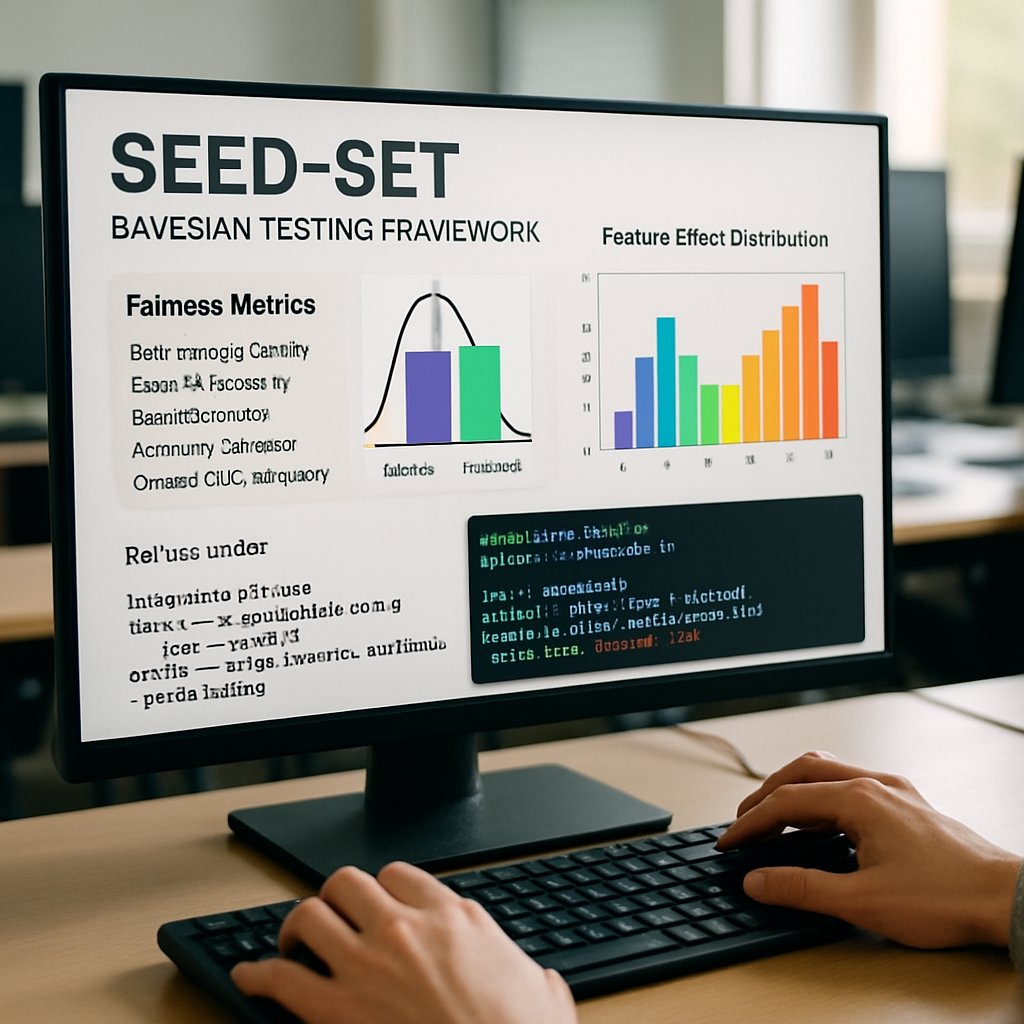
A joint acquisition function balances exploration against exploitation during scenario search. Therefore, test engineers can uncover hidden edge cases with half the usual budget. Experiments on power grids, urban routing, and aerial rescue validate the claims.
- Up to 2× more optimal test candidates than baselines
- Approximately 1.25× broader scenario coverage
- Reduced human labels through LLM proxy evaluations
Researchers used open-source simulators and released code, enabling peer validation. Moreover, early adopters can reproduce findings and extend tests to novel domains. Notably, MIT Fair AI guidelines informed several design choices during development.
These performance gains illustrate sample efficiency and domain generality. However, understanding the underlying math clarifies why the framework scales. The next section explores that engine.
Why SEED-SET Framework Matters
Business stakes for autonomous decisions keep rising across energy, mobility, and defense. Meanwhile, public trust hinges on demonstrable fairness and safety. MIT Fair AI initiatives consistently stress transparency alongside performance. Regulators reference the NIST AI Risk Management Framework when auditing complex models. Consequently, organizations require concrete metrics that map ethical principles into measurable evidence.
SEED-SET addresses that gap by integrating stakeholder utility into every scenario proposal. Therefore, internal reviewers can quantify alignment trade-offs before deployment. Moreover, DARPA’s support signals strategic importance for national security systems.
In short, the framework converts abstract ethics into actionable dashboards. Consequently, teams gain defensible evidence for boardrooms and regulators. To appreciate this benefit, we now inspect the Bayesian core.
Inside The Bayesian Engine
SEED-SET models objective metrics with one Gaussian process and subjective utilities with another. Additionally, a hierarchical prior links both processes, promoting knowledge transfer. The acquisition function selects candidate scenarios maximizing expected moral regret reduction.
Meanwhile, Bayesian updating refines beliefs after each simulation or proxy evaluation. Consequently, search converges toward ethically sensitive regions without exhaustive sweeps. Researchers report that the method produced double the optimal cases on benchmark domains. An explicit noise model isolates labeling uncertainty from true utility variance. Consequently, confidence intervals on fairness scores remain reliable even with sparse data. The MIT Fair AI community views this statistical rigor as essential.
These mechanics explain the efficiency boost. However, automation introduces fresh proxy risks. The following section dissects those trade-offs.
LLM Proxy Key Trade-Offs
Labeling subjective judgments is time consuming and expensive. Therefore, SEED-SET prompts a large language model to compare scenario pairs. In contrast, baseline methods rely on continuous human panels.
The proxy reduces cost but may drift from real stakeholder fairness perceptions. Researchers urge complementary user studies before high-stakes adoption. Nevertheless, early pilots suggest proxies match human rankings in simple domains. Critics ask whether MIT Fair AI should rely on LLMs still under scrutiny.
Balanced governance can harness savings while controlling bias. Subsequently, we examine that governance context.
Positioning Within Governance Landscape
NIST’s AI RMF stresses continuous monitoring, measurement, and documentation. SEED-SET supplies a scalable testing apparatus that complements those high-level controls. Moreover, linking objective metrics with stakeholder alignment scores maps directly to RMF 'Measure' actions. Consequently, MIT Fair AI research aligns closely with policymakers' vocabulary.
Corporate compliance teams can embed SEED-SET dashboards into existing audit pipelines. Consequently, evidence flows seamlessly from engineering sandboxes into governance reports. Furthermore, DARPA sponsorship indicates future defense procurement may expect similar system-level ethics tests. Industry consortia are considering shared scenario repositories to standardize reporting. Moreover, such repositories could accelerate cross-sector learning on ethics failures. Adopters can cite MIT Fair AI evidence when negotiating liability clauses.
These links turn research into policy leverage. Therefore, engineering managers need actionable steps next. The following playbook outlines those steps.
Practical Steps For Teams
First, inventory critical decision pipelines that influence customers or citizens. Then, define objective performance metrics and target fairness constraints. Implementing MIT Fair AI insights requires cross-functional coordination.
- Deploy SEED-SET in simulation to explore scenario space
- Use LLM proxies only for early iteration
- Conduct human validation studies before production rollout
- Log alignment and fairness scores for auditors
Additionally, link outputs to the AI Ethics Business Certification™ knowledge areas for staff training. Consequently, capability maturity improves while regulators observe documented due diligence. Meanwhile, dashboards should flag alignment regressions during continuous integration. Teams can route alerts to risk officers for rapid triage.
These steps translate research into repeatable practice. In contrast, inaction leaves hidden risks unaddressed. Our final section synthesizes the journey and issues a call to act.
Conclusion And Next Actions
SEED-SET shows how MIT Fair AI advances convert abstract principles into measurable safeguards. The framework doubles optimal discoveries, broadens coverage, and respects budget limits. Furthermore, Bayesian design and LLM proxies accelerate fairness alignment without endless manual reviews.
Nevertheless, governance integration and human validation remain essential. Therefore, teams should pilot SEED-SET now, document outcomes, and refine processes with stakeholder panels. Professionals can deepen expertise through the linked certification and lead trusted deployments. Act today to place your organization at the forefront of responsible, profitable, and aligned automation.
Disclaimer: Some content may be AI-generated or assisted and is provided ‘as is’ for informational purposes only, without warranties of accuracy or completeness, and does not imply endorsement or affiliation.


