

AI CERTS
1 week ago
watsonx Orchestrate preview positions IBM as agentic control hub
Furthermore, IBM claims the multi-agent preview answers those concerns. In contrast, rivals emphasise single-assistant approaches. Therefore, the world’s attention now rests on whether watsonx Orchestrate can prove value beyond IBM’s installed base. That proof will depend on scale, security and open integrations.
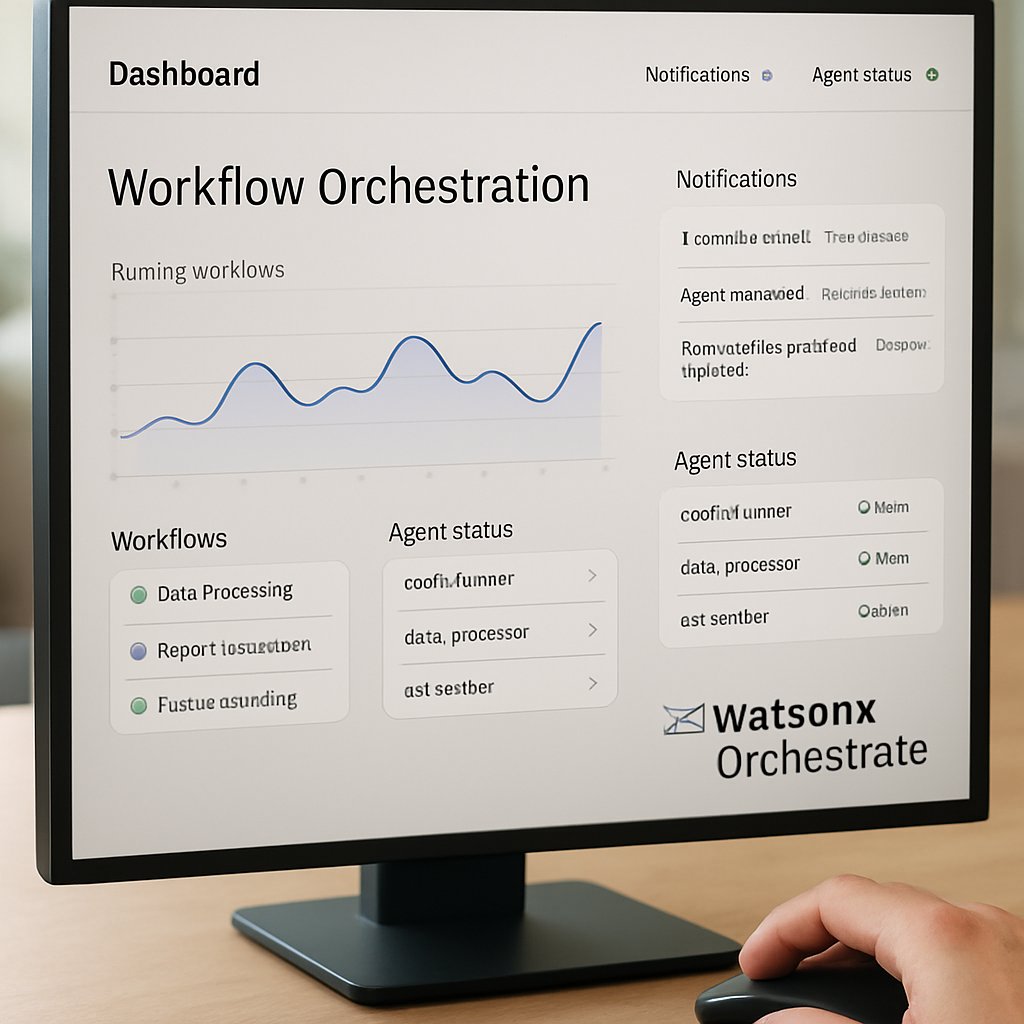
watsonx Orchestrate Control Plane
watsonx Orchestrate sits above models, data and tools. Additionally, it routes tasks among specialised agents and enforces policy. The resulting control lattice provides planning, memory and tool sequencing for complex workflows. IBM calls this design an “agentic control plane” because it coordinates many autonomous entities rather than one monolith.
Rob Thomas, IBM’s commercial chief, said hundreds or even thousands of agents will soon run concurrently. Consequently, a unifying layer must observe, govern and optimise them. Here, watsonx Orchestrate promises native metrics, policy hooks and real-time telemetry.
These traits align with hybrid ambitions. Moreover, Red Hat OpenShift AI lets companies deploy the plane across clouds and on-prem. Therefore, regulated industries may integrate agents without abandoning localisation rules.
The concept delivers three immediate benefits:
- Shared memory across 80+ integrated applications.
- Observability dashboards monitoring cost, latency and compliance.
- Pluggable interfaces for external models through Model Context Protocol.
These advantages clarify IBM’s hybrid message. However, customers will demand transparent pricing before expanding pilots.
The section underlines IBM’s architectural bet. Subsequently, attention shifts to practical features.
Key Preview Features Unveiled
The private preview arrives with several modules already functional. Firstly, Agent Builder offers no-code and pro-code paths. Consequently, developers can assemble an agent from templates within minutes. Secondly, a catalog surfaces 150+ pre-built entries spanning HR, finance and IT operations. Finally, AgentOps introduces runtime policies, audit trails and anomaly alerts.
Catalog And Builder Tools
IBM highlights speed as the headline metric. For example, business analysts can clone a procurement agent, adjust data connections and publish it without writing code. Meanwhile, professional teams may extend behaviour using the Agent Development Kit. Moreover, the catalog connects to 80+ SaaS applications, easing orchestration across existing stacks.
Early testers praise visual debugging and step replay. Nevertheless, Gartner warns that usability must stay consistent as the library surpasses 500 tools. Therefore, IBM’s design must scale gracefully.
Feature depth matters, yet domain breadth matters equally. Consequently, partnerships with Oracle, Salesforce and Anthropic broaden reach. watsonx Orchestrate counts those alliances as proof of momentum.
These modules showcase tangible progress. However, impact rests on real business outcomes; the next section explores those possibilities.
Enterprise Use Cases Expand
IBM markets agents for HR, procurement and sales first. For instance, a time-off agent queries Workday, updates calendars and notifies managers. Additionally, a supplier-risk agent ingests live Confluent streams and triggers ServiceNow tickets. Such enterprise scenarios illustrate how multi-agent collaboration reduces manual steps.
S&P Global pilots demonstrate value too. Their credit analysts now invoke agents that summarise filings, cross-check data and file comments. Consequently, turnaround time reportedly dropped 30%. Furthermore, IBM mainframe teams test Project Bob agents that modernise COBOL workflows.
Professionals can deepen expertise by pursuing the AI Architect™ certification. The coursework aligns with designing secure agent pipelines on watsonx Orchestrate.
These examples hint at broad applicability. However, security and governance could slow adoption if unsolved.
Security Governance Imperatives Rise
Agent ecosystems introduce fresh attack surfaces. Moreover, OWASP lists goal hijacking and memory poisoning among top risks. Therefore, companies need granular policies for identity, delegation and runtime isolation.
AgentOps Observability Layer Explained
AgentOps embeds policy engines directly into watsonx Orchestrate. Consequently, administrators can throttle privileges, inspect tool calls and freeze rogue agents. Additionally, the layer logs every state change for auditors. In contrast, some rivals offload oversight to third-party platforms, adding latency.
Nevertheless, experts caution that no platform yet meets emerging NIST standards fully. Furthermore, VentureBeat surveys show 62% of CISOs expect agent-driven incidents within a year. IBM answers with Anthropic-authored hardening guides and default opt-outs for risky tools.
These protections strengthen trust. Subsequently, readers should examine market positioning to understand competitive stakes.
Adoption Outlook Next Steps
The agent race now spans IBM, Microsoft, Google and countless startups. However, IBM leans on hybrid credibility and deep system integration. Analysts note that advantage, yet they also flag packaging complexity as a hurdle.
Pricing details remain vague. Consequently, prospective buyers continue requesting consumption calculators and case studies. Meanwhile, IBM promises general availability for core preview modules by June 2026.
Market success will depend on three factors:
- Seamless multi-agent scaling across clouds.
- Clear, predictable cost structures.
- Ecosystem health of partners and certifications.
watsonx Orchestrate addresses the first and third points today. Furthermore, new customer testimonials could answer the second. Therefore, CIOs should monitor pilot metrics closely.
These insights frame likely adoption paths. Consequently, the article concludes with strategic guidance.
Conclusion
IBM has planted a significant flag with watsonx Orchestrate. Moreover, the preview’s control plane, catalog and AgentOps features form a cohesive foundation for large-scale orchestration. Early use cases show promising productivity gains, while governance capabilities confront mounting security fears. Nevertheless, transparent pricing and independent benchmarks will influence wider enterprise adoption.
CIOs evaluating multi-agent strategies should request sandbox access, study policy templates and upskill teams. Consequently, earning the linked AI Architect certification can accelerate readiness. Explore the preview, validate performance and position your organisation for the coming agentic wave.
Disclaimer: Some content may be AI-generated or assisted and is provided ‘as is’ for informational purposes only, without warranties of accuracy or completeness, and does not imply endorsement or affiliation.


