

AI CERTS
2 hours ago
AI Environmental Impact Drives Iowa Water Policy Shift
Moreover, federal researchers forecast rapid jumps in computing electricity that will compound regional strain on limited supplies. This article unpacks how data-center cooling choices, disclosure gaps, and new rules intersect within Iowa's evolving landscape. Additionally, it presents verifiable numbers, expert insights, and actionable steps for technology leaders.
Readers will learn why balancing performance, Sustainability targets, and Water equity demands strategic innovation. Therefore, understanding precise usage patterns becomes essential for informed investment decisions. Let's examine the core developments shaping this debate.
Intensifying Iowa Water Stress
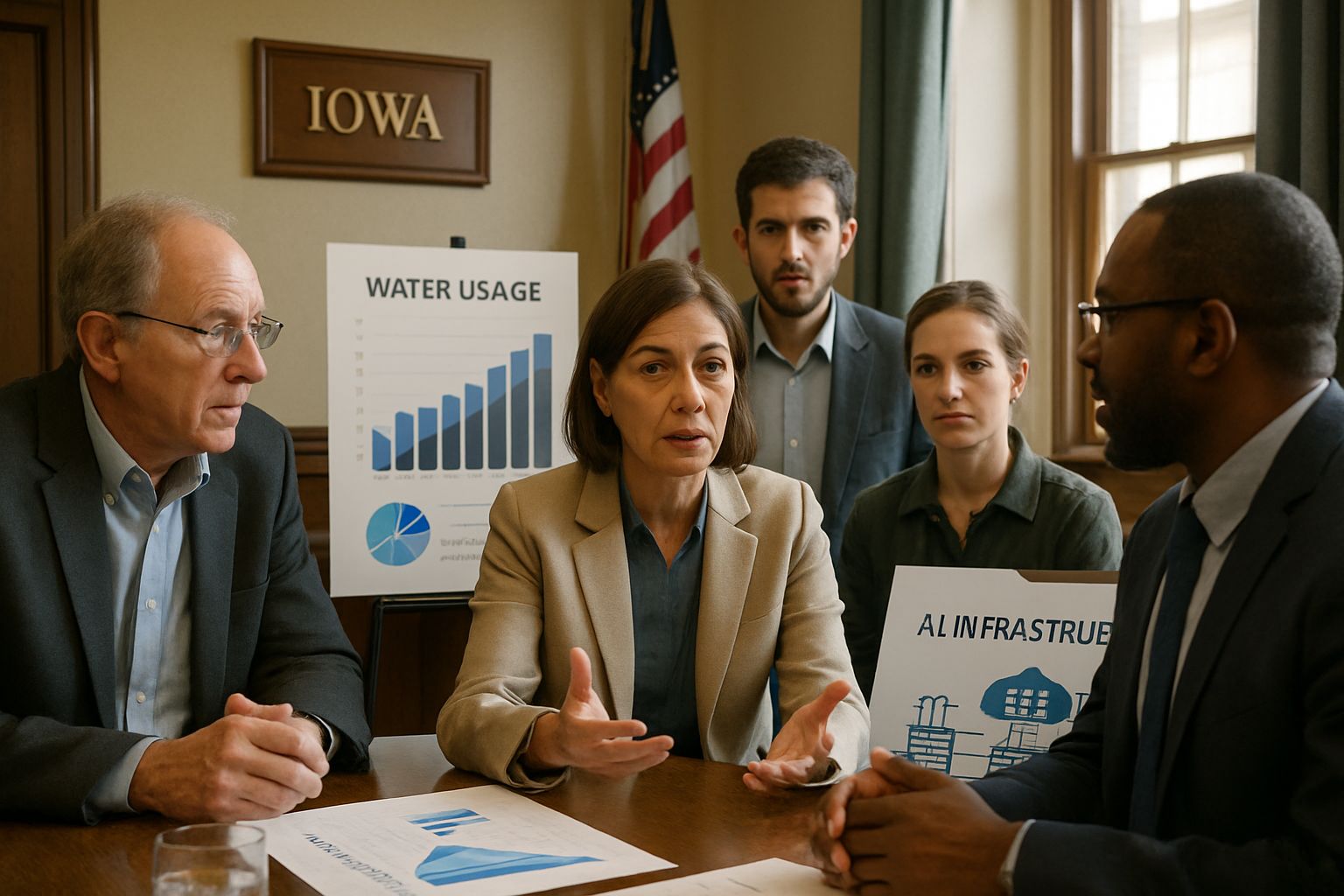
West Des Moines utilities reported Microsoft draws of 11.5 million gallons during July 2022's heat wave. However, the utility still imposed outdoor restrictions for every household in summer 2025. Google's Council Bluffs campus approached one billion gallons in the latest fiscal year. Consequently, Water managers warned that single facilities can equal a mid-sized city's annual demand.
Eric Masanet argued that even efficient designs magnify local risk when siting concentrates loads. Moreover, residents asked councils to condition future approvals on zero-evaporative cooling promises. The AI Environmental Impact became the centerpiece of heated public meetings across Polk County. In contrast, operators highlighted economic benefits and pledged storm-water reuse projects.
Nevertheless, several council members demanded quarterly transparency reports detailing on-site withdrawals and discharge volumes. Iowa's new Chapter 50 rule now forces permits above 25,000 gallons per day to include hydrologic analysis. Subsequently, developers must show no material impairment of municipal reserves. These numbers reveal mounting pressure on finite supplies. However, deeper national trends paint an even sharper picture.
Surging Federal Demand Forecasts
Lawrence Berkeley Lab estimated national data-center electricity at 176 TWh during 2023. Furthermore, the report projects up to 580 TWh by 2028 under aggressive AI growth scenarios. Indirect Water footprints scale with that electricity because most U.S. power plants still rely on thermal cooling. Consequently, indirect Consumption could dwarf on-site losses if grids stay fossil-heavy.
DOE Secretary Jennifer Granholm therefore framed capacity planning as an AI Environmental Impact challenge for every region. Moreover, the same study placed direct national withdrawals at 17.4 billion gallons during 2023. That figure already equaled residential use for several large cities combined. In contrast, operators stress improving PUE metrics, yet WUE remains stubborn in evaporative systems.
Shaolei Ren cautioned that water-saving hardware often increases grid intensity, complicating net Sustainability reporting. Therefore, policymakers must evaluate both sides of the ledger before approving incentives. The AI Environmental Impact lens helps integrate electricity, climate, and watershed factors into one governance framework. Federal projections underscore looming resource crunches. Subsequently, corporate engineering choices will decide which trade-offs dominate locally.
Shaping Corporate Cooling Choices
Microsoft announced that post-2024 facilities will favor closed-loop systems requiring minimal Water. However, engineers admitted energy draw could rise several percent under air-cooled layouts. Google tested liquid-to-chip loops that recover heat for nearby greenhouses. Consequently, community groups welcomed co-benefits but still requested monthly transparency dashboards.
Meta piloted desiccant-based units in Altoona, aiming to cut direct Consumption by half. In contrast, retrofitting legacy halls remains expensive, slowing fleet-wide adoption. Eric Masanet emphasized that rapid AI workload growth can erase efficiency gains within months. Moreover, utility incentives could accelerate the pivot toward low-Water hardware.
The AI Environmental Impact again surfaced as a core metric during such negotiations. Corporate innovation offers measurable relief to the AI Environmental Impact yet introduces new grid stresses. Therefore, investors now scrutinize both PUE and WUE ratios before funding expansions. Nevertheless, state oversight mechanisms are evolving to match that complexity.
Rapid Regulatory Shifts Emerging
Iowa DNR's Chapter 50 rules took effect on 18 June 2025. Consequently, any operator pumping above 25,000 gallons daily now files detailed impact assessments. Utilities gain leverage because permits can be conditioned on aquifer modeling and conservation plans. Furthermore, several legislators introduced disclosure bills mirroring semiconductor water-reporting standards.
Local NGOs urged inclusion of indirect Consumption estimates within filings. DOE analysts supported that request, arguing integrated data better captures AI Environmental Impact. Moreover, proposed rules include civil penalties for non-compliance and misreporting. Christina Murphy noted the new framework finally aligns municipal supply planning with hyperscale growth.
Nevertheless, critics worry enforcement staff remain underfunded. In contrast, operators welcome uniform standards because patchwork ordinances raise project risk. Early implementation will reveal practical strengths and loopholes. Subsequently, economic narratives will drive ongoing public debates.
Local Economic Development Debate
County officials tout billions in capital investment and construction employment during multi-year campus builds. Furthermore, Microsoft alone funded potable line extensions that will serve emerging suburbs. Tax abatements, however, often offset that revenue bump for several years. Key figures illustrate the scale.
- 3,500 construction jobs during peak build
- $65 million utility upgrades financed by operators
- 2–7% municipal demand attributed to campuses
Moreover, some chambers argue that ancillary tech firms follow hyperscale anchors, diversifying local economies. Nevertheless, critics highlight lost agricultural land and rising residential rates driven by infrastructure amortization. The AI Environmental Impact frames this trade-off as more than a budget ledger. In contrast, corporate press releases emphasize global Sustainability targets and carbon matching.
Therefore, balanced scorecards combining jobs, Sustainability, Water, and Consumption metrics are gaining traction during negotiations. Economic upsides remain tangible yet uneven. However, future planning hinges on holistic resource accounting.
Balancing Future Resource Tradeoffs
Stakeholders increasingly demand scenario tools that link capacity plans with watershed data and grid decarbonization paths. Consequently, several utilities collaborate with Lawrence Berkeley Lab on open digital twins for regional forecasts. Moreover, state geologists recommend adaptive permits that tighten thresholds during drought. The AI Environmental Impact perspective ensures such models weigh indirect and direct Consumption equally.
Additionally, professionals can enhance their expertise with the AI for Everyone™ certification. In contrast, some advocates call for mandatory course completion before permit applications. Nevertheless, technical literacy across boards remains uneven, slowing consensus. Integrated modeling and training could harmonize growth with Sustainability. Subsequently, decision makers must convert insights into enforceable benchmarks.
Key Takeaways And Outlook
Ultimately, escalating compute appetite touches every faucet and power line. Therefore, leaders must confront the AI Environmental Impact with transparent numbers and adaptive permits. Iowa provides a revealing case where proactive rules, corporate innovation, and public scrutiny interact daily. Moreover, federal forecasts warn that indirect Water losses could eclipse direct site savings without clean energy expansion.
Consequently, balanced scorecards tracking Consumption, Sustainability, and jobs offer the clearest navigation tool. Professionals should review their facility data, engage utilities early, and pursue certified training. Take the next step by exploring the linked credential and join peers building resilient digital ecosystems.
Disclaimer: Some content may be AI-generated or assisted and is provided ‘as is’ for informational purposes only, without warranties of accuracy or completeness, and does not imply endorsement or affiliation.


