

AI CERTS
2 hours ago
Rough Sets Powering AI Conflict Governance
This article examines how these methods illuminate AI Conflict Governance for enterprise stakeholders. We connect academic advances, market signals, and practical playbooks. Additionally, we highlight certification paths that help professionals translate theory into oversight practice. In contrast, symbolic approaches complement black-box auditing rather than replace it. Therefore, understanding both camps improves strategic investment decisions.
Rough Sets Resurface Again
Researchers have revived rough sets in the last two years. June 2025 saw Decision-Theoretic Rough Sets applied to multi-stakeholder dilemmas. Meanwhile, an April 2026 preprint measured concept inconsistency in dermatology models using boundary analysis. Additionally, journals report fuzzy and probabilistic extensions that refine classical approximations with risk thresholds.
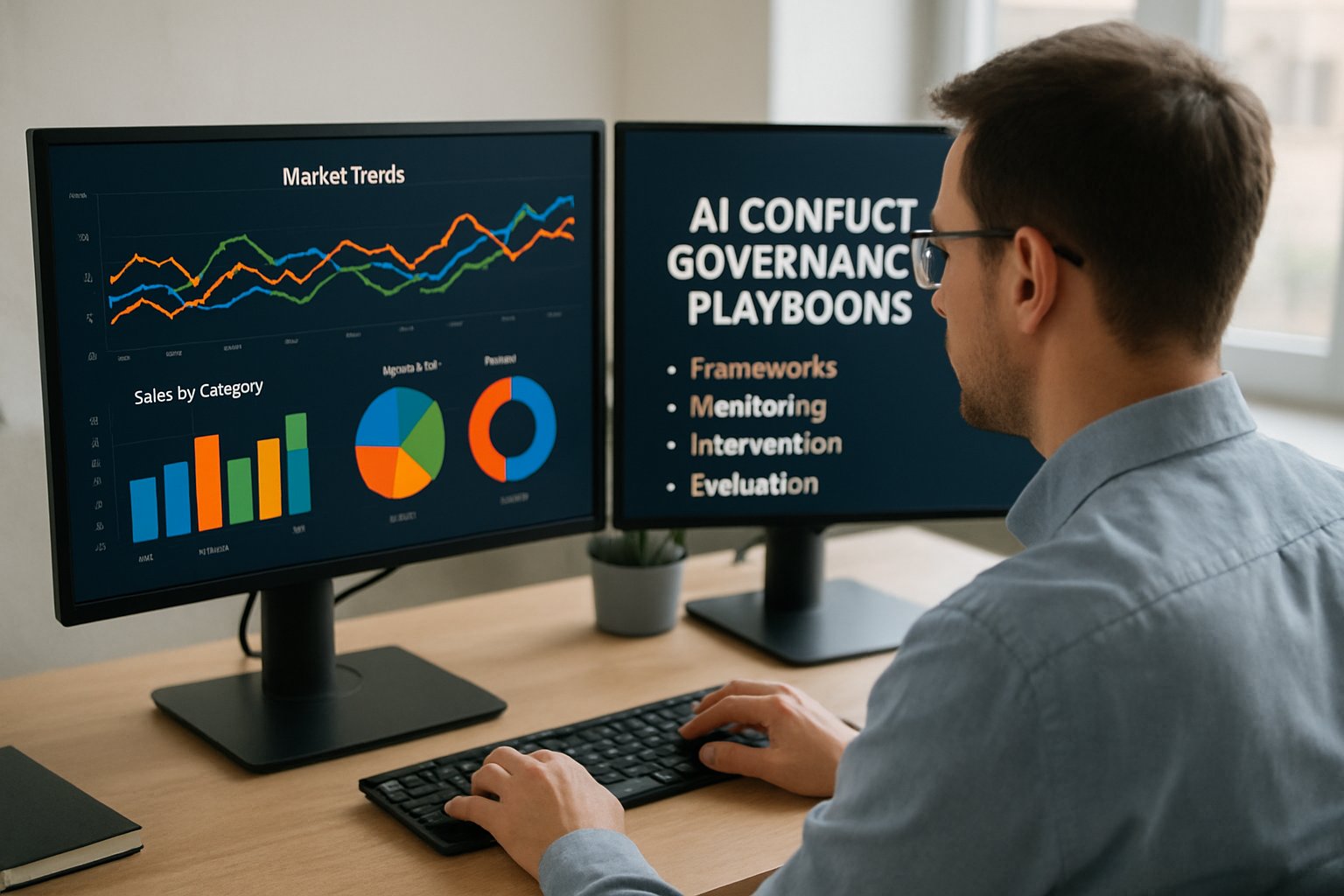
These studies confirm the framework still evolves, not merely repeats past results. Moreover, game-theoretic variations optimize region sizing for dynamic disputes. Consequently, symbolic rule extraction remains relevant despite neural dominance. UNU analysts recognise the renewed relevance for peacekeeping operations. These developments reposition rough sets within AI Conflict Governance discussions.
Rough sets now answer fresh governance questions around ambiguity and cost. Subsequently, market forces shape how the mathematics reaches production.
Market Forces Accelerate Governance
Analysts project explosive growth for governance tooling. MarketsandMarkets forecasts USD 5.78 billion by 2029, reflecting 45.3 percent CAGR. Grand View Research predicts USD 3.59 billion by 2033, underlining sustained demand. Furthermore, IBM, Credo AI, and others compete to bundle lifecycle controls, monitoring, and compliance playbooks. Accurate Prediction of audit costs guides procurement decisions.
Yet vendor brochures rarely mention rough sets explicitly. In contrast, they emphasize dashboards, bias tests, and automated documentation. Nevertheless, symbolic engines can quietly power explainability modules behind those interfaces. Budget holders ask whether AI Conflict Governance benefits outweigh migration costs.
The market rewards solutions that marry clarity with scale. Therefore, understanding adoption gaps becomes imperative. We next unpack the core conflict frameworks informing those solutions.
Core Conflict Frameworks Explained
Pawlak’s conflict model partitions opinions into positive, boundary, and negative regions. Consequently, negotiators spot issues requiring mediation. Decision-Theoretic Rough Sets add probabilistic thresholds α and β plus explicit loss functions. Additionally, three-way decisions map cleanly onto accept, defer, reject governance actions.
Diplomacy researchers liken the boundary region to a neutral negotiation zone. Moreover, DRSA supports multi-criteria scoring when policy disputes involve privacy, fairness, and revenue. Logic based rule sets extracted here remain understandable by legal teams. UNU scholars exploring peace technology have recently adopted three-way conflict analysis for stakeholder simulations. The frameworks formalize AI Conflict Governance choices in mathematical terms.
These frameworks supply transparent, mathematically grounded guardrails. Subsequently, we examine why industry uptake lags. Industrial realities introduce technical and cultural hurdles.
Industrial Adoption Gaps Persist
Enterprise data often lives in high-dimensional embeddings generated by deep networks. However, classical rough sets assume structured attribute tables. Scaling symbolic algorithms demands hybrid pipelines that translate embeddings into interpretable features. Watchtower risk teams report integration friction when datasets shift daily.
Additionally, governance teams fear parameter choices in fuzzy extensions may appear subjective. Nevertheless, transparent documentation of thresholds can mitigate audit concerns. Prediction latency also matters; streaming applications cannot tolerate heavy rule mining each minute. Scalability hurdles often stall AI Conflict Governance pilots.
Technical debt, speed, and cultural inertia slow adoption. Therefore, a practical playbook helps practitioners proceed incrementally. The next section outlines such a roadmap.
Practical Governance Playbook Steps
Practitioners can embed rough-set conflict checks within existing risk tiers. Moreover, decision gates should output accept, defer, or reject labels aligned with policy owners.
Key Certification Pathways Forward
- Calibrate DTRS thresholds against quantified loss functions.
- Route high boundary cases to human review queues.
- Document extracted rules in model cards for audit trails.
- Integrate continuous monitoring for threshold drift.
Diplomacy teams can pair this workflow with established escalation protocols. Watchtower style dashboards then visualize unresolved boundary issues for executives. Professionals can enhance their expertise with the AI Researcher™ certification. Additionally, the program deepens understanding of rough-set Logic and regulatory alignment. The playbook operationalizes AI Conflict Governance through simple thresholds.
The playbook aligns symbolic rigor with operational realities. Consequently, research insights become day-to-day guardrails. We now turn to emerging research frontiers.
Future Research Directions Emerging
Scholars target scalability by coupling rough sets with sparse autoencoders. Furthermore, teams explore incremental algorithms that update approximations in near real time. UNU labs test conflict simulators that feed live governance dashboards for humanitarian deployments. Prediction improvements will follow as these methods shorten feedback loops.
Moreover, regulators may reference three-way decisions in upcoming technical standards. Logic transparency helps policymakers judge compliance without deciphering deep gradients. Watchtower product owners already prototype connectors exposing boundary alerts via APIs. Emerging research aims to automate AI Conflict Governance feedback loops.
Research thus converges on speed, scale, and auditability. Nevertheless, sustained collaboration between academia and industry remains essential.
Conclusion Insights And Action
Rough-set methods deliver transparent, cost-aware conflict analytics for emerging risks. Consequently, they enrich AI Conflict Governance without discarding existing dashboards. Market momentum signals expanding budgets for compliant operations. However, success hinges on bridging symbolic Logic with real-time infrastructure. Professionals should experiment with pilot projects while pursuing advanced credentials. Therefore, consider enrolling in the AI Researcher™ program today.
Additionally, share findings with cross-functional Diplomacy teams to embed governance culture. Consequently, your organization will transform risks into resilient advantage. In contrast, delaying action may invite regulatory penalties and reputational harm. Take proactive steps and lead the next chapter of responsible innovation.
Disclaimer: Some content may be AI-generated or assisted and is provided ‘as is’ for informational purposes only, without warranties of accuracy or completeness, and does not imply endorsement or affiliation.


