

AI CERTS
2 hours ago
Emotionless AI Sports Redefine Robo-Athletic Milestones
Nevertheless, markets, regulators, and fans now grapple with games played by tireless metal bodies devoid of nerves. This article unpacks the milestones, technology, commercial signals, and cultural debate behind the new robo-athlete era. Moreover, it scrutinizes whether Robotics excellence can replace human Athletics drama or merely create a parallel spectacle. Readers seeking deeper technical mastery can upskill through the AI Robotics Specialist™ certification.
Robots Entering Global Sports
Industry dashboards logged two headline breakthroughs during the past year. Furthermore, Sony unveiled Ace, a table-tennis system that captured three of five matches against elite humans. In contrast, Beijing’s E-Town Half-Marathon saw Lightning complete 21 kilometers in 50 minutes. The run eclipsed Jacob Kiplimo’s 57:20 human world record. Consequently, mainstream outlets started tracking Emotionless AI Sports alongside traditional leagues.
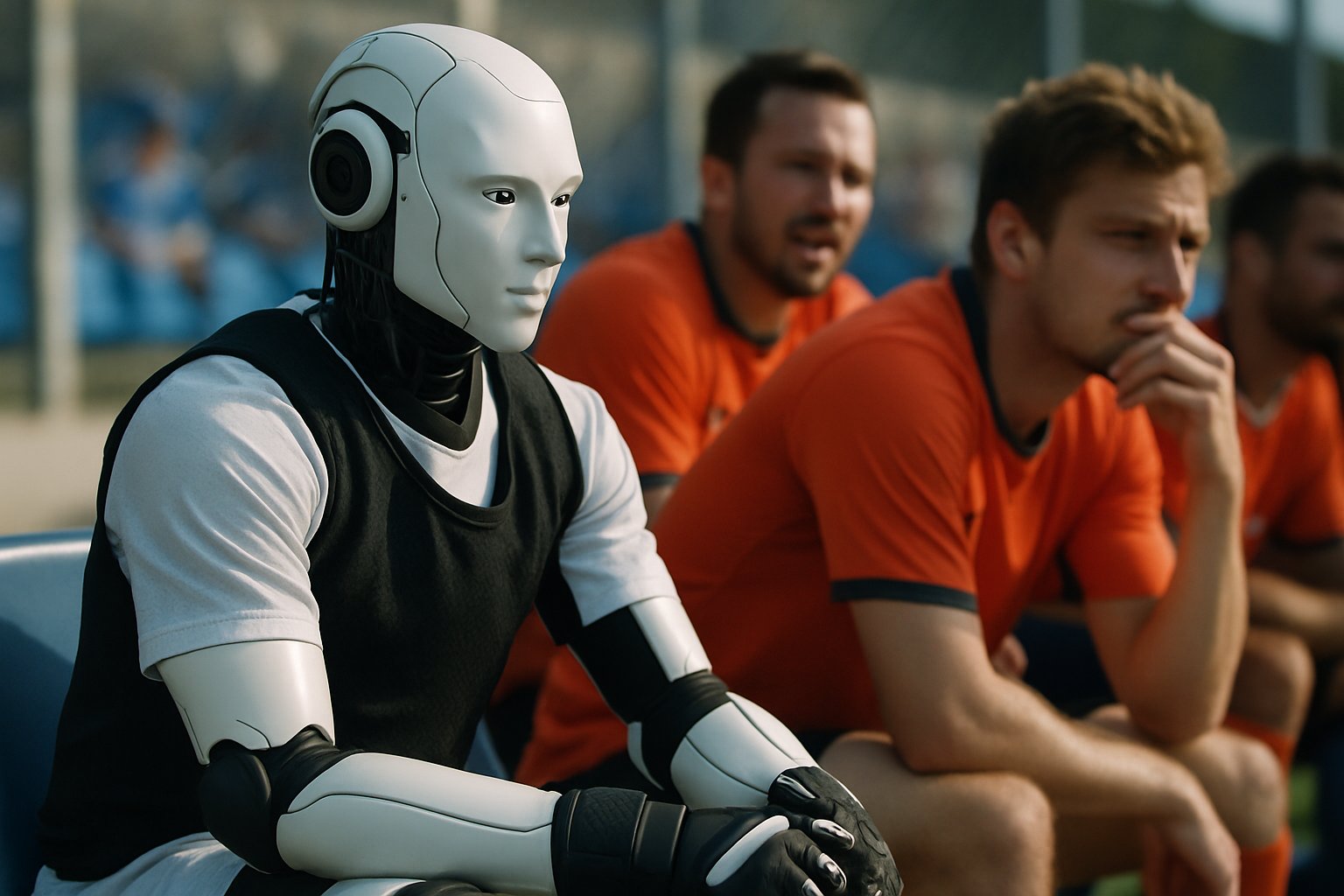
These landmark wins signaled more than publicity stunts. Moreover, they demonstrated hardware, perception, and control stacks achieving reliable real-world Performance under pressure. Nevertheless, many observers questioned whether the spectacle lacked the Dull Drama fans crave from fallible heroes. Such skepticism sets the stage for deeper technical scrutiny below. Momentum is undeniable, yet meaning remains contested. Therefore, we next examine Sony’s Ace in detail.
Ace Beats Elite Humans
Researchers at Sony AI Zurich built Ace around a mobile base and eight-joint arm. Additionally, multi-camera rigs captured ball trajectories within milliseconds. Deep reinforcement learning policies were first trained in simulation, then fine-tuned through tens of thousands of real rallies. Consequently, Ace delivered shots up to 19.6 meters per second and won three of five matches against elite opponents. Peter Dürr stated that the robot matched human reaction times while never tiring.
Key figures help quantify the breakthrough:
- Shot velocity peaked at 19.6 m/s, exceeding many professional standards.
- Training combined 500,000 simulated rallies and 20,000 physical rallies.
- Success rate against elite players reached 60 % across documented matches.
Moreover, Ace ran fully autonomously, unlike earlier table-tennis models requiring teleoperation. However, critics cited controlled lighting, polished floors, and pre-calibrated tables as environmental crutches. Emotionless AI Sports celebrated the win, yet seasoned coaches still question psychological intangibles missing from the exchange. Technically, Ace shows how sim-to-real pipelines close latency gaps. Subsequently, we shift from paddles to marathon asphalt.
Humanoids Dominate Half-Marathon Record
Beijing’s robot half-marathon unfolded on April 19, 2026, within a segregated lane beside human runners. Lightning, developed by Honor, completed the 21.0975-kilometer course in 50 minutes and 26 seconds. Consequently, headlines proclaimed the first robotic time faster than the reigning men’s human record. However, officials penalized several entrants found using momentary remote control during balance recoveries. Moreover, some units crashed, underlining continuing robustness challenges. Du Xiaodi of Honor stressed that cooling systems and carbon-fiber frames, derived from smartphone engineering, mattered more than showmanship.
Independent researchers therefore warned against equating segregated lanes with open road races. Nevertheless, the demonstration revealed impressive actuator strength, battery density, and sensor fusion under extended load. Emotionless AI Sports again dominated trending charts, even as purists lamented missing Dull Drama moments like mid-race psychological swings. Robot runners shattered times yet exposed autonomy caveats. Consequently, attention turns to the engineering enabling such feats.
Tech Behind Athletic Bots
Athletic robots integrate high-power actuators, millisecond vision, and deep RL for split-second decisions. Furthermore, domain randomization bridges simulation and messy stadium floors, narrowing the reality gap. Sony’s researchers randomized ball spin and lighting; Honor’s engineers varied surface friction within virtual laps. Consequently, controllers generalized better during live Emotionless AI Sports demonstrations. Nevertheless, thermal buildup remains a ceiling for marathon-length Performance. Industry watchers label such competitions the crucible of Emotionless AI Sports research.
Battery energy density also constrains humanoid stride length and overall Athletics viability. However, new silicon-carbide inverters and phase-change cooling promise lighter packs and faster heat rejection. Professionals can deepen expertise in such architectures through the AI Robotics Specialist™ program. Hardware advances close critical speed and stability gaps. Nevertheless, market forces now shape the development roadmap.
Market And Ethical Debate
Venture analysts peg ball-picking robot sales at USD 115 million for 2026, with double-digit growth projected. Moreover, broader sports-tech valuations already exceed USD 20 billion worldwide. Consequently, startups pitch Emotionless AI Sports products as new revenue streams for clubs seeking 24/7 practice partners. However, sponsors worry that blank expressions create Dull Drama for television viewers. Meanwhile, unions fear that tireless machines will erode human Athletics storylines and ticket sales.
Key arguments shaping policy include:
- Safety: high-speed limbs raise liability and insurance premiums.
- Fairness: remote guidance blurs autonomy lines.
- Cultural value: fans cherish heroic failure, not flawless Precision Performance.
Nevertheless, federations like RoboCup craft rulebooks defining autonomy grades and fail-safe conditions. Therefore, regulators may borrow those frameworks before sanctioning mixed human-robot events. Money accelerates innovation yet magnifies ethical tension. Subsequently, scenario planning becomes essential.
Future Scenarios And Stakes
Analysts foresee dedicated robot leagues within five years, mirroring e-sports growth curves. Moreover, mixed relays pairing humans and machines could offer novel fan engagement while preserving classic Athletics moments. In contrast, purists predict spectator fatigue if Emotionless AI Sports cannot generate relatable Dull Drama. Consequently, storytelling layers such as team engineering backstories may replace facial expressions.
Technical roadmaps indicate lithium-sulfur packs, stronger composites, and self-healing joints will boost on-field Performance by 30 %. Furthermore, cloud-edge orchestration may let swarm referees monitor rule compliance in real time. Robotics advancements from these trials should spill into logistics, disaster relief, and elder care. Therefore, even skeptics might welcome by-products if safety standards stay rigorous. Multiple futures remain plausible, hinging on regulation and audience sentiment. Finally, we distill the narrative.
Robots now smash serves and records, yet technology, markets, and culture still negotiate their rightful place. Emotionless AI Sports has proven technical viability across racket courts and road courses. Moreover, Sony’s Ace and Honor’s Lightning highlight rapid strides in sensing, actuation, and sim-to-real learning. Nevertheless, spectators still crave Dull Drama, unpredictable errors, and human backstories that algorithms cannot mimic.
Consequently, rule makers and broadcasters must shape formats that balance Robotics spectacle with relatable Athletics narratives. Professionals eyeing the field should deepen technical fluency through the earlier mentioned AI Robotics Specialist™ certification. Ultimately, Emotionless AI Sports will thrive or stall depending on whether engineers can inject stakes beyond pure Performance.
Disclaimer: Some content may be AI-generated or assisted and is provided ‘as is’ for informational purposes only, without warranties of accuracy or completeness, and does not imply endorsement or affiliation.


