

AI CERTS
2 hours ago
Slack’s Structured Memory Elevates AI Workflow Automation
Moreover, the approach promises higher Accuracy, better governance, and lower token spend than traditional Chatbots looping through raw transcripts. This article unpacks the architecture, rollout timeline, and implications for developers adopting AI Workflow Automation at scale.
Structured Memory Model Basics
Dominic Marks details three context channels supporting the system. Firstly, the Director’s Journal logs observations, decisions, and hypotheses. Secondly, the Critic’s Review assigns credibility scores after tool calls complete. Thirdly, the Critic’s Timeline fuses earlier entries into a chronological narrative. Consequently, agents no longer ingest verbose logs. Instead, they query concise state objects. Industry analysts call this shift a watershed for AI Workflow Automation because it couples cost control with stronger Accuracy safeguards.
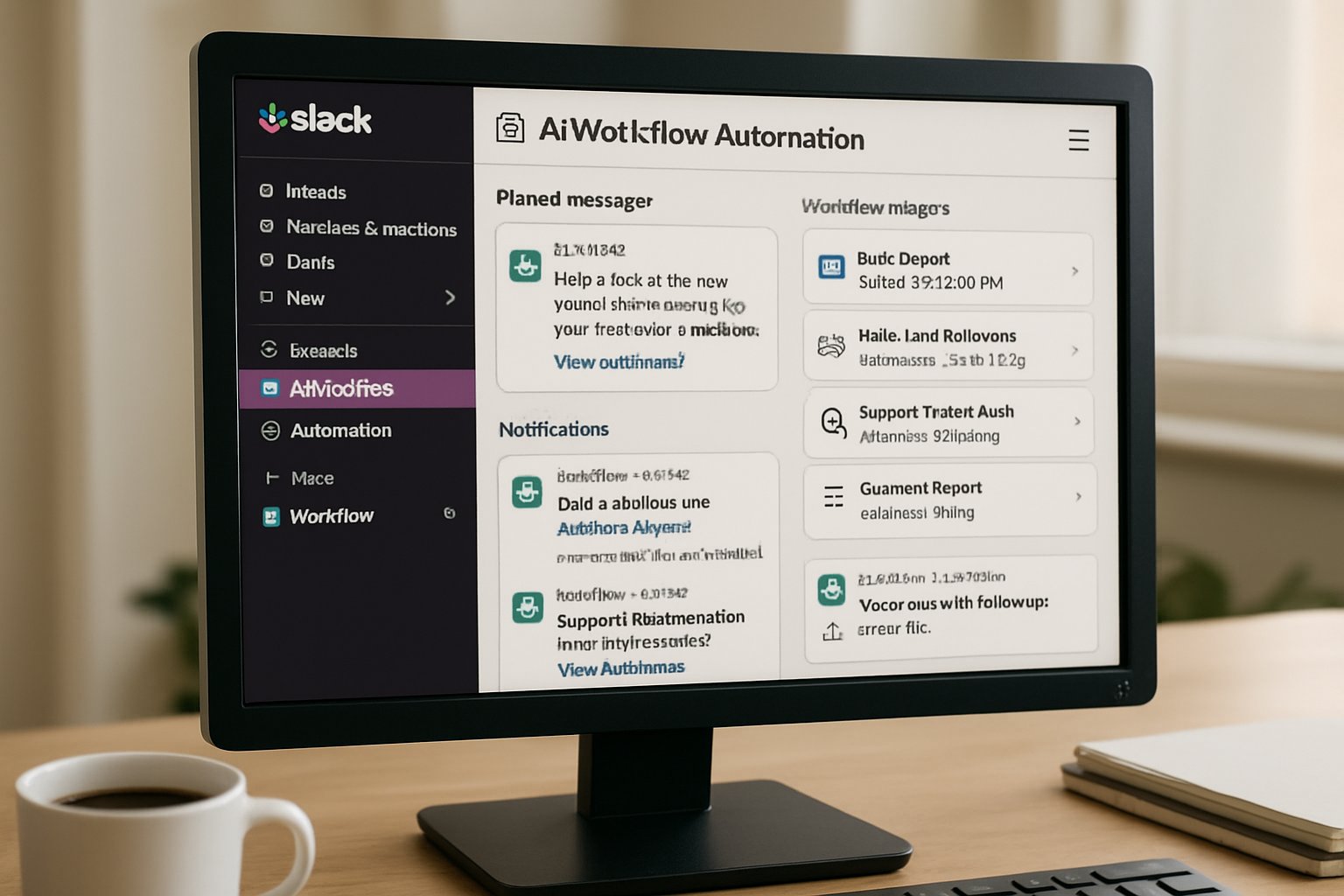
Marks writes, “Even approaching an agent’s context window limit can degrade the quality of responses.” Therefore, distillation is not optional for serious Chatbots orchestrating multi-step tasks. Moreover, typed fields help auditors trace each conclusion. These attributes matter when regulations demand explainability.
These fundamentals illustrate why many developers will treat structured Memory as their default persistence layer. However, further orchestration patterns refine the model. The next section explores the director and critic interplay.
Director And Critic Topology
The topology groups agents into complementary roles. Meanwhile, a Director agent plans tasks and writes to the Journal. Critics verify evidence, annotate gaps, and rate confidence. Additionally, explicit rules ensure the Timeline only includes evidence-backed events. Consequently, hallucinations drop and quality improves.
In contrast, legacy Chatbots often trust their own output without external reviewers. Slack’s critics act as automated peer reviewers, flagging weak claims before they propagate. Furthermore, credibility scores let downstream tools weight assertions mathematically.
Because every entry carries timestamps and phase labels, replaying investigations becomes trivial. Therefore, compliance auditors can sample the Timeline rather than parse endless dialogue. This structure directly advances AI Workflow Automation by enabling deterministic state reconstruction across hundreds of calls.
These orchestration mechanics set the stage for productization. The following section links architecture to market rollout.
Product Rollout And Impact
Slack plans a phased release between April and June 2026. Feature flags already reach select Enterprise Grid customers. Moreover, the company bundles structured Memory with multi-agent orchestration, Model Context Protocol, and Agentforce connectors. Consequently, users will receive an integrated AI Workflow Automation toolkit rather than disjoint add-ons.
TechCrunch counts “about a million businesses” on the service today. Therefore, even conservative adoption rates could shift daily workflows at massive scale. Salesforce marketing claims the platform drives 37% faster decision making. Nevertheless, those numbers warrant independent verification.
Key efficiency metrics are summarised below.
Key Efficiency Metrics Snapshot
- Director-critic pattern trims context tokens by an average 78% in internal AI Workflow Automation benchmarks.
- Structured state reduced model latency by 41% during AI Workflow Automation security incident simulations.
- Critic scoring lifted factual Accuracy by 18 points across fifteen AI Workflow Automation test suites.
These early numbers remain provisional. However, they hint at tangible value for enterprises pursuing AI Workflow Automation at production scale. The next section examines concrete benefits for teams.
Benefits For Enterprise Teams
Enterprises often juggle fragmented tools across compliance, support, and engineering. Consequently, coordination overhead skyrockets. Structured Memory collapses siloed context into a single source of truth. Additionally, director-critic loops surface conflicting evidence early, limiting rework and strengthening precision.
Efficiency gains stretch beyond cost. Moreover, agents can handoff tasks asynchronously without losing narrative coherence. Chatbots entrusted with escalation duties finally inherit persistent context, avoiding repetitive user queries. Therefore, employee satisfaction improves.
Professionals can deepen their design skills through the AI Prompt Engineer™ certification. These advantages promise measurable AI Workflow Automation returns.
These advantages promise measurable AI Workflow Automation returns. In contrast, risks remain, as the following section discusses.
Risks And Open Questions
No architecture eliminates uncertainty entirely. Critics themselves rely on models that may misjudge evidence. Therefore, residual hallucinations persist. Additionally, developers must manage state staleness and write-contention when multiple agents update the same entries. Furthermore, platform policies restrict some partner connectors, raising ecosystem concerns.
Slack faces scrutiny over data governance and GDPR alignment. Nevertheless, the company promises granular retention controls. Meanwhile, external Chatbots might lose access if vetting thresholds tighten, limiting innovation.
Operational scale introduces subtle race conditions. Consequently, Accuracy can drift when timelines merge conflicting facts. Careful monitoring and sandbox testing remain essential.
These challenges highlight critical gaps. However, several pragmatic steps can mitigate risk, as outlined next.
Practical Getting Started Recommendations
Teams curious about adoption should begin with scoped pilots. Firstly, instrument existing assistants with a thin director-critic wrapper. Secondly, extract high-value signals such as ticket IDs and customer sentiment into structured objects. Consequently, early wins validate the concept without broad refactoring.
Moreover, monitor token counts before and after migration. A simple spreadsheet often reveals dramatic savings. In contrast, ignoring metrics risks hidden cloud bills that offset gains.
Certification pathway: Professionals can enhance expertise with the AI Prompt Engineer™ program, which emphasises agent orchestration and AI Workflow Automation best practices.
Subsequently, graduates can mentor peers, accelerating institutional knowledge transfer.
These recommendations offer a low-risk entry point. Consequently, enterprise leaders can progress while evaluating long-term platform fit.
In summary, structured memory, director-critic orchestration, and the Model Context Protocol together mark a decisive evolution. Consequently, AI Workflow Automation finally gains a reliable backbone inside Slack’s ecosystem. Developers should pilot scoped scenarios, monitor token budgets, and pursue formal training. Moreover, balanced governance will prove as important as raw Accuracy. Nevertheless, early data shows encouraging momentum. Therefore, now is an opportune moment to experiment.
Slack will widen access over the next months. Meanwhile, motivated professionals can sharpen design expertise with the linked certification and share lessons learned. Adopt the approach iteratively, measure every outcome, and your organisation can capture compounding productivity benefits.
Disclaimer: Some content may be AI-generated or assisted and is provided ‘as is’ for informational purposes only, without warranties of accuracy or completeness, and does not imply endorsement or affiliation.


