

AI CERTS
2 hours ago
UFC Fight Forecasts With AI Sports Analytics
However, recent research highlights accuracy plateaus, data leakage scares, and strategic trade-offs. This article dives deep into the evolving UFC fight prediction ecosystem, balancing hype with evidence. Moreover, readers gain a roadmap for vetting claims and monetizing insights responsibly. Expect hard numbers, method breakdowns, and practical guidance throughout.
AI Sports Analytics will appear repeatedly because it anchors the discussion and the industry vocabulary. Meanwhile, every claim cites public repositories that you can inspect today. Subsequently, the article equips decision-makers with numbers rather than sensational knock-out metaphors.
UFC Data Foundations Explained
Every serious model begins with raw numbers from ufcstats.com or mirrored community scrapes. Additionally, Kaggle and Hugging Face hosts provide cleaned tables spanning about 6,000 historical fights. Modelers enforce point-in-time snapshots to prevent future information from leaking backward.
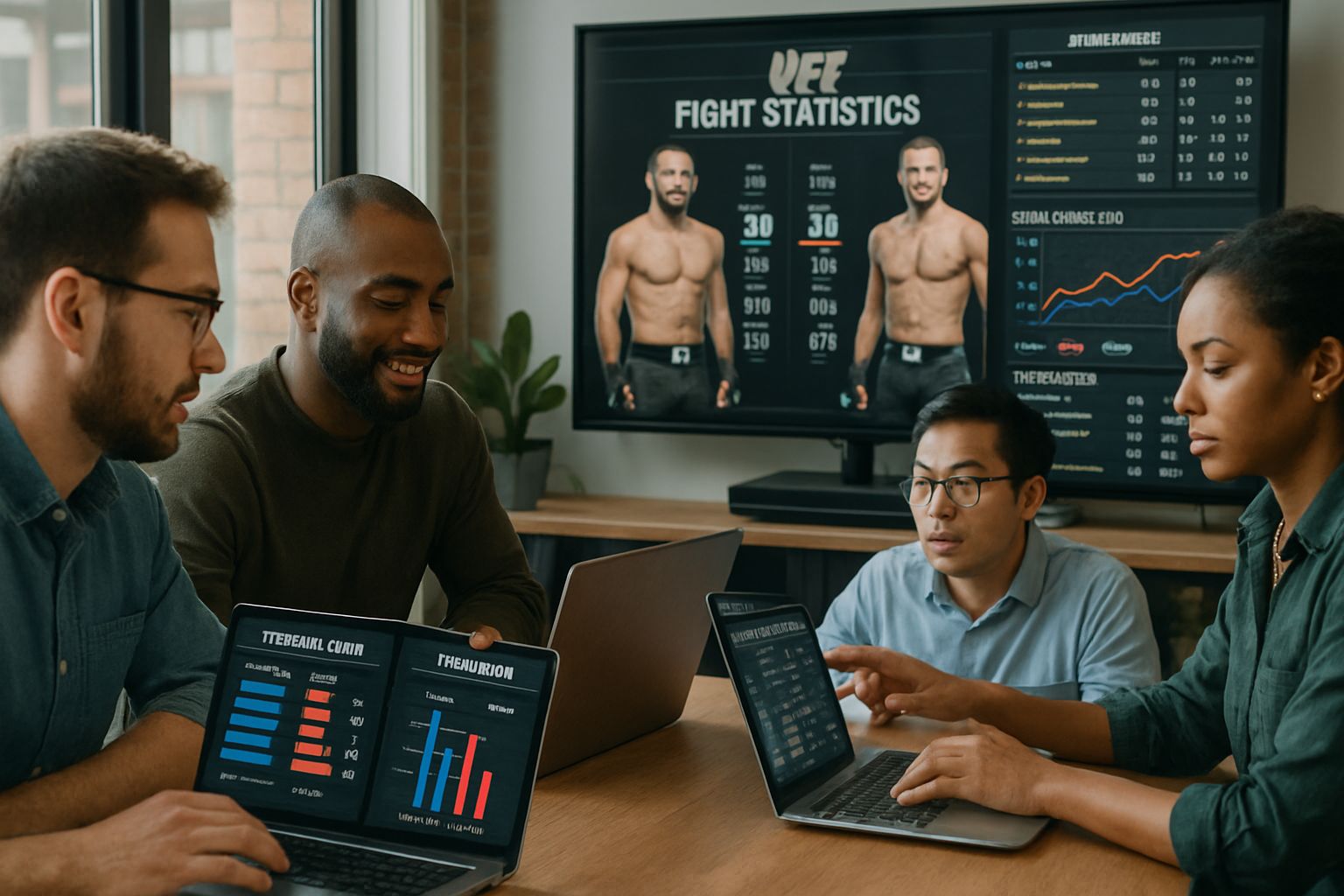
In contrast, careless joins inflate backtested accuracy and mislead investors. AI Sports Analytics practitioners engineer differential features such as reach gap and recent win rate. Moreover, Elo ratings evolve after each bout to capture momentum effects.
Sports technologists also merge closing-line odds to quantify market consensus. Consequently, any missing timestamp on odds data becomes a glaring red flag. Solid datasets and rigorous snapshots set the ceiling for truthful benchmarks. Therefore, understanding the plumbing readies us for the modeling techniques ahead.
Modeling Techniques Overview Today
Gradient boosted trees dominate pre-fight prediction contests. CatBoost, LightGBM, and XGBoost appear in almost every public notebook. However, ensembles often top single learners by combining diverse decision boundaries.
Hyperparameter sweeps with Optuna or Bayesian search squeeze extra percentage points of accuracy. Meanwhile, logistic regression remains the baseline sanity check. AI Sports Analytics teams openly publish SHAP plots to explain feature contributions and counter black-box fears. Analytics leaders favour calibrated outputs because betting stakes require probability, not just binary picks.
Sports leagues favor transparent models when approaching regulators. These techniques push predictive power yet remain accessible with commodity hardware. Subsequently, we examine how they perform on real UFC datasets.
Performance Benchmarks Snapshot 2026
Peer reviewed numbers anchor credibility more than marketing decks. The March 2026 SISFOTEK Global paper posted 79.25 % accuracy for lightweight fights. Haymaker’s public dashboard shows 65.2 % on a broader 1,605-fight test slice.
In contrast, FightTracker targets in-round scoring and cites roughly 80 % classification success. Moreover, Haymaker claims 81.3 % hit rate when model confidence exceeds 72 %.
- JURNAL SISFOTEK Global: 79.25 % accuracy, ROC-AUC 88.67 %
- Haymaker: 65.2 % accuracy, AUC-ROC 0.714 on 1,605 fights
- FightTracker live model: ≈80 % accuracy on round scoring
AI Sports Analytics observers must adjust expectations by weight class and time split. Consequently, a single high metric rarely generalizes across divisions. Prediction variance widens when odds data is withheld. Meanwhile, Haymaker notes that market favourites alone hit 68 %, matching its model on overlap fights. Therefore, incremental gains still matter because small edges compound over seasons.
Benchmarks confirm progress yet expose lingering performance ceilings. Next, we balance upside with notable headwinds.
Opportunities And Current Limitations
Accurate predictions inspire new fan experiences and media segments. Furthermore, sportsbooks test dynamic pricing tied to real-time model signals. Coaches also exploit scenario analytics during fight camps.
Nevertheless, classification improvements slow as models converge toward market efficiency. Data gaps around late replacements or injuries cause abrupt distribution shifts. Moreover, regulatory scrutiny rises as operators market machine learning picks to casual bettors.
AI Sports Analytics faces ethical questions about responsible gambling and data scraping compliance. Consequently, transparent disclaimers and audit trails become mandatory for credibility. Opportunities excite, yet limitations demand careful governance. Therefore, verification best practices gain priority.
Verification Best Practices Checklist
Seasoned reporters and investors follow a reproducibility checklist before trusting any UFC model. Firstly, request the exact dataset with point-in-time guarantees. Secondly, confirm train, validation, and test periods follow chronological order.
- Dataset timestamps and odds timing
- Temporal splits and sizes
- Complete feature catalog and SHAP ranking
- Backtest assumptions, including transaction costs
- Open code or third-party replication
Moreover, examine whether XGBoost hyperparameters match claimed metrics. Subsequently, compare model probabilities against closing odds for calibration sanity. AI Sports Analytics stakeholders can strengthen credibility by following these steps rigorously.
Diligent verification filters hype and safeguards capital. Next, we explore commercial implications.
Business Implications Ahead For
Media rights holders crave differentiated content to retain cord-cutting audiences. Therefore, predictive win probabilities enrich broadcast graphics and drive second-screen engagement. Additionally, fantasy platforms integrate analytics dashboards to keep users sticky.
Sports operators trial micro-betting products that refresh odds every 30 seconds. Consequently, latency-optimized pipelines become a competitive moat. AI Sports Analytics also underpins sponsorship forecasting dashboards for broadcasters. Investors notice that Haymaker and FightTracker monetize data APIs, white-label widgets, and affiliate fees.
Professionals can boost expertise with the AI Executive™ certification. Moreover, product managers armed with reliable probabilities can negotiate stronger sponsorship deals.
Commercial value depends on trust, latency, and regulatory compliance. Finally, we wrap with key lessons and an action plan.
Conclusion And Next Steps
UFC fight modeling matured from hobbyist spreadsheets into a semi-professional analytics ecosystem. AI Sports Analytics now delivers measurable accuracy, though division and temporal caveats persist. Moreover, gradient-boost ensembles and XGBoost continue offering a pragmatic accuracy-to-complexity ratio. Nevertheless, leakage risks, small samples, and market efficiency temper lofty investor expectations.
Readers should vet dataset timestamps, validate splits, and demand transparent SHAP rankings. Consequently, credible models unlock fan engagement, live wagering products, and sponsor dollars. Pursue the steps outlined and consider expanding skills with industry certifications to stay ahead. Stay curious, and let AI Sports Analytics guide your next octagon insight.
Disclaimer: Some content may be AI-generated or assisted and is provided ‘as is’ for informational purposes only, without warranties of accuracy or completeness, and does not imply endorsement or affiliation.


