

AI CERTS
5 hours ago
Bloomberg MAC3 Update Redefines AI Finance Portfolio Risk
Real estate and infrastructure sit within the same factor framework. Six model horizons and over 3,000 factors sit behind the scenes, accessible through API-ready files or PORT Enterprise screens. Therefore, quants can pull variance-covariance matrices, factor returns, and exposures directly into Python or R workflows. However, the announcement also revives debate about appraisal smoothing and model risk in thinly traded assets. This report unpacks the new release, adoption signals, technical caveats, and strategic implications for modern portfolios.
Private Markets Risk Breakthrough
Bloomberg positions the Private Assets Model as the missing piece in enterprise risk governance for AI Finance teams. Previously, MAC3 decomposed only publicly traded instruments. Now, factors derived from 50,000 private funds estimate style, sector, and leverage attributes for illiquid holdings. Additionally, hedge funds and liquid alternatives receive dedicated factor groups, enabling attribution alongside equities or bonds. Jose Menchero describes the expansion as “total portfolio coverage” that aligns with allocator demands.
Furthermore, six calibrated horizons—from daily to five-year—let oversight teams match forecast windows with decision cycles. In practice, firms run daily VaR reports incorporating yesterday’s private credit flows instead of last quarter’s marks. Meanwhile, API distribution means data science teams avoid flat-file workarounds.
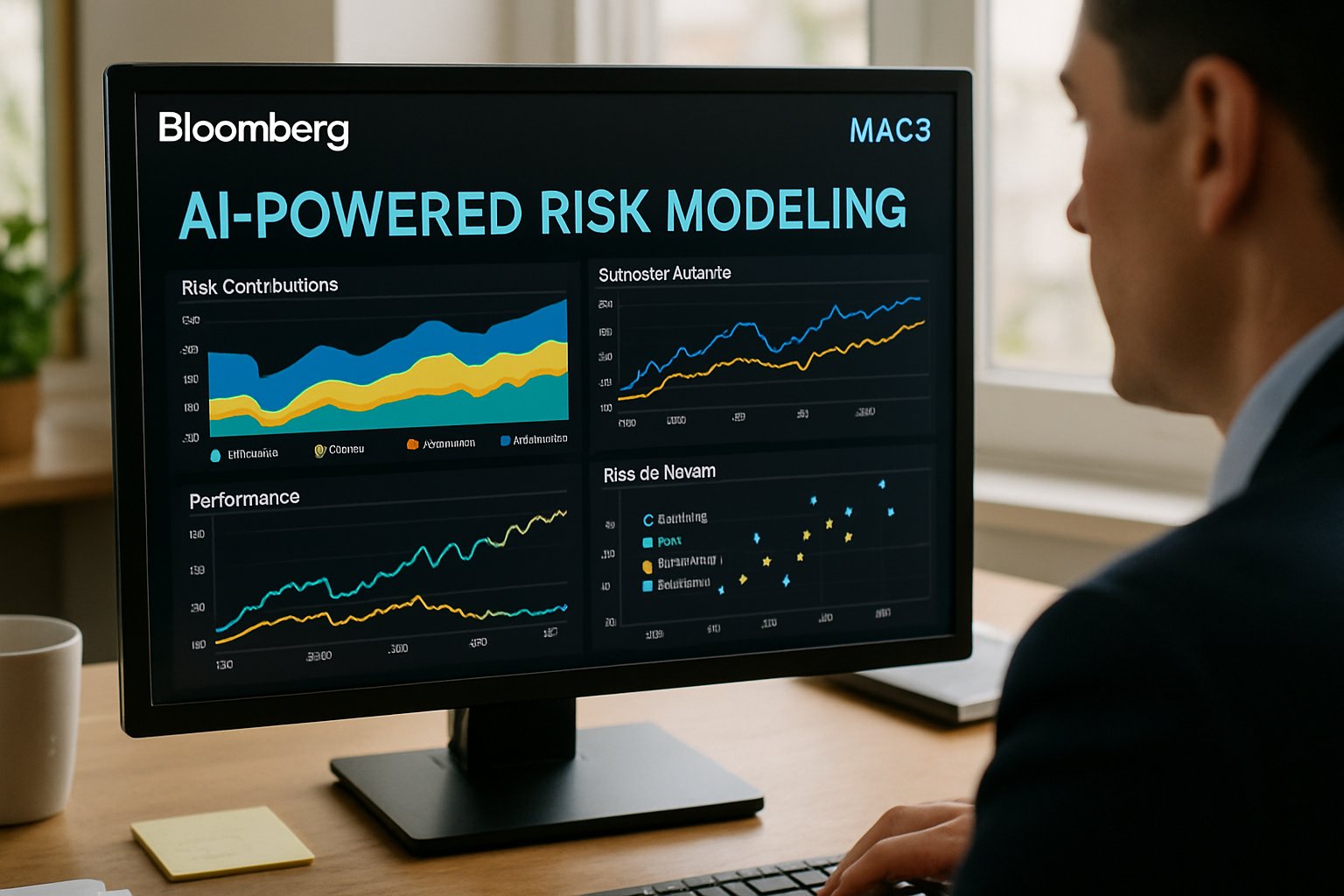
The breakthrough expands three core capabilities:
- Unified factor exposures across public and private assets
- Variance-covariance matrices that integrate alternative betas
- Machine-readable outputs for automated stress testing
These features promise sharper visibility. Nevertheless, valuation issues lurk beneath the surface. The next section examines the scale and architecture supporting the promise.
Model Architecture And Scale
At the heart of the suite sits a vast factor library. Bloomberg discloses more than 3,000 systematic drivers, including 700 equity factors and 1,000 fixed income factors. Moreover, 300 commodity and 340 currency factors appear beside 30 private equity factors. Consequently, multi-asset portfolios receive granular attribution without switching models. Each factor series has six parameter sets covering short and long horizons. Therefore, users can toggle between responsive and stable volatility views during volatile periods.
Data lakes feed the architecture. Trades, evaluations, and corporate actions flow from the Bloomberg Terminal into the calculation engines every night. Meanwhile, private market valuations connect through FIGI identifiers mapped to fund cash flows. Clients may license the MAC3 Risk Model Files service. It delivers exposures, factor returns, and full variance-covariance matrices in CSV or JSON. Consequently, quants integrate the data into in-house optimizers or AI pipelines with minimal friction.
The scale impresses many AI Finance professionals. However, some warn that extensive factor sets can invite overfitting. These concerns lead directly to integration and governance questions discussed next.
Operational Data Integrations Rise
The expansion would falter without clean data ingestion. Therefore, the vendor has fostered an ecosystem of integration partners. On April 8, 2026, Canoe Intelligence announced a certified link that pushes private fund documents directly into PORT Enterprise. Furthermore, Brad Foster highlighted that automation removes hours of manual mapping for each capital call. In contrast, legacy workflows demanded spreadsheets and emailed PDFs. Similar tie-ups with Burgiss extend FIGI tagging across private capital administrators.
Clients report productivity gains. Marshall Wace, an early adopter, cites faster end-of-day position reconciliations when private hedge fund exposures land in the model automatically. Additionally, exposure reports now combine swap books, equity baskets, and real estate partnerships in a single dashboard. Consequently, the chief analytics officer views liquidity buckets and factor shocks in near real time.
Seamless ingestion strengthens the operational case. Nevertheless, model accuracy still depends on appraisal data quality. The validation challenges receive focused attention in the following discussion.
Validation And Caveats Discussed
Independent experts applaud the ambition yet underline persistent limitations. CAIA researchers remind users that private fund net asset values update infrequently. Consequently, appraisal smoothing can understate volatility and correlation. Morningstar analyses label the phenomenon “volatility laundering.” Moreover, thousands of factors raise dimensionality concerns. Overfitting may distort tail estimates when markets shift.
The vendor counters with multi-horizon calibration and transparency. Factor definitions, exposures, and historical returns ship to clients, who can backtest against proprietary metrics. Nevertheless, governance teams must interrogate mapping assumptions, especially for evergreen credit vehicles. Therefore, many institutions run parallel models or apply lag adjustments before feeding model outputs into board reports.
Such scrutiny aligns with AI Finance governance frameworks demanded by regulators. These caveats highlight that technology is necessary but not sufficient. However, disciplined oversight and continuous validation convert model outputs into actionable insight. The strategic payoff emerges next.
Strategic Impact For Portfolios
Allocators crave a single exposure lens across liquid and illiquid sleeves. Consequently, the expanded MAC3 lets investment committees compare hedge fund beta with public factor tilts. Portfolio construction teams can rebalance private commitments when volatility budgets tighten. Moreover, scenario analysis now quantifies how rising rates may hit leveraged real estate and long-duration bonds together.
Firms pursuing advanced analytics in AI Finance also benefit. Machine-readable files power reinforcement learning allocators, while real-time API calls feed dashboard alerts. Additionally, integrated variance-covariance matrices simplify stress simulations across thousands of positions for AI Finance dashboards. Therefore, strategic asset allocation can align volatility budgets to mission objectives rather than siloed asset classes.
Professionals looking to elevate governance skills may consider the Chief AI Officer™ certification. The program teaches cross-asset analytics and leadership for complex data estates.
Unified visibility strengthens decision quality. Nevertheless, competitive forces and pricing pressures shape future evolution, as the final section explores.
Competitive Landscape And Outlook
Bloomberg is not alone in chasing holistic analytics coverage. MSCI Barra, Qontigo Axioma, BlackRock Aladdin, and FactSet compete for enterprise mandates. However, the company wields distribution advantages through its 800-plus client base and ubiquitous Terminal. Moreover, rapid API adoption inside AI Finance workflows cements stickiness. In contrast, rivals often require separate data feeds.
Pricing transparency remains limited across vendors. Therefore, smaller asset managers may struggle to justify full enterprise licenses. Meanwhile, regulators push for model governance disclosures, which could narrow black-box tolerances. Consequently, open factor files may become an industry baseline rather than a differentiator.
Market observers expect further integration of alternative data, climate metrics, and generative AI scenario engines that excite AI Finance leaders. The momentum positions the firm well, yet sustained leadership will depend on methodological clarity and cost alignment.
Competitive dynamics will intensify. Nevertheless, institutions that master cross-asset analytics will capture superior allocation agility.
Bloomberg’s MAC3 update marks a pivotal step for AI Finance. The suite now spans public and private markets, delivering unified factor decomposition, API access, and ecosystem integrations. Moreover, operational gains arise from automated data flows that streamline portfolio reporting. However, appraisal smoothing and factor proliferation introduce model risk that demands vigilant oversight. Independent validation, multi-horizon analysis, and continuous governance remain essential. Consequently, institutions embracing holistic analytics can align strategic allocations with mission goals. Professionals should deepen expertise through recognized programs and stay alert to evolving standards. Act now to embed integrated analytics and secure a competitive edge.


