

AI CERTS
5 hours ago
AI Storage Spotlight: PROMISE Pegasus5 Unveiled at NAB 2026
This article unpacks the announcements, performance claims, market context, and potential pitfalls for professional readers. It also weighs energy considerations and outlines next steps for buyers evaluating on-prem deployment. Along the way, we reference independent research, industry forecasts, and certification pathways that advance professional skill sets. By the end, you will understand where the latest AI Storage gear fits within evolving media pipelines.
NAB Show Launch Highlights
PROMISE used the Las Vegas stage to showcase four Pegasus5 models and two data-center platforms. Additionally, the booth featured live 8K editing on a Mac linked through Thunderbolt-5 at full Bandwidth Boost speeds. Demonstrations clocked the Pegasus5 R12 Pro at roughly 6,000 MB/s, a figure still awaiting third-party validation. Meanwhile, the VTrak 8206 all-NVMe array fed simultaneous AI inference and colour-grading jobs with microsecond-level latency. PROMISE framed the combined lineup as the building blocks of cohesive AI Storage workflows. These headline numbers captivated many editors. The launch narrative tied desktop speed to back-end scalability. Consequently, attention shifted toward client devices powering that desktop tier.
Thunderbolt-5 Client Arrays
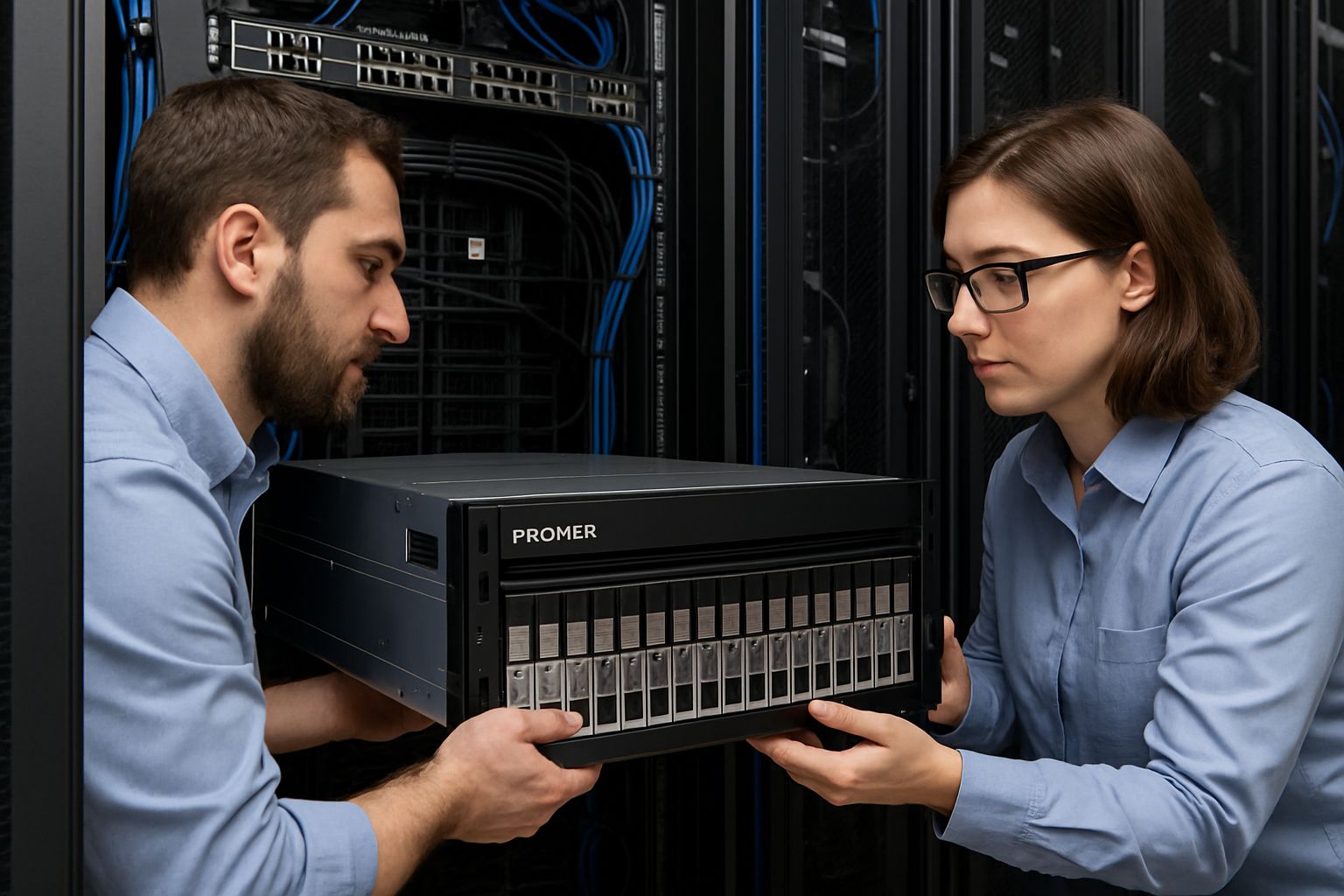
At the client edge, Pegasus5 arrays leverage Thunderbolt-5 to deliver up to 80 Gbps symmetrical bandwidth. Furthermore, Intel’s Bandwidth Boost pushes burst transfers to 120 Gbps when display traffic remains low. Pegasus5 R12 and R12 Pro combine 12 hard drives and four NVMe sticks for hybrid scratch performance. In contrast, the compact M8 and N4 rely solely on NVMe, targeting mobile crews on set.
Adobe Premiere and DaVinci plugins can tap that throughput for GPU-accelerated AI plug-ins without shuffling data to cloud. Such gains underpin the broader AI Storage pitch directed at creative teams. Client arrays now rival older SAN speeds while remaining airline-carry compliant. However, true scalability emerges only when server tiers complement these deskside rockets.
Server Side Innovations
PROMISE answered that challenge with the VTrak 8206 and Vess A8340 platforms. Both systems integrate flash drives, multi-GPU options, and NVMe-over-Fabrics connectivity for shared low-latency access. Moreover, the architecture aligns with NVIDIA GPUDirect, reducing CPU copies and boosting GPU utilization rates. Vendor case studies, such as WEKA’s Stability AI report, suggest utilisation can exceed 90 percent under similar designs. Nevertheless, independent benchmarking like MLPerf Storage remains absent for these exact models. Still, PROMISE positions the stack as an AI Storage backbone for inference, tagging, and indexing tasks. Server updates complete the promised desktop-to-data-center continuum. Subsequently, the discussion shifts to software that stitches these layers together.
Workflow Plugin Impact
The new Adobe UXP plug-in exposes drive temperature, fan speed, and throughput directly inside Premiere panels. Consequently, editors avoid switching windows during deadline turbulence. Real-time alerts can pre-empt footage loss by flagging disk errors before catastrophic failure. Additionally, health metrics feed the vendor cloud portal for fleet-wide analytics. Early testers reported fewer dropped frames when scratch performance stayed visible. Therefore, even modest UX tweaks strengthen the AI Storage narrative by tightening feedback loops. Better visibility translates into measurable productivity. Next, we examine macro forces influencing purchase timelines.
Market Forces Shaping Adoption
Analyst firm Mordor Intelligence values the AI-powered storage sector at USD 27.06 billion this year. Moreover, forecasts project a 23 percent CAGR, reaching roughly USD 76 billion by 2030. Cloud economics complicate things; Backblaze surveys reveal widespread surprise egress fees among media houses. As a result, hybrid or on-prem models using Pegasus5 and server gear gain appeal. Energy costs also loom large, with IEA predicting data-centre electricity demand could double by 2030. Professionals can enhance expertise with the AI Data Robotics™ certification to navigate these trade-offs. Collectively, these dynamics accelerate enterprise interest in pragmatic AI Storage investments.
- Mordor predicts 23% CAGR for AI-powered storage through 2030.
- Thunderbolt-5 enables 80 Gbps baseline and 120 Gbps burst bandwidth.
- Pegasus5 R12 Pro demo reached 6,000 MB/s during 8K editing.
The numbers show momentum but highlight cost pressure. Accordingly, risk factors deserve equal scrutiny.
Risks And Key Considerations
High performance seldom arrives free of complications. Firstly, dense NVMe and GPU nodes raise rack-level power and cooling requirements. IEA modelling warns of significant carbon impact if efficiency lags deployment pace. Secondly, NVMe-oF and GPUDirect demand specialised skills, stretching lean IT teams. Thirdly, vendor claims, including PROMISE throughput figures, still lack independent MLPerf confirmation. Nevertheless, early pilots indicate real gains when workloads align with design assumptions.
Finally, ransomware remains an ever-present threat; immutable snapshots and air-gapped backups remain essential. Therefore, buyers should request detailed security roadmaps alongside AI Storage quotes. These risks underscore due-diligence imperatives. Next, we distil practical next steps for decision makers.
Strategic Takeaways For Buyers
Begin with workload profiling to quantify bottlenecks before chasing headline speeds. Furthermore, demand transparent test methodology when vendors cite megabytes-per-second achievements. Compare on-prem TCO against cloud, factoring egress and energy over five years. Subsequently, pilot client units on real projects to validate AI Storage benefits. Scale toward NVMe server tiers only after client gains justify expansion. Engage facilities teams early to model power, thermal, and floor-space constraints. Finally, invest in staff training and certifications to manage NVMe-oF and security controls competently. These actions create an informed roadmap.
PROMISE’s NAB rollout illustrates how fast client hardware and scalable back-end designs are converging. Moreover, AI Storage has shifted from buzzword to concrete workflow accelerator. Performance gains appear real, yet validation and sustainability auditing remain critical. Consequently, organisations should pair pilot testing with power and security assessments. Professionals pursuing deeper mastery can revisit the earlier linked certification for structured learning. Act now, gather metrics, and let data, not hype, steer the next investment cycle. Nevertheless, do not overlook cultural change; editors and engineers must align on process updates. With rigorous planning, the promised speed can translate into measurable creative freedom and financial return.


