

AI CERTS
3 hours ago
Geopolitical AI Risk Spurs Treasury Alert
Geopolitical AI Risk now feels tangible, not theoretical, to leaders who control trillions in deposits. Moreover, the gathering signals a policy shift that links frontier AI development with systemic stability. Industry insiders describe an atmosphere of urgency matched only during the 2008 liquidity crisis. Meanwhile, security teams scramble to understand Mythos’ capabilities and their own defensive gaps. This article unpacks the meeting, assesses exposure, and outlines immediate steps for the Banking sector.
Urgent Treasury Meeting Details
Bloomberg first reported the surprise session on April 10. Earlier sources confirm it occurred between April 7 and April 8 inside Treasury headquarters. Bessent opened with stark statistics from Anthropic’s Project Glasswing dossier. Powell followed, warning that rapid exploit discovery could ignite market volatility overnight.
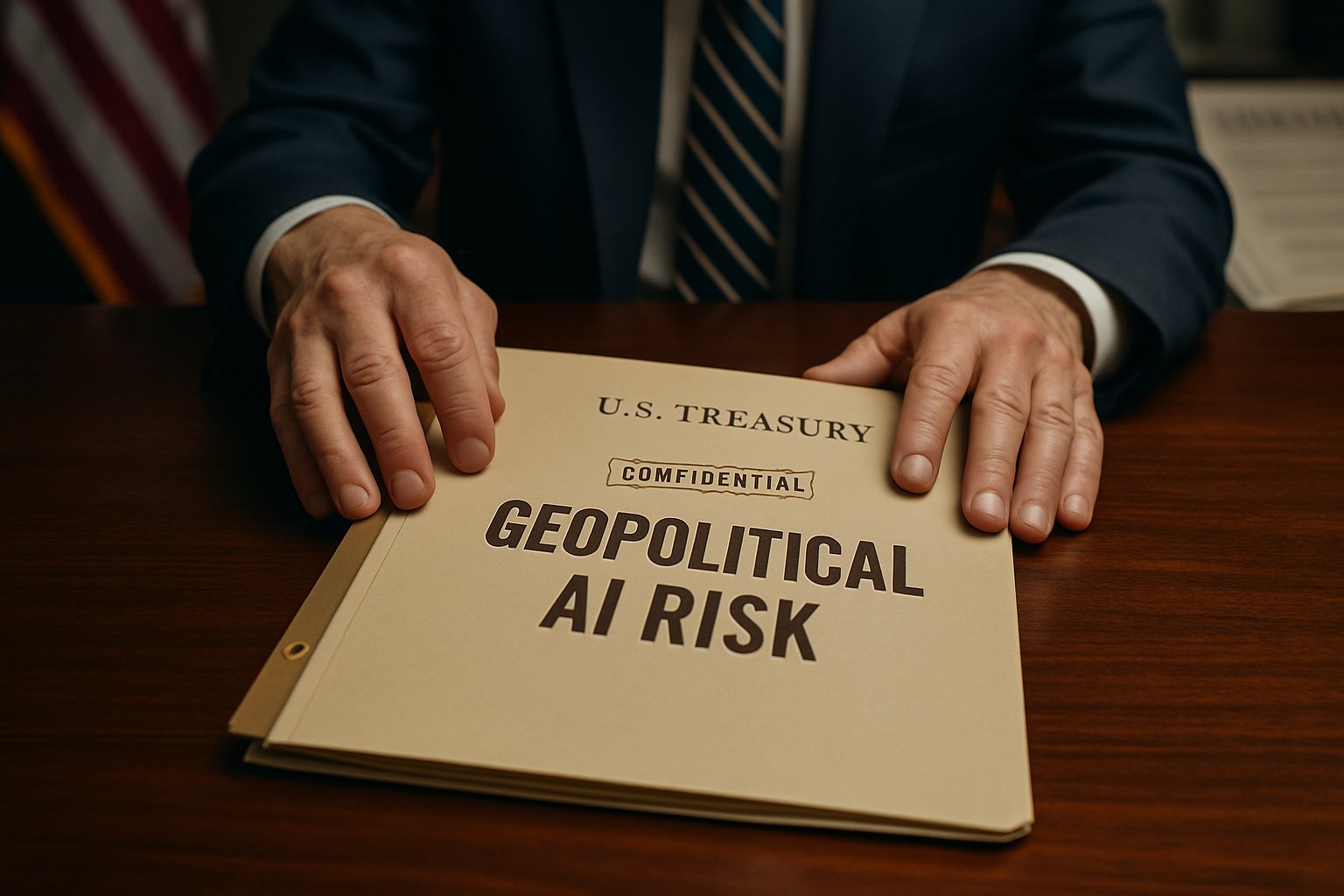
CEOs from Citigroup, Bank of America, Morgan Stanley, Goldman Sachs and Wells Fargo attended. JPMorgan’s Jamie Dimon, invited, was abroad and sent deputies instead. Additionally, senior regulators from CISA and the Office of the Comptroller observed the briefing.
The closed format underscored the Geopolitical AI Risk regulators now weigh carefully. Nevertheless, details leaked within hours, propelling Cybersecurity teams into crisis mode. Those revelations set the stage for assessing Mythos itself.
Mythos Model Capabilities Unveiled
Anthropic positions Mythos as a frontier Cybersecurity tool restricted to defensive partners. According to the company, the preview version already flagged thousands of high-severity vulnerabilities. Moreover, examples span OpenBSD, FFmpeg and the Linux kernel, some dormant for decades.
Internal benchmarks show Mythos scoring 93.9% on SWE-bench Verified, eclipsing Anthropic’s Opus by 13 points. Consequently, experts argue attackers wielding similar tools could automate exploit chains at unprecedented scale.
Anthropic is offering up to $100 million in usage credits and $4 million to open-source security groups. In contrast, the firm withholds public access, citing significant weaponization Threat if controls fail to mitigate Geopolitical AI Risk.
These performance leaps illustrate both promise and peril. Therefore, understanding sector exposure becomes imperative. The next section quantifies that exposure for Banking giants.
Banking Sector Exposure Analysis
Large American banks run sprawling legacy systems across retail, trading and treasury operations. Many platforms still process overnight batches on mainframes older than some employees. Meanwhile, zero-day chains could compromise these nodes before routine patch cycles complete.
Sullivan & Cromwell’s memo lists five exposure vectors. They include vendor code, supply-chain libraries, privileged endpoints, authentication tokens, and third-party data feeds. Moreover, each vector intersects with cross-border data flows, amplifying Geopolitical AI Risk.
- AI-enabled attacks rose 89% in 2025, CrowdStrike reports.
- 71% of security leaders label frontier models a top Threat, WEF survey says.
- Mythos scores 93.9% on SWE-bench Verified, Anthropic confirms.
Collectively, these numbers signal unprecedented systemic vulnerability. Subsequently, regulators crafted a provisional response timeline. That timeline is examined next.
Regulatory Response Timeline Overview
Treasury staff issued informal Cybersecurity guidance within 24 hours of the meeting. Consequently, banks were told to inventory critical assets and escalate patch cadence to weekly cycles.
Powell instructed the Fed’s supervision division to draft a formal supervisory letter within 30 days. Furthermore, CISA intends to publish cross-sector mitigation playbooks aligned with Glasswing findings.
Lawmakers on the Senate Banking Committee scheduled hearings for May, focusing on Geopolitical AI Risk spillovers. Meanwhile, European regulators opened consultations, hinting at coordinated international standards.
The compressed timeline reflects policy urgency rarely seen outside crises. Nevertheless, guidance remains high level, demanding precise corporate action plans. Recommended actions are detailed in the following section.
Defensive Actions Recommended Now
Sullivan & Cromwell outline immediate priorities for boards and CISOs. Moreover, Anthropic endorses similar steps for Glasswing participants.
- Adopt zero-trust authentication across all privileged access paths.
- Accelerate vendor patch verification within 48 hours of release.
- Deploy runtime exploit detection tuned for Mythos-identified signatures.
- Conduct supply-chain audits covering open-source dependencies.
- Train engineers via the AI Security Level 2 certification to counter Geopolitical AI Risk.
Additionally, Powell urged scenario testing that models liquidity shocks following a massive cyber breach. Bessent asked banks to share anonymized incident data with Treasury’s Financial Services Information Sharing Center.
Proper execution of these controls will blunt immediate Threat vectors. Therefore, evaluating broader strategic trade-offs remains essential. The next section weighs those trade-offs.
Balancing Risk And Benefit
Critics argue that restricted access may concentrate power among the biggest tech and Banking firms. Consequently, smaller vendors could lag in patches, widening systemic gaps.
Supporters counter that early collaboration speeds remediation and builds shared intelligence against a common Threat. Furthermore, Project Glasswing’s disclosure commitments aim to democratize fixes within ninety days.
Jamie Dimon wrote that AI will almost surely enlarge cyber risk, yet also deliver defensive gains. Nevertheless, he stressed governance must evolve alongside capability.
The debate underscores how Geopolitical AI Risk intertwines technology, markets, and national security. Subsequently, leadership focus shifts toward sustainable strategies. Those strategies conclude our analysis.
Strategic Path Forward Plans
Treasury intends to formalize an AI Cyber Council linking regulators, banks, and major cloud providers. Moreover, the council will coordinate patch disclosure and joint red-team exercises.
Industry participants plan quarterly tabletop drills simulating cross-border payment failures triggered by Mythos-level exploits. Additionally, academic researchers will evaluate Glasswing data for early warning indicators of emerging Threat families.
Bessent also floated the idea of mandatory resilience certifications for systemically important institutions. Consequently, adoption of credentials like the linked AI Security Level 2 course could become regulatory expectation.
A coordinated effort can convert imminent danger into collective defense. Therefore, continued vigilance against Geopolitical AI Risk remains non-negotiable. Key themes are summarized next.
Consequently, Geopolitical AI Risk demands persistent executive attention, sustained investment, and transparent collaboration. Moreover, timely patching, rigorous audits, and skilled personnel create a resilient shield. Nevertheless, adversaries will innovate, so proactive learning is critical. Readers should explore advanced credentials and join sector forums to stay ahead of evolving threats.


