

AI CERTs
2 months ago
Education Future Risk: When AI Professors Lead College Courses
A charismatic lecturer appears on screen, yet behind the avatar no human stands at the podium. Instead, a large language model streams real-time explanations to postgraduate designers in Hong Kong. Similar scenes unfold in Singapore and Moscow, signaling a seismic turn for higher instruction. Consequently, administrators worldwide debate whether artificial professors mark an inevitable evolution or a perilous gamble. This discussion sits at the core of Education Future Risk, a concept now gripping campus boardrooms. Moreover, market analysts forecast billions in new spending on instructional AI during the next decade. Faculty unions, in contrast, warn that rushed deployments could erode trust, equity, and academic integrity. Amid these cross-currents, University leaders seek evidence, policies, and certifications that balance innovation with prudence. The following report dissects technical pilots, market trajectories, benefits, and hazards to inform strategic decisions. Furthermore, each section flows toward actionable guidance, ensuring busy stakeholders grasp the stakes in minutes.
Global AI Course Pilots
HKUST shocked Asia’s lecture halls in Spring 2024 by launching ten avatar lecturers for Social Media for Creatives. Initially, each avatar combined Midjourney artwork, facial animation software, and ChatGPT dialogue to co-teach specific modules. Meanwhile, surveys showed students appreciated 24/7 Q&A access, yet still valued human mentoring from Prof. Pan Hui. Nanyang Technological University followed soon after, unveiling a Retrieval-Augmented Generation chatbot, Professor Leodar, tailored for local idioms. Moreover, an arXiv study dated 12 June 2024 reported 97.1% positive experience among participants. Skolkovo School of Management raised eyebrows in summer 2025 by letting a text bot named Robert become sole instructor. Consequently, the AI-taught cohort outperformed a traditional control group, though a human mediator supervised logistics. These pilots illustrate rapid escalation from teaching assistants toward autonomous professors, intensifying Education Future Risk debates. Therefore, evidence from small samples now informs boardroom forecasts and investor slide decks.
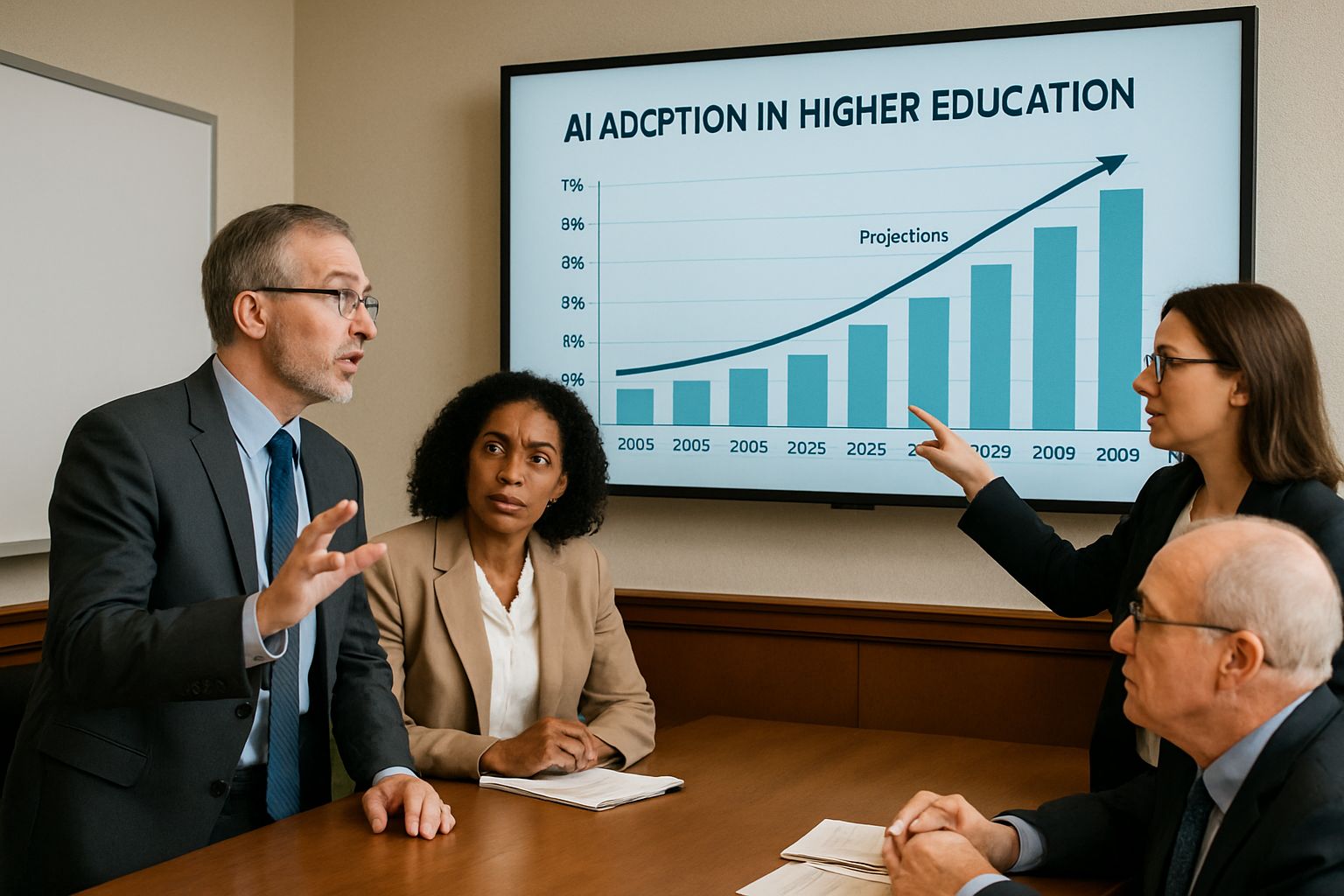
Pilot results look promising but remain narrow in scope. However, scaling them globally will demand rigorous validation, a point explored in the next section.
Market Growth Signals Opportunity
Analysts at Grand View Research estimate the AI education market at USD 5.88 billion in 2024. Moreover, they project expansion to roughly USD 32.27 billion by 2030, implying a 31.2% CAGR. Consequently, venture capital flows toward avatar platforms, LLM orchestration stacks, and integration consultancies. University procurement teams, however, face volatile vendor forecasts and sparse interoperability standards. In contrast, some administrators negotiate shorter contracts, reducing lock-in risk while measuring real outcomes. Additionally, workforce planners ask whether AI instructors could alleviate regional Educator shortages and stabilize tuition costs. These fiscal questions intertwine with Education Future Risk scoring models used by boards and credit analysts.
The money is real, yet projections hide uncertainty. Therefore, leaders need balanced metrics before approving large commitments, as the following benefits section explains.
Benefits Enhance Teaching Scale
Proponents argue AI professors boost access, personalization, and engagement simultaneously. Sal Khan therefore positions Khanmigo as an amplifier that releases human teachers for deeper mentoring. Similarly, HKUST students received instant explanation videos and multilingual summaries on demand. Moreover, Nanyang’s Professor Leodar grounded answers in course documents through RAG, reducing hallucination frequency.
Early data suggest several advantages:
- 24/7 availability improves revision flexibility for working students.
- Adaptive pacing tailors difficulty, boosting Learning confidence.
- Immediate feedback shortens misconception cycles during coding or design tasks.
Consequently, some Digital campus strategies treat AI lecturers as the only viable way to serve massive enrollments. These upsides, nevertheless, must be weighed against Education Future Risk indicators detailed in the next section.
Risks Challenge Academic Integrity
Critics warn that large language models still hallucinate, fabricating citations or misquoting seminal papers. In contrast, RAG helps, yet not all implementations retrieve authoritative sources. Furthermore, OECD TALIS 2024 shows almost 70% of teachers fear plagiarism escalation. Equity also suffers when only wealthy institutions can license premium transformer models and GPU clusters. Additionally, Digital surveillance tools often accompany AI delivery, raising privacy concerns among advocacy groups. Legal scholars ask who becomes liable if an algorithmic professor dispenses harmful lab advice. Therefore, universities now run AI audits, model version control, and kill-switch procedures before semester launch. Education Future Risk ratings incorporate these liabilities, helping trustees visualize aggregate exposure. Nevertheless, no global accreditation rubric yet certifies full AI-led instruction as compliant.
Risks span accuracy, fairness, security, and regulation. Subsequently, policy discussions accelerate, examined in the next section.
Policy Landscape Rapidly Shifts
UNESCO guidelines urge transparency, consent, accessibility, and human oversight for generative education systems. Meanwhile, country statutes diverge; Singapore funds sandbox pilots, whereas France restricts automated grading weights. Consequently, multi-national Universities must navigate overlapping privacy regimes when hosting cloud inference across borders. Additionally, many campuses moved from blanket bans to course-level disclosure frameworks during 2023–2025. Boards frequently reference Education Future Risk dashboards that merge compliance gaps with market signals. Therefore, aligning procurement, pedagogy, and accreditation early reduces surprise audits later.
Regulators are moving, but not in unison. Consequently, strategic guidance becomes urgent, prompting the leadership playbook described next.
Strategic Actions For Leaders
Effective governance starts with a multidisciplinary steering committee including CIO, provost, risk officer, and student representatives. Moreover, procurement teams should demand model cards, bias audits, and uptime guarantees from vendors. Institutional research units can run controlled A/B evaluations before campus-wide rollouts. In contrast, skipping pilots increases Education Future Risk by obscuring flaws until finals week. Additionally, faculty should pursue continuous upskilling. Professionals can enhance mastery with the AI Educator™ certification endorsed by industry groups. University HR departments may subsidize that credential, thereby aligning hiring rubrics with emerging Digital instruction norms. Finally, transparent communication frameworks keep students informed about data use and complaint channels.
Proactive measures cut cost overruns and reputational damage. Subsequently, the concluding section synthesizes insights for next steps.
Future Outlook And Action
Higher education stands at a hinge moment. Nevertheless, evidence so far hints that AI professors can widen access without erasing human guidance. Ongoing pilots should expand into randomized, multi-site trials capturing Learning retention, equity, and employability impacts. Consequently, boards must revisit Education Future Risk metrics each semester, adjusting thresholds as data mature. Moreover, every Educator who experiments with generative tools should document model settings and student feedback transparently. National agencies can, therefore, harmonize audit checklists, mitigating cross-border Education Future Risk in joint degrees. Finally, sustained faculty development will weave Digital literacy, Learning science, and ethics into everyday practice. Stakeholders ready to lead can start today by evaluating campus pilots and pursuing respected credentials. Explore the linked AI Educator™ certification and shape tomorrow’s classrooms with informed confidence. Your next initiative could reduce Education Future Risk while unlocking personalized pathways for millions.
Disclaimer: Some content may be AI-generated or assisted and is provided ‘as is’ for informational purposes only, without warranties of accuracy or completeness, and does not imply endorsement or affiliation.


