

AI CERTS
2 months ago
AI Agent Sandboxes Strengthen Docker–NanoClaw Security Alliance
Therefore, DevOps leaders now prioritize micro-segmentation, blast-radius reduction, and transparent codebases. The emerging stack pairs NanoClaw’s small footprint with Docker Sandboxes’ MicroVM boundary to meet those goals. Meanwhile, the partnership provides a reference design that blends safety, containers simplicity, and familiar deployment workflows.
This article unpacks the alliance, examines tradeoffs, and delivers actionable guidance for production Infrastructure teams. Moreover, readers will discover how to bolster governance with the linked AI Security Level-1 certification.
Why Isolation Matters Today
Modern agents fetch code, compile binaries, and interact with cloud secrets without human review. In contrast, traditional application sandboxes expected predictable workloads rather than self-modifying logic. Consequently, containment boundaries must assume hostile binaries and unpredictable network calls. Therefore, AI Agent Sandboxes enforce per-agent MicroVMs that reset state after each run.
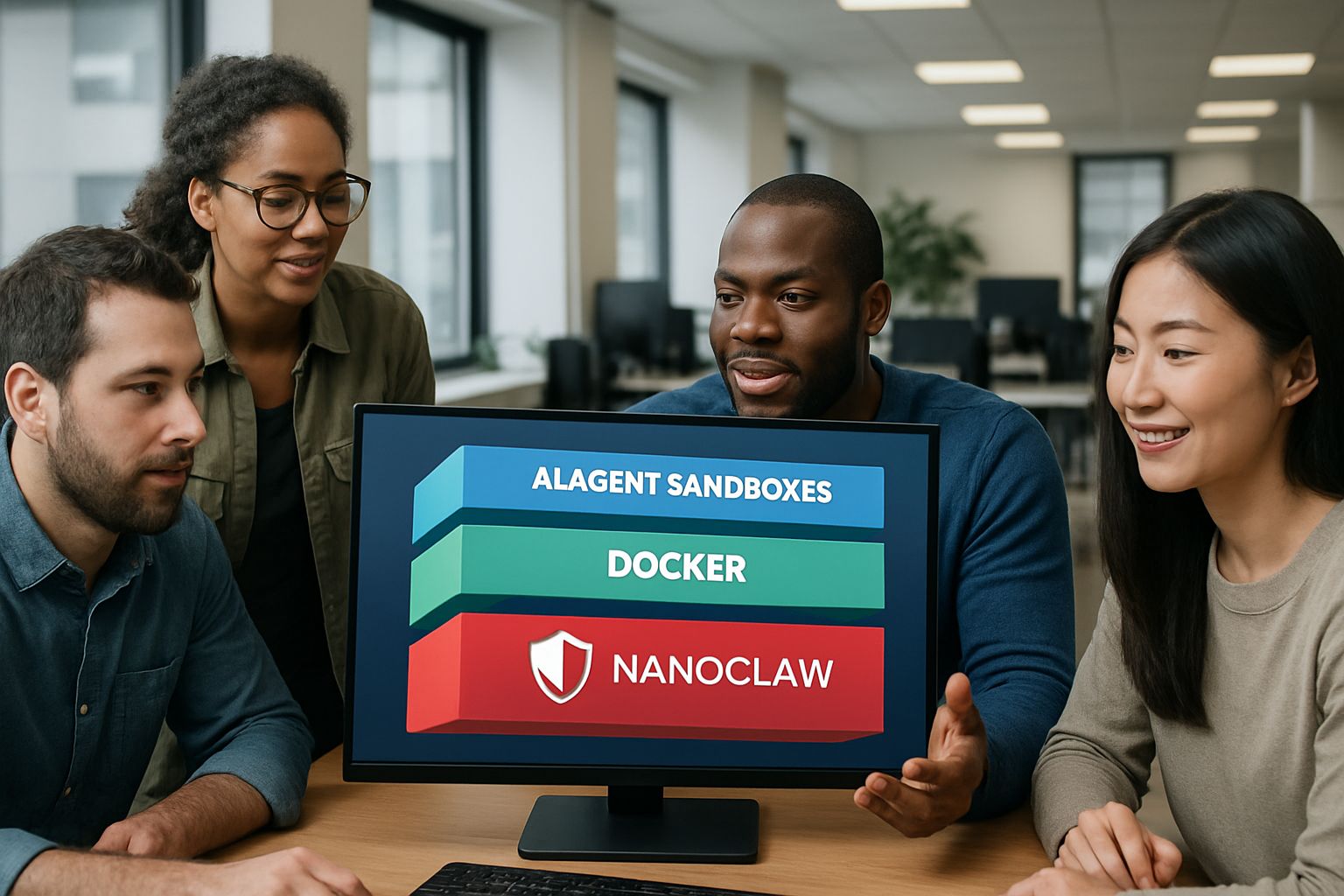
Isolation also simplifies compliance audits. Auditors examine the MicroVM template once, then trust disposable clones spun per task. Moreover, smaller trusted code reduces the surface area that audit teams must model. DevOps pipelines can then promote agent builds through environments without rewriting segregation policies.
Stronger isolation shrinks blast radius and accelerates compliance sign-off. However, technology partnerships determine whether those gains reach production.
Docker And NanoClaw Alliance
Docker released Sandboxes in 2025 to wrap containers with MicroVM defense hardening. Subsequently, NanoClaw integrated the feature on March 13, 2026, after community testing. Mark Cavage stated, “Infrastructure needs to catch up to the intelligence of agents.” The alliance positions NanoClaw as a secure-by-design agent runner built for enterprise Infrastructure.
NanoClaw already launched within classic containers, yet MicroVMs strengthen kernel boundaries on shared hosts. Furthermore, Docker’s credential proxy keeps API secrets outside the sandbox, limiting theft vectors. This separation strengthens overall security posture. GitHub statistics show 23.3k stars, reflecting community traction. Consequently, vendors and consultants now reference the stack as a baseline pattern for regulated workloads.
The partnership blends maturity, popularity, and hardened runtime guarantees. Next, we explore why the market demanded such guarantees after February’s security shock.
Responding To Recent Vulnerabilities
OpenClaw dominated early autonomous agent adoption. Nevertheless, CVE-2026-25253 exposed token theft routes that enabled one-click remote code execution. SentinelOne rated the flaw critical and advised immediate patching and token rotation. Exposure scans found between seventeen and thirty thousand accessible OpenClaw instances online.
Consequently, board-level discussions questioned shared-process agent models. Researchers like Ry Walker argued that Containers alone cannot guarantee host protection without extra isolation. Therefore, AI Agent Sandboxes gained attention as a pragmatic containment upgrade available today. Safety leaders also stressed defense-in-depth; sandboxes help but do not protect compromised credentials.
High-impact exploits reframed isolation from optional to mandatory. Accordingly, architecture decisions now prioritize sandbox adoption over plugin variety.
Architectural Design And Tradeoffs
NanoClaw embraces a minimal codebase that handles orchestration while delegating isolation to Docker. In contrast, OpenClaw embedded policy engines, GUI layers, and extensive connectors. Moreover, fewer moving parts allow faster audits and simpler threat modeling for response teams. However, feature-hungry teams may miss convenient plugins available in heavier frameworks.
Resource usage also shifts. MicroVMs consume more memory than pure Containers, raising scheduling and cost considerations in dense clusters. DevOps engineers must benchmark workloads and tune sandbox lifecycles to maintain node efficiency. Nevertheless, most enterprises accept higher overhead in exchange for reduced blast radius.
Infrastructure integration remains straightforward because Sandboxes inherit Docker networking and volume semantics. Consequently, existing CI pipelines require minor tweaks rather than full rewrites.
Tradeoffs revolve around memory, plugin breadth, and operational muscle. The following guidance helps teams assess those variables systematically.
Operational Guidance For Enterprises
Start by cataloging every agent workload, including runtime privileges and network destinations. Subsequently, group agents by trust level and schedule them in separate AI Agent Sandboxes definitions. Attach read-only volumes where possible, and use Docker’s credential proxy for secrets. Furthermore, patch OpenClaw remnants to version 2026.1.29 or retire them entirely.
- Rotate all API tokens and validate outbound URLs before enabling autonomy.
- Enable audit logging at the MicroVM boundary to satisfy Security operations.
- Scale clusters incrementally while measuring Containers density and memory headroom.
- Deepen skills via the AI Security Level-1™ certification to govern sandbox policy.
Additionally, implement automated cleanup jobs that delete MicroVM snapshots after tasks complete. In contrast, lingering VMs waste memory and blur audit timelines.
Following these steps embeds sandbox hygiene into daily DevOps routines. Finally, we consider the roadmap influencing future adoption.
Future Outlook And Questions
Analysts expect broader container platforms to ship native MicroVM options during 2027. Meanwhile, cloud providers experiment with per-function isolation that could rival AI Agent Sandboxes performance. Docker may publish telemetry demonstrating real-world overhead, calming budget fears. Moreover, independent audits will likely certify NanoClaw stacks against recognized frameworks such as SOC 2.
Governance boards will also demand standardized training. Professionals can prepare through the earlier AI Security Level-1™ program, aligning skills with risk mandates. Nevertheless, no single control neutralizes every threat; layered defenses must remain. Therefore, Infrastructure architects should continue monitoring advisories and updating sandbox images regularly.
Upcoming innovations promise faster boot times and smarter credential isolation. Those enhancements will further cement AI Agent Sandboxes as a mainstream pattern.
Final Thoughts
In summary, AI Agent Sandboxes deliver practical containment without abandoning familiar Docker workflows. Consequently, DevOps teams can pursue autonomous goals while satisfying auditors and risk executives. Moreover, AI Agent Sandboxes mitigate blast radius by destroying each MicroVM after execution. Nevertheless, governance still requires patch management, code reviews, and strict credential hygiene.
Organizations should track performance metrics and iterate sandbox sizing to balance cost with resilience. Professionals seeking deeper expertise should pursue the AI Security Level-1™ credential. Moreover, AI Agent Sandboxes adoption signals a cultural shift toward secure autonomy across Infrastructure stacks. Adopt AI Agent Sandboxes today and share your field findings with the community.
Disclaimer: Some content may be AI-generated or assisted and is provided ‘as is’ for informational purposes only, without warranties of accuracy or completeness, and does not imply endorsement or affiliation.


