

AI CERTS
2 months ago
Taiga Electric AI Launches Nomad Snowmobile Into Mass Market
Sub-zero winds whip across Quebec’s Laurentians, yet a low-whine powertrain replaces the usual two-stroke roar. That sound signals the Nomad, the latest electric snowmobile from Montreal-based Taiga Motors, finally shipping worldwide. Industry watchers call the milestone the first credible mass-market push for battery propulsion on winter trails. This story examines how Taiga Electric AI underpins the launch, the engineering breakthroughs, and the unresolved business risks. Moreover, we trace the company’s dramatic restructuring, new ownership, and capacity plans that promise up to 8,000 vehicles annually. Consequently, investors, fleet operators, and rival OEMs must reassess timelines for widespread mountain Electrification. The analysis blends company statements, independent reporting, and market data to provide a balanced, technical perspective. Readers will also find professional development resources, including the linked certification that supports strategic AI project leadership.
Restructuring Sets New Stage
Taiga nearly collapsed in 2024 after heavy net losses and a mid-season production pause. Nevertheless, UK marine electrification entrepreneur Stewart Wilkinson acquired the assets and injected fresh capital. Subsequently, the Quebec court approved the deal, allowing Taiga to exit creditor protection in October 2024. May 2025 saw operations restart; the Orca personal watercraft rolled off the Montreal line within weeks. Furthermore, executives pledged to resume Nomad Taiga Electric AI production that autumn, targeting international deliveries before year-end. By 5 November 2025, the promise materialised as export units left Montreal for Scandinavia, Alaska, and Hokkaido.
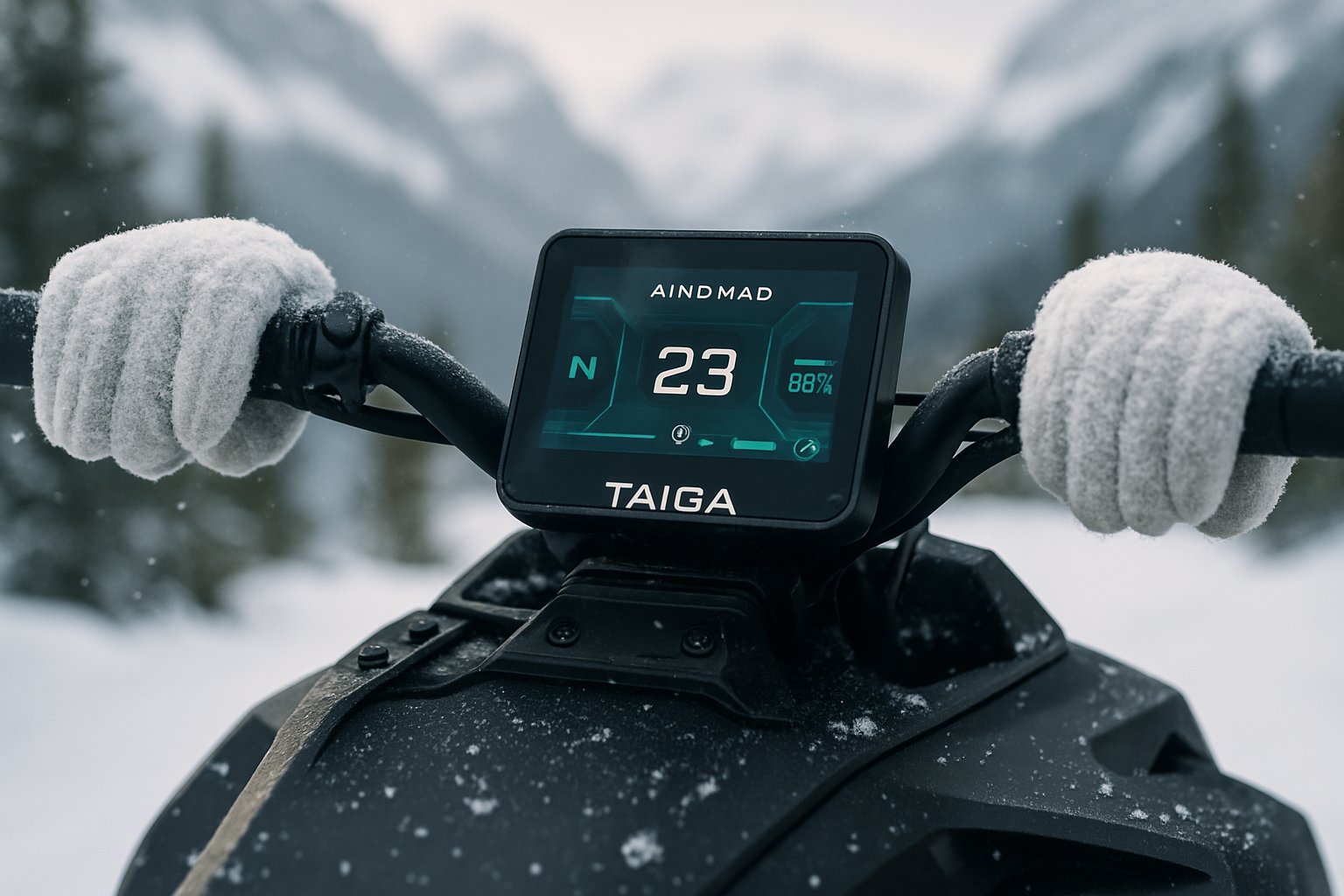
Taiga’s survival hinged on timely capital and decisive legal action. Consequently, production momentum set the scene for technical advances. Meanwhile, engineers tackled cold-weather limitations that previously hindered electric sled adoption.
Technology Tackles Arctic Limits
Extreme cold drains battery capacity and thick snow demands bursts of torque. Therefore, the 2026 Nomad introduces an integrated Tractive Unit combining inverter and interior permanent magnet motor. Taiga claims 15 percent thermal efficiency gains from redesigned stator windings and a fused cooling panel under the battery. Additionally, over-the-air software now offers Custom Drive Modes that tweak throttle response for trail, utility, or sport settings. Nomad packs roughly 67 kW, matching many two-stroke sleds, while range tops out near 100 kilometres. However, real-world endurance still depends on rider aggression, snow density, and elevation climb.
- Integrated motor-inverter reduces cabling losses
- Fused cooling panel stabilises cell temperature
- OTA firmware enables drive-mode updates
Collectively, these advances form the Taiga Electric AI stack that unites hardware telemetry with predictive control algorithms. Hardware and software interplay address historical cold-weather pain points. Nevertheless, scaling production introduces separate hurdles that extend beyond design tweaks. The next section assesses manufacturing capacity and supply chain realities.
Production Capacity And Challenges
Current Montreal capacity peaks at 8,000 combined units yearly across watercraft and snowmobiles. Consequently, weekly throughput would need to triple to rival incumbent sled volumes from BRP or Polaris. In contrast, Taiga produced just 1,056 vehicles during 2023, selling 592 and absorbing a CAD 72.5 million loss. Moreover, supply chain tightness for lithium cells and power electronics remains a global constraint. Matthew Taylor, vice-president operations, credits dedicated staff for the rapid restart but declines to disclose current run rates. Analysts warn that Mass production promises carry risk until quarterly filings confirm sustained output. Therefore, the wider ramp strategy internally called Taiga Electric AI Phase Two prioritizes supplier contracts and robotics.
- 2023 production: 1,056 units
- Plant target: 8,000 units annually
- Nomad deliveries began: November 2025
Meanwhile, dealer coverage along key trail Road corridors still lags, limiting service response for remote owners. Sustained Taiga Electric AI output must therefore align with spare-parts logistics, charging partnerships, and trained technicians. Capacity goals appear achievable on paper. Consequently, competitive pressure heightens as incumbents unveil electric alternatives. The following section compares market players and customer uptake.
Competitive Landscape Quickly Intensifies
BRP launched Ski-Doo and Lynx electric models aimed at resort fleets during 2024. Polaris also experiments with battery sled prototypes while promoting accessory charging stations for groomed trail networks. In contrast, Taiga pursues direct international sales plus early partnerships with SkiStar and Scandinavian tour operators. Market researchers value the entire Snowmobile sector at roughly USD 2 billion, yet electric share remains single-digit millions. Nevertheless, growth forecasts exceed 30 percent annually as regulators tighten emissions and resorts chase quieter machines.
Market Size Forecasts Diverge
Some reports assume rapid fleet conversions, while others predict steady, hobbyist-led adoption over a longer Road map. Therefore, scenario planning proves difficult for suppliers planning cell procurement and winter-grade lubricant production. Scenario models often rely on Taiga Electric AI cost curves to estimate price parity timing. Observers note that Taiga Electric AI still holds a first-mover branding edge among digital native riders. Competitors recognise noise and emissions advantages, accelerating their own roadmaps. Meanwhile, customer value hinges on lifetime economics, not launch publicity. The next subsection explores fleet cost dynamics.
Fleet Economics And Adoption
Resort patrols ride short, repeatable routes, aligning perfectly with 100 kilometre battery range. Additionally, EV drivetrains cut oil changes, belt replacements, and two-stroke tuning. Consequently, SkiStar cites maintenance savings of up to 40 percent across pilot Nomad units. Lower noise also improves guest experience and supports evening grooming near lodges. Professionals can enhance their expertise with the AI Project Manager™ certification. Such training helps teams integrate Taiga Electric AI telemetry dashboards into enterprise asset management platforms. However, upfront purchase price still deters many independent guides despite long-term fuel savings.
Fleet math favours electrics in structured operations. Nevertheless, retail enthusiasts remain cautious until charging infrastructure matures. Validation requirements close our analysis.
Future Steps For Validation
Independent cold-soak tests must verify battery resilience after overnight parking at minus 30 Celsius. Moreover, third-party telematics should confirm promised efficiency gains during steep, powder-heavy ascents. Taiga has not yet released cumulative delivery figures or quarterly production rates for 2026. Until auditors examine Taiga Electric AI inventory logs, investors will treat capacity claims cautiously. Road-side fast chargers for trailers also lag, complicating backcountry tour planning.
Transparent data, robust service networks, and rural charging form the remaining puzzle pieces. Consequently, mass acceptance depends on closing those gaps.
Taiga crossed a vital threshold by shipping the 2026 Nomad abroad, yet the journey is only beginning. Furthermore, resilient supply chains, verified performance data, and stronger dealership coverage must converge before true Mass adoption emerges. Incumbents will intensify Electrification programs while regulators tighten emissions, expanding the addressable Snowmobile customer base.
Nevertheless, Taiga Electric AI retains a technological head start if it can scale responsibly and publish transparent numbers. Readers seeking strategic advantage should explore the linked certification and follow our ongoing coverage of electric off-Road innovation. Consequently, the next six months will reveal whether production volumes match bold forecasts and investor patience.
Disclaimer: Some content may be AI-generated or assisted and is provided ‘as is’ for informational purposes only, without warranties of accuracy or completeness, and does not imply endorsement or affiliation.


