

AI CERTS
2 months ago
FTC Countdown on AI Deceptive Practices
Meanwhile, states defend their experimental safeguards against discrimination and opaque algorithms. Corporate counsel now juggle ideological constraints, multistate compliance, and shifting federal rhetoric. Moreover, trade groups lobby hard for uniform rules promising lower costs and faster deployment. This article unpacks the deadlines, legal theories, and potential business impacts behind the looming conflict. Additionally, readers gain actionable insights for near-term compliance and strategic advocacy. The stage is set for a pivotal policy showdown.
Federal Preemption Policy Push
The White House framed Executive Order 14365 as a shield against fragmented rules threatening innovation. Therefore, the order directs Commerce, DOJ, and the FTC to spotlight statutes demanding output alteration. Administration lawyers argue that forced adjustments could transform truthful content into AI Deceptive Practices violating Section 5. In contrast, state lawmakers describe such reasoning as ideological constraints masquerading as consumer protection. Moreover, DOJ now hosts an AI Litigation Task Force primed to challenge identified state provisions.
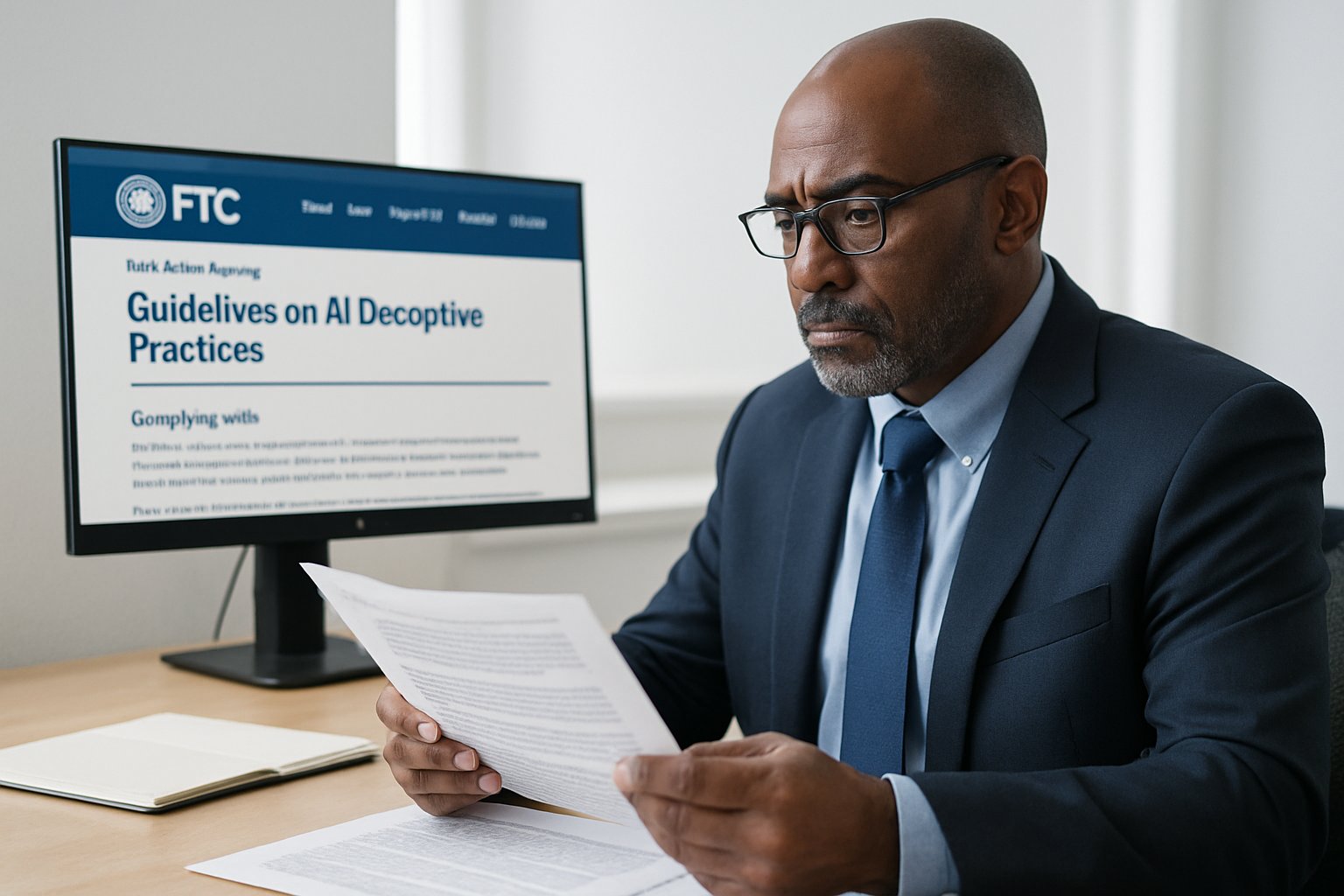
These federal maneuvers illustrate a preemption playbook in motion. However, momentum depends on timely agency outputs we examine next.
FTC Deadline Rapidly Approaches
The ninety-day clock expires the same day this article publishes. Yet, as of press time, the FTC had not released its promised policy statement. Consequently, stakeholders monitor ftc.gov hourly for any signal clarifying enforcement against AI Deceptive Practices. Past behavior offers clues. In February, the Commission issued a COPPA age-verification policy within similar deadlines, showing procedural capability. Additionally, lawyers expect Chair Khan to frame state bias mitigation mandates as inherently deceptive when outputs change. However, Gibson Dunn cautions that policy statements lack formal force and cannot alone preempt statutory text.
Timing pressure intensifies commercial uncertainty. Nevertheless, organizations need concrete answers before product launches this quarter.
State Laws Under Fire
States such as Colorado, California, and Texas invested years drafting algorithmic fairness statutes. Commerce analysts deem several provisions onerous because they require proactive bias mitigation audits and dynamic threshold tuning. In contrast, federal officials say those audits can coerce AI Deceptive Practices by distorting factual scoring.
- Colorado SB24-205: High-risk system duties, civil penalties enforceable by state attorney general.
- California Transparency Act: Frontier model disclosures and safety testing requirements.
- Texas TRAIGA: Real-time algorithmic impact reporting for public agencies.
Furthermore, the Commerce evaluation may link funding eligibility to state repeal or amendment. Consequently, governors fear losing broadband and trade grants during election season.
This pressure places legislatures in a defensive stance. Meanwhile, courts will soon judge whether federal theory overrides local autonomy.
Legal And Political Clash
Constitutional scholars emphasize that an executive order cannot itself nullify a statute. Therefore, the administration relies on Section 5 interpretations, spending conditions, and strategic litigation. Gibson Dunn argues that labeling bias mitigation as AI Deceptive Practices stretches consumer harm doctrine. Nevertheless, uniformity arguments resonate with multinational trade stakeholders who dread divergent audits. Moreover, the National Conference of State Legislatures accuses Washington of ignoring democratic experimentation. Ideological constraints appear on both sides, as each camp frames fairness or freedom as paramount.
The doctrinal battle will likely escalate in appellate courts. Subsequently, companies must anticipate parallel lawsuits and injunctions.
Business Compliance Outlook 2026
Risk officers cannot wait for final rulings. Consequently, prudent firms map overlapping federal and state obligations, adopting the strictest operational baseline. Many teams now treat bias mitigation documentation as a core asset mitigating enforcement across jurisdictions. Additionally, marketing departments review claims to avoid inadvertent AI Deceptive Practices triggers. Trade secrets remain valuable, yet transparency trends demand selective disclosure of model governance artifacts. Moreover, professionals can enhance expertise with the AI+ Legal Strategist™ certification.
Early investment in controls and credentials builds regulator trust. Therefore, firms position themselves advantageously regardless of litigation outcomes.
Strategic Industry Next Steps
First, monitor the FTC newsroom and Federal Register for any late policy drop. Second, prepare public comments addressing ideological constraints and consumer confusion narratives. Third, model potential cost scenarios under varying preemption outcomes affecting cross-border trade deals.
- Review training data for undocumented bias signals.
- Document decision thresholds and rationales.
- Update disclosure statements using plain language.
Additionally, coordinate with state associations to shape possible amendments rather than resist wholesale. AI Deceptive Practices allegations will increasingly surface in advertising, procurement, and investor due diligence.
These proactive steps limit exposure and build goodwill. Consequently, leadership can pivot quickly as legal frameworks settle.
The federal preemption project now reaches its decisive moment. Whether the FTC publishes or stalls, companies must navigate a landscape where AI Deceptive Practices claims define risk. States will defend bias mitigation statutes, asserting consumer equity over corporate convenience. Conversely, Washington will argue that conflicting mandates create AI Deceptive Practices confusing users and harming competition. Consequently, boards should prepare for audits, disclosures, and agile governance to sidestep potential AI Deceptive Practices findings. Finally, explore advanced certifications and industry coalitions to strengthen your compliance narrative.
Disclaimer: Some content may be AI-generated or assisted and is provided ‘as is’ for informational purposes only, without warranties of accuracy or completeness, and does not imply endorsement or affiliation.


