

AI CERTS
4 months ago
Plugable TBT5-AI boosts AI Local Inference desktop edge
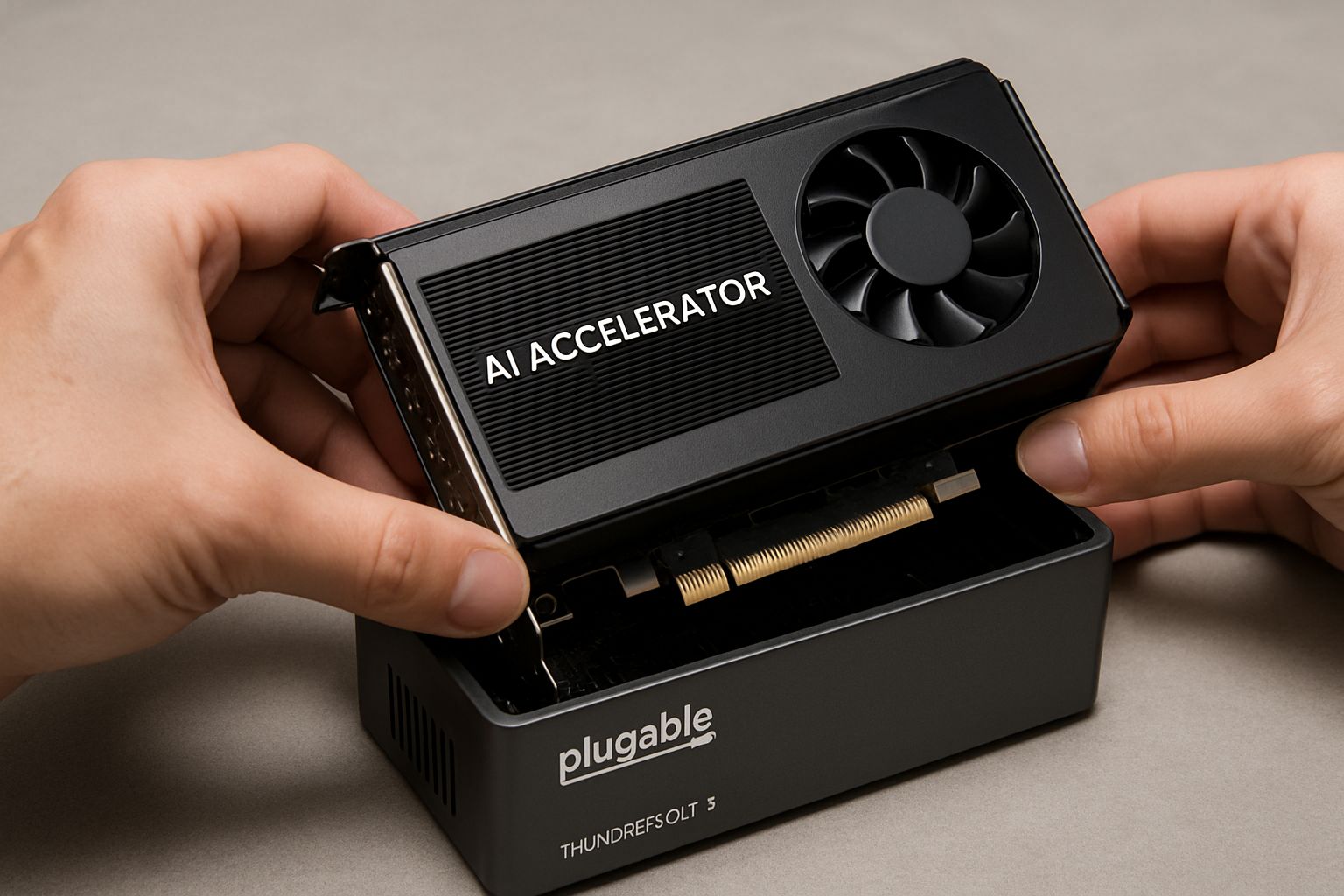
Plugable positions the new enclosure as “Intelligence You Own” for Windows laptops and workstations. Furthermore, the bundle ships with Plugable Chat, Microsoft Foundry Local, and Google MCP integrations. Therefore, many enterprises may accelerate pilot projects without waiting for costly server refreshes. In contrast, early adopters must verify TB5 compatibility across each laptop. This article unpacks the hardware, software, benefits, and caveats surrounding Plugable’s strategy. Readers gain actionable insight before committing budgets to edge computing initiatives.
AI Local Inference Explained
AI Local Inference describes running language or vision models directly on user-controlled hardware. Such processing occurs without leaving the building, creating an air-gapped workflow that satisfies strict data mandates. Moreover, response times drop because requests avoid long hops across public networks. The approach also lets teams fine-tune or mask proprietary datasets before wider distribution. Plugable’s TBT5-AI extends this idea by packaging a powerful GPU inside an external enclosure.
Consequently, a compatible laptop becomes a flexible inference node rather than a mere client. Microsoft’s Foundry Local and Google’s MCP supply runtime and governance layers to keep data readable yet protected. Nevertheless, the method still relies on the Thunderbolt link between enclosure and computer for rapid transfers. Local models, secured cables, and open tooling combine to redefine private AI workflows. However, hardware transport is only half the story; performance depends on Thunderbolt 5 capabilities.
Thunderbolt 5 Powers Desktop
Intel’s Thunderbolt 5 doubles the bidirectional bandwidth offered by its predecessor. Furthermore, a bandwidth-boost mode pushes 120 Gbps from host to device during graphics-heavy bursts. Plugable claims this throughput cuts token latency during conversational queries by double-digit percentages. In addition, the TB5 specification raises power delivery ceilings, enabling the 850 W internal supply to feed 600 W GPUs. Consequently, the external enclosure sustains 24/7 loads without throttling performance.
For Plugable, AI Local Inference hinges on this new cable specification. Nevertheless, real traffic still crosses a PCIe Gen4 x4 link inside each system. Independent benchmarks will need to test how that bottleneck affects larger transformer models. These technical nuances shape deployment plans. Therefore, understanding cable lengths, firmware versions, and chipset lanes becomes critical before purchase decisions.
Secure Data Remains Local
Healthcare, finance, and defense share a common dread: accidental data leakage. Therefore, teams embrace air-gapped solutions that never copy content to external clouds. Plugable leverages this fear by marketing the TBT5-AI as an air-gapped desktop vault. Moreover, Microsoft Foundry Local guarantees that model weights and embeddings stay on the host disk. Google MCP Toolbox adds governed, read-only connections to relational stores, preventing unauthorized writes.
Consequently, auditors can trace every query, fulfilling emerging AI security compliance frameworks. Professionals can enhance their expertise with the AI Security Compliance™ certification. That promise of AI Local Inference reassures compliance officers. These privacy guarantees often outweigh raw speed when executive boards approve budgets. However, software simplicity also matters, which the next section addresses.
Software Stack Simplifies Deployment
Installing Linux drivers once blocked many business users from experimenting with GPUs. Plugable avoids that barrier by focusing on Windows 11 support out of the box. Additionally, Plugable Chat offers a point-and-click interface for retrieval-augmented generation workflows. Setup wizards ingest PDFs, SharePoint folders, and SQL tables before building vector indexes. Moreover, Microsoft Foundry Local manages model lifecycles, patches, and hardware assignment through a familiar MMC-style console.
MCP connectors then restrict the large language model to read-only context, satisfying air-gapped governance policies. Consequently, administrators spend minutes, not days, reaching a production-ready demo. In contrast, traditional bare-metal servers could demand kernel tweaks and multi-GPU orchestration scripts. These tools collectively enable AI Local Inference without command-line gymnastics. These streamlined tools lower expertise requirements. Next, we evaluate real-world throughput and thermal behavior.
Performance Metrics And Limits
Plugable’s marketing cites sub-100 millisecond response times for seven-billion-parameter models. However, independent analysts caution that external PCIe links may inflate latency as parameter counts rise. Grand View Research forecasts multi-billion growth for edge AI hardware, yet warns of fragmented benchmarks. Meanwhile, sustained 600 W draw raises electricity and cooling bills inside every server room. Reviewers should measure three core variables:
- End-to-end token latency under different model sizes
- Bandwidth utilization across Thunderbolt 5 lanes
- Thermal noise and power cost during 24/7 duty
Subsequently, comparing these figures to internal PCIe GPUs or cloud endpoints clarifies total cost of ownership. Nevertheless, early field reports suggest noticeable gains for chat workloads under 30 billion parameters. Precise measurement determines whether AI Local Inference meets interactive application targets. These mixed results underscore the importance of pilot testing. Therefore, organizations should establish benchmarks before mass rollouts.
Adoption Challenges And Outlook
Thunderbolt 5 ports still appear mostly on premium laptops and small form-factor workstations. Consequently, many firms will need adapter cards or refreshed laptop fleets to exploit full bandwidth. Hardware cost also looms; a Blackwell GPU can rival an entire desktop budget. Moreover, edge deployment requires disciplined update processes for Foundry Local, GPU drivers, and MCP libraries. Plugable plans channel sales through integrators, yet has not published retail pricing.
Wide availability will decide if AI Local Inference transcends early-adopter niches. Nevertheless, analysts expect strong demand given compliance pressures and remote work trends. MarketsandMarkets predicts double-digit CAGR for edge AI hardware through 2030. These forecasts encourage vendors but do not guarantee smooth procurement cycles. In contrast, rigid approval boards may pause orders until independent reviews appear. Our final section outlines purchasing steps and compliance tips.
Procurement Details And Compliance
Plugable opened a presale registration portal rather than releasing firm ship dates. Therefore, buyers should obtain written lead-time estimates before announcing internal launch schedules. TAA compliance paperwork will interest public sector teams and federally funded universities. Additionally, confirm that chosen GPUs appear on vendor support matrices to avoid warranty conflicts. System compatibility lists should include BIOS versions, Thunderbolt firmware, and power delivery particulars.
Moreover, inquire whether the asymmetric 120 Gbps boost operates on certified cables longer than one meter. Contract language should define service levels for AI Local Inference workflows. Finally, attach measurable acceptance criteria covering latency, throughput, and air-gapped policy enforcement. These steps mitigate deployment surprises. Consequently, organisations can transition smoothly from pilot to production.
Plugable’s TBT5-AI illustrates a compelling path for secure, desktop-scale AI Local Inference. Moreover, Thunderbolt 5 bandwidth, robust GPUs, and a Windows-first stack offer privacy and agility. Nevertheless, buyers must validate performance, cost, and compatibility before large-scale adoption. Consequently, careful pilots, clear contracts, and skilled personnel remain essential. Explore Plugable’s resources, benchmark rigorously, and pursue certifications to strengthen organisational readiness.
Disclaimer: Some content may be AI-generated or assisted and is provided ‘as is’ for informational purposes only, without warranties of accuracy or completeness, and does not imply endorsement or affiliation.


