

AI CERTS
2 months ago
Uni-1 Vision Model Transforms Creative Workflows
The model underpins Luma Agents, an enterprise service already piloting with Adidas and Publicis Groupe. Consequently, analysts are watching closely to see if a unified approach can truly compress creative timelines while meeting brand safety needs.
Luma Launch Context Insights
Luma revealed Uni-1 and its agent platform on 5 March 2026. Moreover, the disclosure followed a $900 million Series C round that lifted the startup’s valuation near $4 billion. Funding of that scale signals serious infrastructure plans. In contrast with earlier pipeline stacks, the company now markets “Unified Intelligence” as its guiding theme. Early customers report end-to-end asset delivery from one conversational brief. Therefore, Luma positions the rollout as a turning point for agency operations. The Uni-1 Vision Model sits at the center of this strategy, coordinating specialist generators like Veo 3 and ElevenLabs when required. These partnerships extend coverage without surrendering single-threaded control. As deployments broaden, adoption metrics will reveal whether consolidation really improves throughput and governance.
Architecture Under The Hood
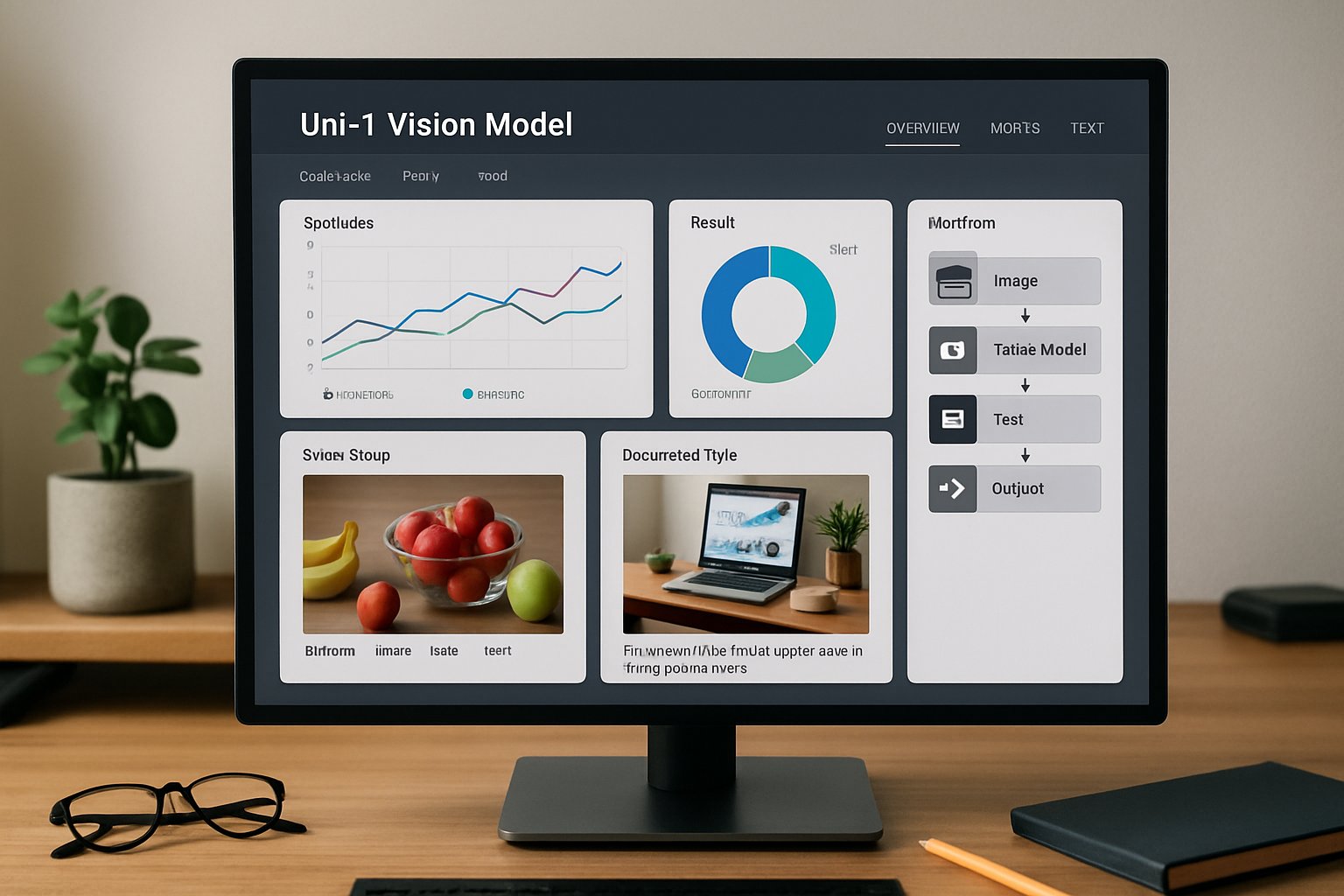
Luma describes Uni-1 as a decoder-only autoregressive transformer. Consequently, both words and pixels enter the same interleaved token stream. That design allows internal reasoning to occur before any visible rendering. Additionally, the company claims the model “thinks in language while imagining in pixels.” That phrase captures the promised marriage between chain-of-thought planning and high-fidelity synthesis. The Uni-1 Vision Model therefore treats every modality as first-class data. Such parity matters for Multimodal AI systems expected to answer a layout question and then output a matching storyboard. Implementation specifics remain proprietary, yet the concept aligns with recent academic papers on joint token spaces.
Decoder Design Specifics Deep
Uni-1’s token vocabulary spans text, image patches, and modality control cues. Moreover, causal masking ensures the model predicts each next token while retaining entire session context. Luma also hints at a hierarchical planner within the transformer stack. Consequently, long instructions decompose into smaller actionable segments during generation. That mechanism, if verified, could explain strong performance on Logic Benchmarks demanding multi-step visual reasoning. The Uni-1 Vision Model further applies a self-critique loop, sampling drafts, evaluating them internally, and iterating before final output. Nevertheless, no peer-reviewed paper yet details these routines, leaving external researchers eager for deeper visibility.
Enterprise Adoption Momentum Now
Adidas, Mazda, and Serviceplan rank among the first production users. Furthermore, Publicis Groupe is integrating agents into its global content studios. These rollouts target repetitive adaptation tasks such as aspect-ratio conversion, language localization, and voiceover synthesis. Because the Uni-1 Vision Model persists context across those steps, brands hope to cut manual handoffs. Early anecdotal reports mention 40 percent cycle-time savings, yet formal ROI numbers remain undisclosed. Professionals can enhance their expertise with the AI Developer™ certification to better evaluate such deployments. Meanwhile, Luma ensures that generated assets carry audit trails, supporting compliance reviews required by major advertisers.
- Named pilot clients: Adidas, Publicis, Mazda, Humain
- Reported speed gains: Up to 40 percent per campaign
- Planned capability expansion: Full audio and 3-D support
These early figures suggest traction. However, scalability across varied brand guidelines remains the critical next test. Success stories will likely influence wider Multimodal AI adoption within media networks.
Benchmark Claims Under Scrutiny
Luma highlights state-of-the-art scores on RISEBench, a suite measuring temporal, spatial, and causal understanding. Additionally, Uni-1 posts strong ODinW-13 detection numbers, implying fine-grained object awareness. Press outlets even report outperformance over Google’s Nano Banana family on key Logic Benchmarks. Nevertheless, raw tables and evaluation seeds are unavailable publicly. Therefore, independent labs cannot yet replicate findings. The Uni-1 Vision Model may indeed lead, yet transparency will decide community trust. Industry watchers urge Luma to release checkpoint slices or host blind comparison challenges. Meanwhile, competitors race to close any genuine gap, accelerating overall Multimodal AI progress. Two-line summary: Benchmark leadership excites buyers. However, verification will determine lasting credibility. The next paragraph explores associated risks.
Risks And Open Questions
Unified systems amplify both strengths and weaknesses. Consequently, a hallucinated detail can propagate across every downstream asset before detection. Moreover, training-data provenance remains opaque, raising potential copyright exposure. Analysts also caution that autonomous agents might unintentionally drift from brand tone without rigorous guardrails. The Uni-1 Vision Model integrates automated review layers, yet human oversight costs still apply. In contrast, traditional toolchains allow staged approvals that isolate errors earlier. Further, regulators may demand disclosure of source datasets, echoing music industry lawsuits against other Multimodal AI vendors. Releasing transparent documentation would mitigate many concerns. These challenges highlight critical gaps. However, Luma’s funding and partner roster provide resources to address them in coming quarters.
Strategic Takeaways Moving Forward
Enterprises evaluating unified generation should track three focal points:
- Benchmark reproducibility across public Logic Benchmarks
- Concrete ROI metrics from live campaigns
- Governance tooling that scales with regulatory shifts
Therefore, procurement leaders need both technical audits and legal reviews. Meanwhile, creative directors should pilot low-risk projects first, refining prompt styles suited to the Uni-1 Vision Model. Additionally, staff upskilling remains vital. Obtaining the AI Developer™ credential equips teams to build custom extensions around Luma’s API. In contrast, ignoring capability advances could leave agencies disadvantaged as clients demand faster iterations. Two-line summary: Strategic diligence balances innovation and risk. Consequently, early movers with solid controls may capture outsized value.
The conversation around Uni-1 encapsulates the broader Multimodal AI race. Furthermore, it spotlights how unified token spaces could elevate reasoning-driven creative output. The next sentences wrap up the discussion.
Conclusion
Luma’s Uni-1 Vision Model offers an ambitious vision of seamless creative production. Moreover, early pilots hint at faster cycles and richer cross-modal coherence. Nevertheless, benchmark transparency and data provenance remain unresolved. Consequently, enterprises should test carefully, demand audit access, and invest in skilled builders. Pursuing an AI Developer™ certification strengthens in-house capability and ensures informed vendor selection. Explore the technology now, and lead your organization into the next era of unified creative intelligence.
Disclaimer: Some content may be AI-generated or assisted and is provided ‘as is’ for informational purposes only, without warranties of accuracy or completeness, and does not imply endorsement or affiliation.


