

AI CERTS
2 months ago
Nokia AI-RAN Tests Signal 6G Roadmap
T-Mobile’s over-the-air demo used a commercial smartphone streaming video while generative AI processed queries in parallel. Meanwhile, Indosat achieved Southeast Asia’s first Layer-3 5G call on the same platform. SoftBank demonstrated how spare GPU cycles could monetize edge capacity by hosting third-party inference workloads. Moreover, Nokia executives set an ambitious timetable, promising field trials in late 2026 and commercial release in 2027.
Industry observers welcomed the clarity yet cautioned that power, economics, and openness questions remain unresolved. This article unpacks the milestone, partners, economics, technical implications, and skills path for professionals tracking Nokia AI-RAN. Each section details verified data, analyst insight, and practical next steps for network strategists.
AI-RAN Milestone Overview
Nokia’s March 1 announcement confirmed functional parity between baseband Layer-1 processing and concurrent AI workloads on GPUs. Tests leveraged the Nvidia Aerial stack running on the Grace Hopper 200 platform, clocking stable 100 MHz C-band throughput. Additionally, generative-AI tasks answered real-time prompts without degrading radio performance. Rémy Pascal of Omdia called the outcome “a step up in maturity” for Nokia AI-RAN.
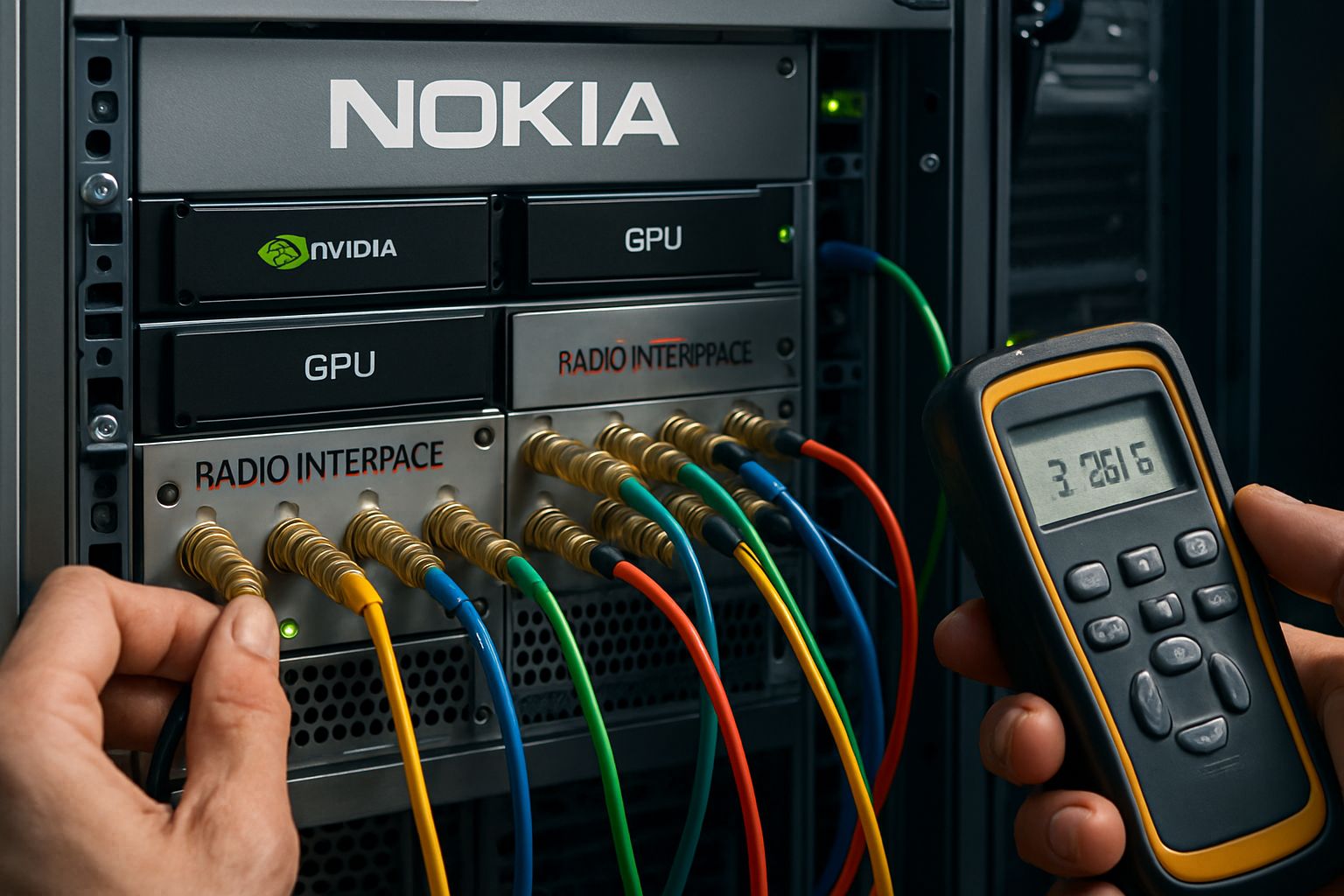
Operator diversity validated portability. T-Mobile used commercial AirScale Massive MIMO hardware, while Indosat combined cloud-native cores with remote radio heads. Meanwhile, SoftBank’s orchestrator dynamically allocated unused GPU cycles to external AI inference services. Therefore, the milestone proved the architecture’s flexibility across spectrum bands, deployment models, and business cases. Field trial units will ship to partners late 2026, according to Nokia’s CTO quoted by Fierce Network.
The milestone delivers proof that converged AI and radio processing is technically viable today. However, wider adoption depends on capital, power, and ecosystem coordination discussed next.
Operator Trials Show Potential
Each operator demo spotlighted unique goals and constraints. T-Mobile’s Seattle lab streamed 4K video over C-band while running conversational AI on the same server. Consequently, engineers observed consistent 900 Mbps downlink throughput and sub-6 millisecond AI response times. Indosat sought voice quality validation for emerging 6G edge applications within dense Jakarta sites. Their Layer-3 5G call maintained 99.999 % availability across repeated handovers, meeting internal SLA thresholds. SoftBank focused on monetization, offering retailers GPU-as-a-Service during off-peak network hours. Moreover, its orchestration stack measured 72 % average GPU utilization, up from 45 % in legacy Open RAN servers.
- Peak downlink: 900 Mbps (T-Mobile)
- AI inference latency: 6 ms median
- GPU utilization gain: +27 percentage points
- Availability: 99.999 % during handovers
These metrics illustrate early performance headroom and commercial creativity unlocked by Nokia AI-RAN. Consequently, partners are accelerating investment, as explored in the following section.
Partner Investments Strengthen Momentum
Capital inflows underline strategic commitment. Nvidia invested US$1 billion in Nokia on 28 October 2025 to co-develop accelerated networking platforms. Furthermore, Dell, Supermicro, and Quanta pledged server availability for the AnyRAN deployment model. AnyRAN extends Nokia’s existing purpose-built and Cloud RAN portfolio, ensuring feature consistency across silicon choices. BT, Vodafone, Elisa, and NTT DOCOMO have joined evaluation programs targeting 2027 launch windows. Meanwhile, the AI-RAN Alliance now counts more than one hundred participating companies, showcasing ecosystem depth.
Omdia projects a cumulative US$200 billion AI-RAN revenue pool by 2030, dwarfing today’s US$35 billion RAN market. Therefore, investors view Nokia AI-RAN as a lever to recapture growth in an otherwise flat sector. Nevertheless, commercialization depends on credible economic and energy models, discussed next.
Market Opportunity And Economics
Operators currently spend cautiously because the global RAN market stagnated at US$35 billion during 2025. Consequently, any new platform must justify additional capital with measurable savings or fresh revenue. Nokia positions GPU convergence as a utilization play that transforms excess capacity into a saleable resource. SoftBank’s retail inference experiment exemplifies that vision. However, analysts question whether edge colocation demand will materialize fast enough.
- Higher spectral efficiency lowering spectrum costs.
- Energy reduction through AI scheduling optimizers.
- GPUaaS revenue during network idle periods.
Omdia’s Pascal notes all three must align before operators allocate multiyear budgets. Meanwhile, regulatory pushes for 6G readiness amplify urgency around experimentation.
Economic upside exists but remains conditional on balanced cost structures within Nokia AI-RAN deployments. The technical foundation influencing those costs appears next.
Technical Energy Impact Analysis
Running Layer-1 functions on GPUs disrupts traditional baseband timing budgets. Nevertheless, Nokia’s tests proved deterministic latency on Grace Hopper using firmware optimizations and precise time protocols. Furthermore, converging workloads increases rack density, pushing power draw beyond many existing shelter limits. IEA data show data centers consumed 415 TWh in 2024, with AI expected to double demand by 2030. Consequently, operators must address site power upgrades, liquid cooling, and renewable sourcing.
Nokia says AI scheduling can cut RAN energy by up to 30 %, partially offsetting GPU overhead. In contrast, skeptics argue gains will not outweigh full-tilt inference surges during peak hours. Therefore, transparent field trial telemetry is critical. T-Mobile plans to publish comparative energy baselines after its 2026 Washington trials.
Technical validation appears solid yet energy economics remain unproven for Nokia AI-RAN at scale. Risks and governance issues follow.
Risks, Debates, Next Steps
Vendor lock tops many procurement checklists. Because current proofs rely on Nvidia GPUs, some operators fear limited bargaining power. Open RAN advocates lobby regulators to mandate silicon diversity within 6G funding programs. Security also looms large as third-party workloads access RAN-adjacent data paths. Moreover, privacy regulators may impose localization rules that complicate global GPUaaS marketplaces.
Industry groups seek guidance. The AI-RAN Alliance is drafting reference models that define abstraction layers above proprietary acceleration. Subsequently, Nokia pledged to open certain AnyRAN APIs to independent software vendors. Experts recommend the following immediate actions.
- Request detailed KPIs from trial operators.
- Conduct site power audits before pilots.
- Negotiate multi-vendor accelerator options.
- Plan security assessments for edge inference.
These tasks will shape the commercial readiness of Nokia AI-RAN through 2027. Skills development is another prerequisite.
Skills And Certification Path
Telecom teams now require AI, GPU, and Kubernetes fluency alongside traditional RF engineering. Consequently, professionals should blend network knowledge with user-centric AI design expertise. Professionals can enhance their expertise with the AI+ UX Designer™ certification. Additionally, Nokia’s AnyRAN partner labs will offer hands-on workshops during upcoming field trials. Nvidia University programs also supply accelerated computing curricula tailored for edge networking.
Upskilled staff accelerate deployment timelines, reducing integration risk for Nokia AI-RAN operators. The following conclusion recaps main insights and urges decisive next moves.
Nokia AI-RAN has moved from concept to validated lab reality across three continents. Partner funding, AnyRAN compatibility, and 6G urgency combine to create a potentially massive addressable market. However, energy consumption, total cost, and openness concerns demand transparent field data and industry governance. Consequently, upcoming 2026 trials with T-Mobile, SoftBank, and Indosat will become pivotal litmus tests.
Meanwhile, practitioners who upgrade skills and pursue recognized credentials position themselves for leadership roles. Act now—review the certification above, follow trial findings closely, and prepare strategic roadmaps before commercial release in 2027.
Disclaimer: Some content may be AI-generated or assisted and is provided ‘as is’ for informational purposes only, without warranties of accuracy or completeness, and does not imply endorsement or affiliation.


