

AI CERTs
4 months ago
DeepSeek V4 Release Spurs Global Tech Tension
Rumors around DeepSeek V4 have reached a fever pitch. However, the Hangzhou lab still withholds an official statement. Industry professionals crave clarity because the stakes span technology, policy, and market competition. Furthermore, secondary leaks promise a giant leap in long-context reasoning and unified generation across text, images, and video. Consequently, analysts race to verify every technical hint while geopolitical undercurrents intensify.
Meanwhile, investors watch download counts that surpass 75 million for earlier DeepSeek releases. Additionally, U.S. regulators explore export-control angles linked to alleged Nvidia Blackwell usage in China. Therefore, the coming announcement could redefine both Multimodal AI benchmarks and cross-border hardware strategy. The following report synthesizes verified facts, contested claims, and practical monitoring advice.
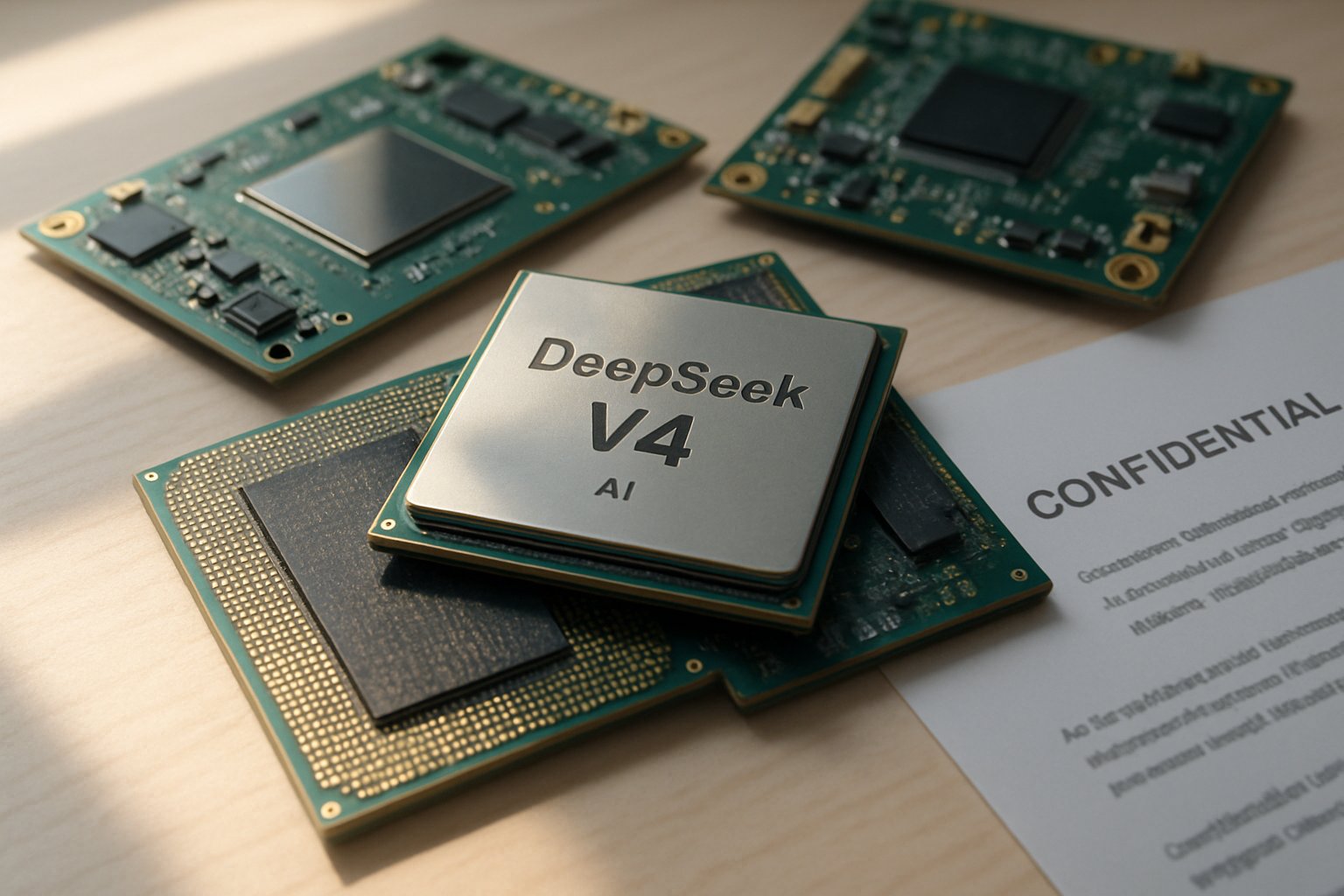
Release Rumors Intensify Globally
Multiple outlets flagged an early-March Model Launch window. Nevertheless, no public checkpoints or research paper appeared by 4 March 2026. Reuters cited unnamed insiders who confirmed private previews for Huawei and Cambricon but not Nvidia or AMD. Moreover, Creative Strategies analyst Ben Bajarin framed the decision as a strategic hedge by Chinese Tech leadership.
In contrast, unofficial trackers on Evolink and AwesomeAgents list provisional commit hashes that lack reproducible weights. Subsequently, open-source enthusiasts continue polling DeepSeek’s GitHub every hour. Consequently, pressure mounts on the company to either publish or recalibrate expectations.
These mixed signals underscore the absence of hard evidence. However, stakeholders still prepare infrastructure for immediate testing once files drop.
This uncertainty keeps attention high. Consequently, our next section reviews the most discussed specifications.
Technical Specs Leak Widely
Leaked slides suggest DeepSeek V4 adopts a trillion-parameter Mixture-of-Experts design. Furthermore, each token may activate about 32 billion parameters, lowering inference costs. Additionally, community forums repeat the headline figure: a one-million-token context window. If accurate, such scale would let lawyers, coders, and researchers process entire books in one shot.
Meanwhile, reports claim native support for Multimodal AI generation across text, images, and video without pipeline stitching. Consequently, product teams could build streamlined user flows. Nevertheless, engineers caution that genuine multimodality demands unified embeddings, not mere adapters.
- 1 T parameters (rumored)
- 1 M-token context (rumored)
- Open-weights license: unconfirmed
- Ascend and Cambricon first-class targets
- 75 M cumulative model downloads to date
These figures remain provisional until official benchmarks ship. Nevertheless, preparation today shortens validation cycles tomorrow.
Speculation alone cannot drive procurement. Therefore, we turn to the hardware and policy friction shaping the roll-out.
Geopolitics Around Chip Access
Reuters reported that DeepSeek withheld early Model Launch builds from U.S. GPU vendors. Consequently, Nvidia and AMD lost a head start on driver optimization. Moreover, one U.S. official alleged training occurred on Nvidia Blackwell boards inside China, potentially breaching export rules.
Meanwhile, Huawei’s Ascend and Cambricon accelerators reportedly received priority tuning. In contrast, Western partners await release candidates. Therefore, supply-chain analysts expect fragmented performance profiles during initial deployments. Additionally, Jensen Huang’s earlier statement that China trails by “nanoseconds” now gains renewed attention.
This chip split highlights growing Chinese Tech self-reliance. However, regulatory investigations could alter the balance rapidly.
Hardware politics influence developer readiness. Consequently, intellectual-property tension adds another layer.
Intellectual Property Clash Escalates
Anthropic publicly accused DeepSeek of large-scale distillation attacks on Claude. Moreover, the blog details 150 k illicit exchanges linked to DeepSeek among 16 M total. Consequently, questions emerge about model provenance and safety alignment.
Meanwhile, DeepSeek has issued no detailed rebuttal. Nevertheless, compliance teams already draft mitigation plans. Additionally, legal experts warn that open-weights releases could accelerate unauthorized reuse.
In contrast, some researchers argue that open models democratize Multimodal AI and lower entry barriers. Therefore, the clash pits innovation against control.
These disputes could influence release timing. However, market impact remains the decisive arena.
Potential Market Impact Ahead
Should the rumored specs hold, DeepSeek V4 could pressure peers on context length and modality breadth. Furthermore, enterprise buyers may reassess vendor roadmaps. Additionally, a generous license would enable startups to prototype advanced assistants quickly.
Consequently, chip sales patterns might shift. AMD recently disclosed $390 M in MI308 inference revenue. Meanwhile, prioritizing Ascend support could boost Huawei server demand inside Chinese Tech ecosystems.
Professionals can sharpen competitive skills through the AI Prompt Engineer certification. Moreover, certified staff accelerate safe deployment of cutting-edge models.
Market forecasts will stabilize only after reproducible benchmarks emerge. Therefore, constant monitoring remains essential.
Strategic vigilance sets the stage for actionable watch points next.
Next Steps For Watchers
Teams should set GitHub and Hugging Face alerts for any Model Launch artefacts. Furthermore, prepare sandbox clusters on both Ascend and CUDA hardware. Additionally, draft compliance checklists covering export controls and distillation provenance.
Journalists ought to queue interview requests with DeepSeek, Anthropic, and chip vendors. Moreover, policy reporters should track Commerce Department statements regarding Blackwell shipments. Consequently, early access to quotes will sharpen coverage.
Meanwhile, researchers can design evaluation suites that stress 1 M-token contexts. In contrast, product managers may prototype multimodal interfaces assuming gradual weight availability.
These proactive steps reduce lag once DeepSeek V4 finally lands. Consequently, organizations will pivot faster than less prepared rivals.
Timely readiness completes the insight loop. Therefore, we conclude with final reflections.
Conclusion: DeepSeek V4 sits at the intersection of breakthrough engineering, geopolitical maneuvering, and intellectual-property controversy. Moreover, leaked specs promise unmatched context size and true Multimodal AI capability. Nevertheless, absent official confirmation, prudent teams balance anticipation with caution. Consequently, continuous monitoring, cross-vendor infrastructure readiness, and upskilling through recognized certifications will secure early advantage. Act now, subscribe for real-time updates, and explore professional pathways to lead the coming wave.
Disclaimer: Some content may be AI-generated or assisted and is provided ‘as is’ for informational purposes only, without warranties of accuracy or completeness, and does not imply endorsement or affiliation.


