

AI CERTS
2 months ago
YOFC Fibre Powers AI-Ready Hollow-Core Networks
Hollow-core technology is finally leaving research labs and entering commercial trenches. At this inflection point, YOFC Fibre promises to reshape global AI network design. Consequently, operators and hyperscalers are scrutinising its performance, cost, and scale. Industry momentum accelerated after YOFC announced a hollow-core launch during MWC Barcelona 2026.
Moreover, fresh lab records show attenuation dropping to 0.05 dB per kilometre on 21.7-km draws. Analysts believe those numbers narrow the gap with premium solid fibre, unlocking new optical connectivity economics. However, commercialisation still hinges on manufacturing yield, field handling, and interoperability standards. This article examines the roadmap, market context, technical gains, remaining hurdles, and strategic implications for data centers. Finally, it outlines training options like the linked AI Cloud certification for professionals seeking an edge.
AI Era Demands Speed
AI model training clusters exchange petabytes of gradients across sprawling campuses. Therefore, every microsecond of latency impacts GPU utilisation and electricity bills. Hollow-core fibres guide light through air, delivering roughly 30% lower delay than conventional glass. For financial exchanges, those milliseconds translate into revenue protection. Meanwhile, cloud architects count on deterministic paths to orchestrate storage disaggregation between data centers.
YOFC Fibre addresses these pain points by combining low-latency propagation with high single-wavelength throughput. Independent trials have reported 1.2 Tbit/s over a single channel, proving headroom for AI synchronisation storms. Consequently, momentum around this technology is intensifying. The AI era magnifies latency sensitivity and bandwidth hunger. Such pressures make transformative media like hollow-core irresistible.
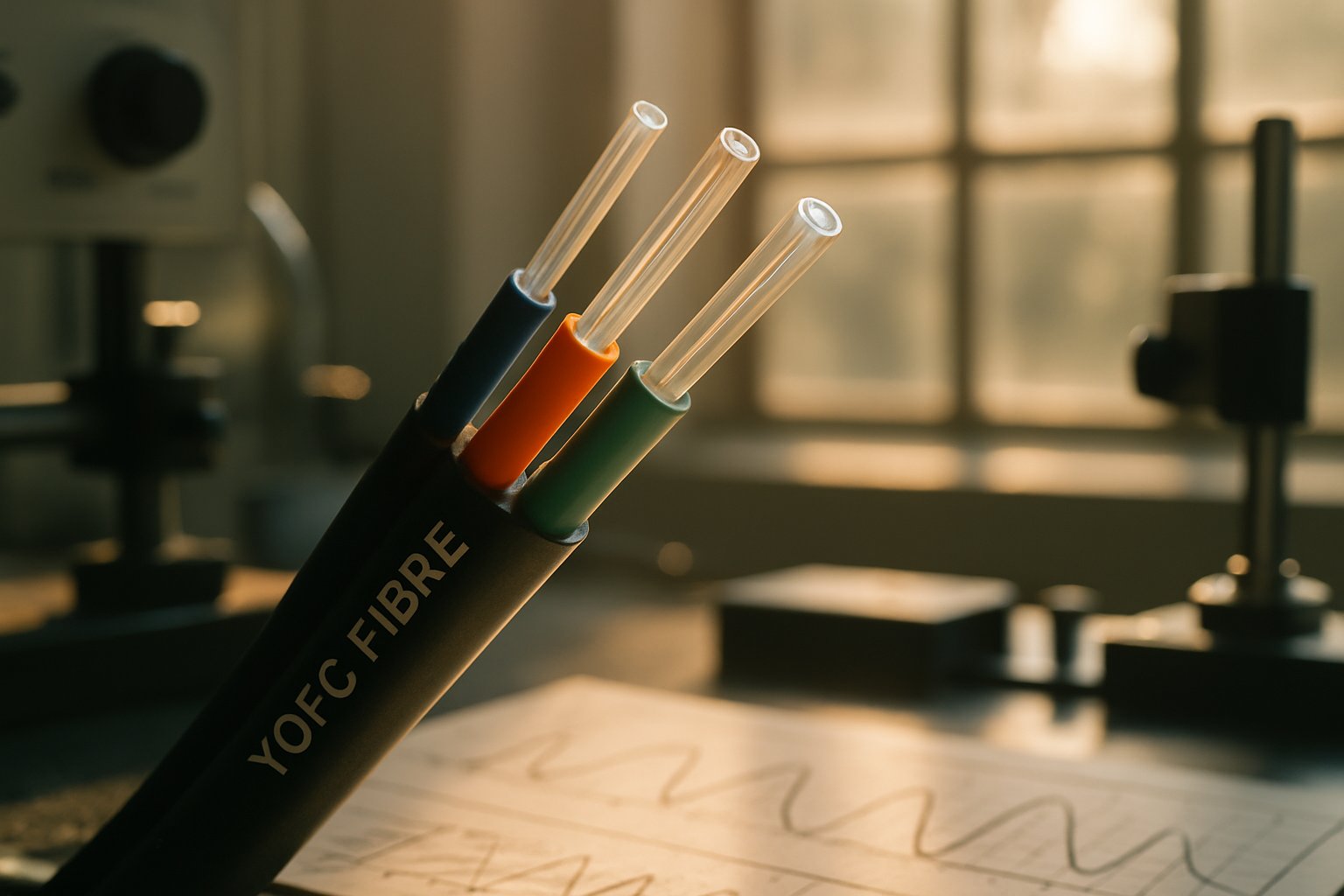
YOFC Launch Roadmap Insights
YOFC chose MWC Barcelona 2026 as its global stage for the commercial hollow-core unveiling. Zhuang Dan, company president, describes the reveal as the flagship of an “AI-2030” blueprint. Furthermore, an on-site demo will stream between exhibition halls to highlight sub-microsecond hop latency. Prior groundwork matters. At OFC 2025, engineers showcased YOFC Fibre samples with 0.05 dB/km attenuation and 21.7-km uninterrupted draws. Additionally, operator pilots with China Mobile and China Telecom validated 800G transmission across metropolitan rings.
In contrast, Western deployments, such as Lumenisity’s 7-km London route, emphasise financial trading traffic. Subsequently, YOFC plans mass-production upgrades and joint testing with hyperscalers during 2026. These milestones illustrate a methodical transition from lab triumphs to shipping products. The roadmap balances publicity with credible technical evidence. However, deeper physics explain why attenuation improvements matter, which the next section unpacks.
Technology Under The Hood
Hollow-core fibre guides photons through a central air channel surrounded by anti-resonant cladding. Therefore, signal velocity approaches 0.99c rather than 0.67c in silica cores. Such physics delivers the celebrated low-latency advantage. YOFC engineers brand their variant “Supporting-Tube HCF” and integrate nested capillaries to arrest leak paths. Moreover, the design achieves attenuation within striking distance of premium ultra-low-loss glass.
- 0.05 dB/km attenuation record (OFC 2025)
- 21.7 km single-fibre draw milestone
- 1.2 Tbit/s single-wavelength demo
- 100 Tbit/s aggregated throughput
YOFC Fibre uses stack-and-draw fabrication, enabling long, continuous preforms without diameter drift. Optical connectivity also benefits because air guidance suppresses nonlinearities that plague dense WDM channels. Consequently, transmitters can push higher launch powers, simplifying amplifier siting along terrestrial spans. Nevertheless, splicing remains tricky because hollow structures collapse under standard heat profiles. Specialised ferrules and index-matching gels mitigate that issue yet raise installation cost. Air guidance unlocks speed and spectral purity. Still, technology alone lacks context until market forces weigh in, which the following section explores.
Market And Deployment Landscape
Analyst projections for hollow-core revenue range from several hundred million to three billion dollars by 2030. Azura Consultancy cites double-digit CAGR driven by hyperscale data centers expanding east-west fabrics. Additionally, national carriers in China already operate commercial lines between Shenzhen and Hong Kong. Operator statements claim average loss of 0.07 dB/km on those YOFC Fibre links. Meanwhile, euNetworks deploys Lumenisity cable in London to shave milliseconds off trading routes.
In contrast, submarine operators remain cautious, awaiting longer lifetime studies. Market adoption therefore hinges on both volume pricing and operational assurance. Furthermore, Microsoft Azure is outsourcing production to reach scale for regional expansion. MWC Barcelona will likely become a barometer; carrier purchase orders announced there could shift supply dynamics. Deployments today prioritise latency-sensitive verticals and showcase commercial readiness. Consequently, benefits for AI workloads deserve separate attention.
Benefits For AI Workloads
Distributed AI training suffers when node synchronisation waits for straggling packets. Therefore, lower propagation delay directly lifts GPU occupancy. Tests on YOFC Fibre links between adjacent data centers delivered 30% low-latency improvements and 8% efficiency gains. Moreover, air guidance mitigates Kerr nonlinearity, letting engineers squeeze more wavelengths per fibre. Consequently, fewer parallel cables are required, slashing trenching expense.
Optical connectivity overheads in digital signal processing also drop, saving rack power. Additionally, quantum-safe key distribution trials hint at converged security and data transport over the same medium. AI clusters value time savings and spectral density. Nevertheless, barriers could stall volume uptake, as next discussed.
Barriers And Next Steps
Manufacturing yields still trail conventional single-mode geometry. Consequently, price per kilometre remains several times higher. In contrast, YOFC Fibre cost curves are improving as draw towers scale and scrap rates fall. However, splicing tools require specialised inserts, complicating field repairs. Operators also note learning curves for installers previously trained on solid glass. Moreover, standards bodies have yet to ratify connector classifications, leaving multi-vendor optical connectivity uncertain.
Low-latency enthusiasm will fade if early lines exhibit frequent outages. Therefore, independent test labs must validate attenuation, crush resistance, and bend tolerance. YOFC promises fresh data in Barcelona, while MWC Barcelona panels will debate interoperability. Cost, tooling, and certification hurdles remain formidable. However, strategic planning can mitigate risks, as the final section highlights.
Strategic Takeaways Ahead
Boards evaluating network upgrades should model latency value against capital intensity. Additionally, vendor diversification protects supply as YOFC Fibre scales production. Early adopters enjoy marketing advantages and lower jitter today. Professionals can enhance expertise with the AI Cloud Architect™ certification. Furthermore, training helps teams integrate hollow-core safely inside critical facilities.
Stakeholders attending MWC Barcelona should request independent attenuation reports before signing contracts. Strategic diligence balances hype with engineering reality. Consequently, informed action today positions networks for the AI decade.
Conclusion
YOFC Fibre has moved from lab novelty to credible backbone candidate within three intense years. Record attenuation, 20-kilometre draws, and live 1.2-Tbit/s trials validate physics and manufacturing. Moreover, enterprises now possess a viable path to low-latency, high-capacity links without excessive DSP overhead. Nevertheless, cost, splicing complexity, and standard gaps demand prudent pilots.
Therefore, technology leaders should monitor upcoming trade show announcements and insist on third-party audits. Professionals ready to drive adoption can deepen knowledge via the linked AI Cloud certification, unlocking new optical connectivity insights. Act decisively, and YOFC Fibre could future-proof your AI infrastructure.
Disclaimer: Some content may be AI-generated or assisted and is provided ‘as is’ for informational purposes only, without warranties of accuracy or completeness, and does not imply endorsement or affiliation.


