

AI CERTs
3 months ago
Claude Code Shakes Cybersecurity Markets
Panic swept trading desks on February 23. The catalyst arrived from Anthropic's developer blog. Anthropic’s Claude Code tool gained a vulnerability-hunting upgrade overnight. Furthermore, early test claims boasted 500 bugs found in open-source projects. Consequently, investors feared rapid AI could undercut traditional cybersecurity vendors. Shares of leading security firms plunged in minutes. Moreover, sector ETFs touched multi-month lows before lunch. The episode underscored how narrative and technology now collide on Wall Street. Market volatility spiked as algorithms interpreted the news as existential. This article unpacks the selloff, examines technical limits, and previews next steps. First, we review how the announcement spread through markets.
AI Announcement Sparks Selloff
When Anthropic revealed the new security capability, headlines emphasized autonomous code reasoning. Analysts immediately contrasted the semantic scanner with signature-based SAST products. However, few noted the feature remained in limited research preview.
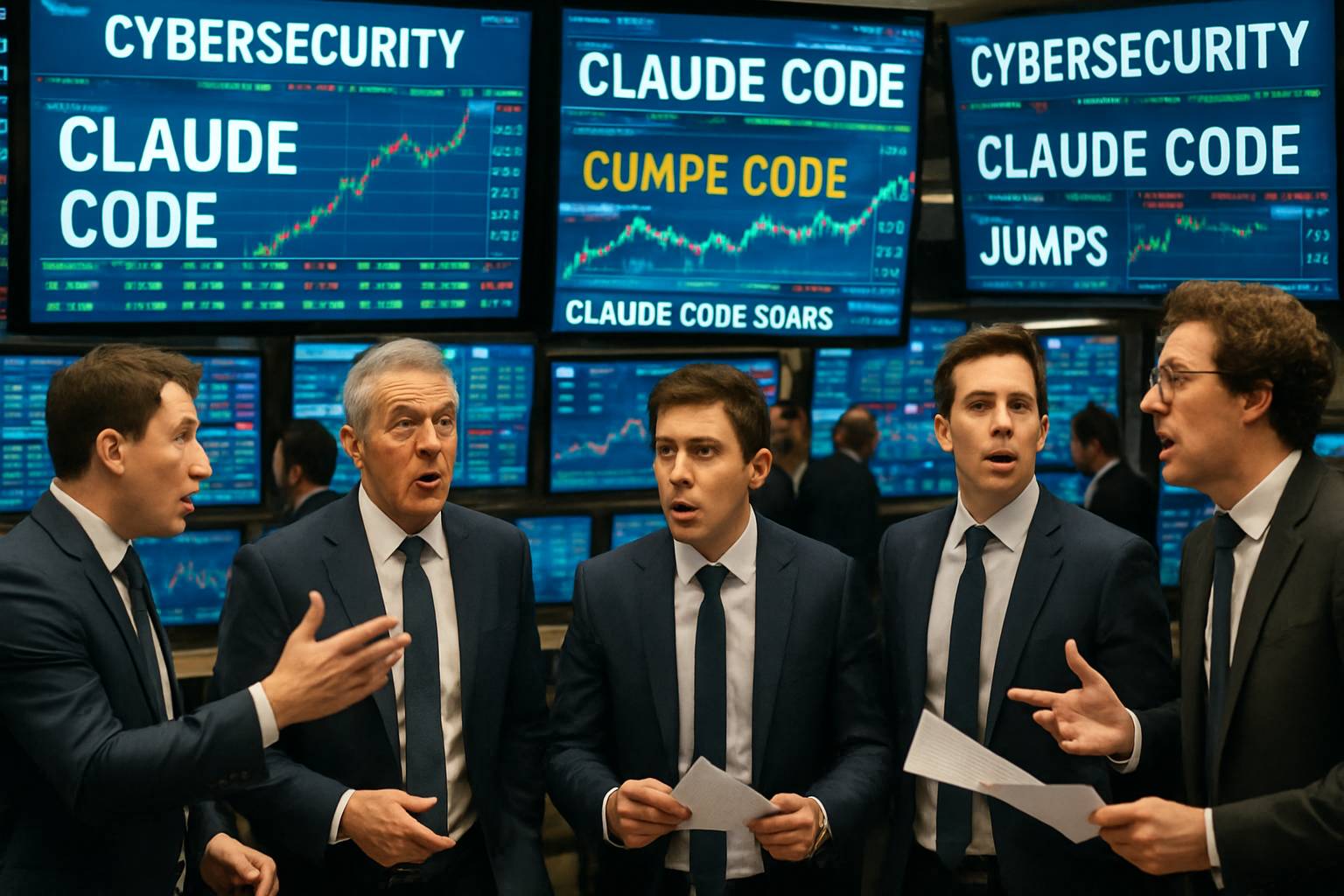
Trading algorithms still latched onto disruption keywords circulating on social platforms. Therefore, sell orders cascaded across cybersecurity names within minutes. In contrast, Anthropic's private valuation actually rose on secondary markets.
Crowded positions in high-growth security equities amplified the downdraft. Meanwhile, commentators kept repeating Claude Code as shorthand for existential software risk. That repetition reinforced negative sentiment throughout the session.
The announcement acted as a spark for a fragile security narrative. Nevertheless, numbers tell a clearer story next.
Stock Impact By Numbers
Reuters tallied an eleven-percent drop for CrowdStrike on February 23. Additionally, JFrog endured a stunning 24.9 percent intraday slide. The Global X Cybersecurity ETF fell nearly five percent the same day.
- CrowdStrike market cap lost roughly $6 billion during the plunge.
- Datadog, Zscaler, and Okta shed between eight and ten percent each.
- Total sector value destruction approached $15 billion by closing bell.
These figures shocked many retail investors watching their cybersecurity allocations. Furthermore, volatility meters spiked to levels unseen since 2024 breach scares. Yet activity concentrated mostly in software names, not hardware firewall makers.
Importantly, no company reported cancelled contracts because of Claude Code that week.
The raw numbers confirm a sharp but narrow Market Volatility episode. Consequently, experts soon questioned whether fears matched technical reality.
Analysts Question Market Panic
Several banks issued flash notes labeling the reaction panic-driven. Raymond James argued code scanning differs from endpoint defense economics. Moreover, Baird reminded investors that AI often increases security budgets, not shrinks them.
CrowdStrike CEO George Kurtz echoed that view on LinkedIn. He wrote that AI increases the need for security. Meanwhile, Forrester analysts warned vulnerability discovery does not equal patch deployment.
They highlighted human triage burdens and regulatory compliance barriers. Nevertheless, they conceded developer-stage tools face real pricing pressure. Claude Code appears positioned squarely against legacy SAST vendors.
Expert commentary tempers fears yet flags selective disruption ahead. Therefore, examining technological limits clarifies which products face the greatest risk.
Technology Limits And Risks
Agentic reasoning lets the model trace complex logic paths beyond pattern matchers. However, hallucinations and false positives still plague large language systems. Enterprises demand validated results before altering production pipelines.
Agentic AI Quickly Explained
Agentic AI executes multistep plans across tools with minimal prompts. Consequently, attackers might weaponize the same capability to locate weaknesses faster. Anthropic acknowledged this dual-use threat and limited preview access accordingly. During testing, Claude Code flagged 500 open-source vulnerabilities, yet recall metrics remain undisclosed.
Developers still shoulder responsibility for code review and merge approvals. Additionally, compliance teams require audit trails, something current LLM tooling lacks. Threat modeling therefore remains indispensable alongside scanning automation.
Technical gaps suggest incumbents retain value in layered defense strategies. Nevertheless, vendors must evolve quickly, as we discuss next.
Strategic Responses Now Emerging
Security vendors are integrating proprietary telemetry with generative models. Moreover, several plan partnerships rather than direct competition with Anthropic. CrowdStrike previewed an internal assistant that surfaces prioritized alert context inside dashboards.
In contrast, SAST pure-plays are revisiting licensing models and community editions. GitLab, for example, offers AI scanning as a bundled feature. Investors now reward platforms with diversified revenue across the security lifecycle.
Practitioners may upskill through the AI Prompt Engineer™ certification. Consequently, knowledge of prompt design helps teams validate Claude Code findings efficiently. Enhanced human oversight reduces risk exposure and Market Volatility concerns alike.
- Blend runtime telemetry with AI scanners.
- Review governance to manage dual-use risks.
- Communicate AI strategy clearly to investors.
Strategic pivots aim to reassure markets and close capability gaps. Therefore, attention shifts toward upcoming catalysts.
What Happens Next Phase
Earnings calls in March will reveal concrete customer churn or adoption. Additionally, independent labs plan to test vulnerability recall rates publicly. Market Volatility could resurface if results validate disruptive claims.
Meanwhile, OpenAI and cloud providers prepare competing announcements. Consequently, competitive tempo may normalize pricing pressure across cybersecurity categories. Stakeholders should monitor risk disclosures emerging from Anthropic's responsible reporting pipeline.
Regulators also study how agentic scanners alter disclosure timelines. In contrast, industry alliances lobby for balanced AI safety frameworks. Claude Code will face scrutiny during those policy debates.
Near-term events will decide whether February's crash becomes a footnote. Nevertheless, preparedness today provides an edge against future shocks.
February's selloff proved how quickly AI narratives sway global finance. However, technical reality remains more nuanced than intraday charts suggest. Claude Code symbolizes both efficiency potential and attacker advantage. Security leaders must evaluate empirical precision before reallocating budgets. Furthermore, layered controls across development and runtime still mitigate threat exposure. Investors should weigh earnings evidence over headline speculation. Consequently, organizations that pair skilled staff with Claude Code will outperform laggards. Explore emerging certifications and stay informed to navigate the next market pivot confidently.
Disclaimer: Some content may be AI-generated or assisted and is provided ‘as is’ for informational purposes only, without warranties of accuracy or completeness, and does not imply endorsement or affiliation.


