

AI CERTs
6 months ago
Proficiency Assessment Engines Reshape Personalized Learning
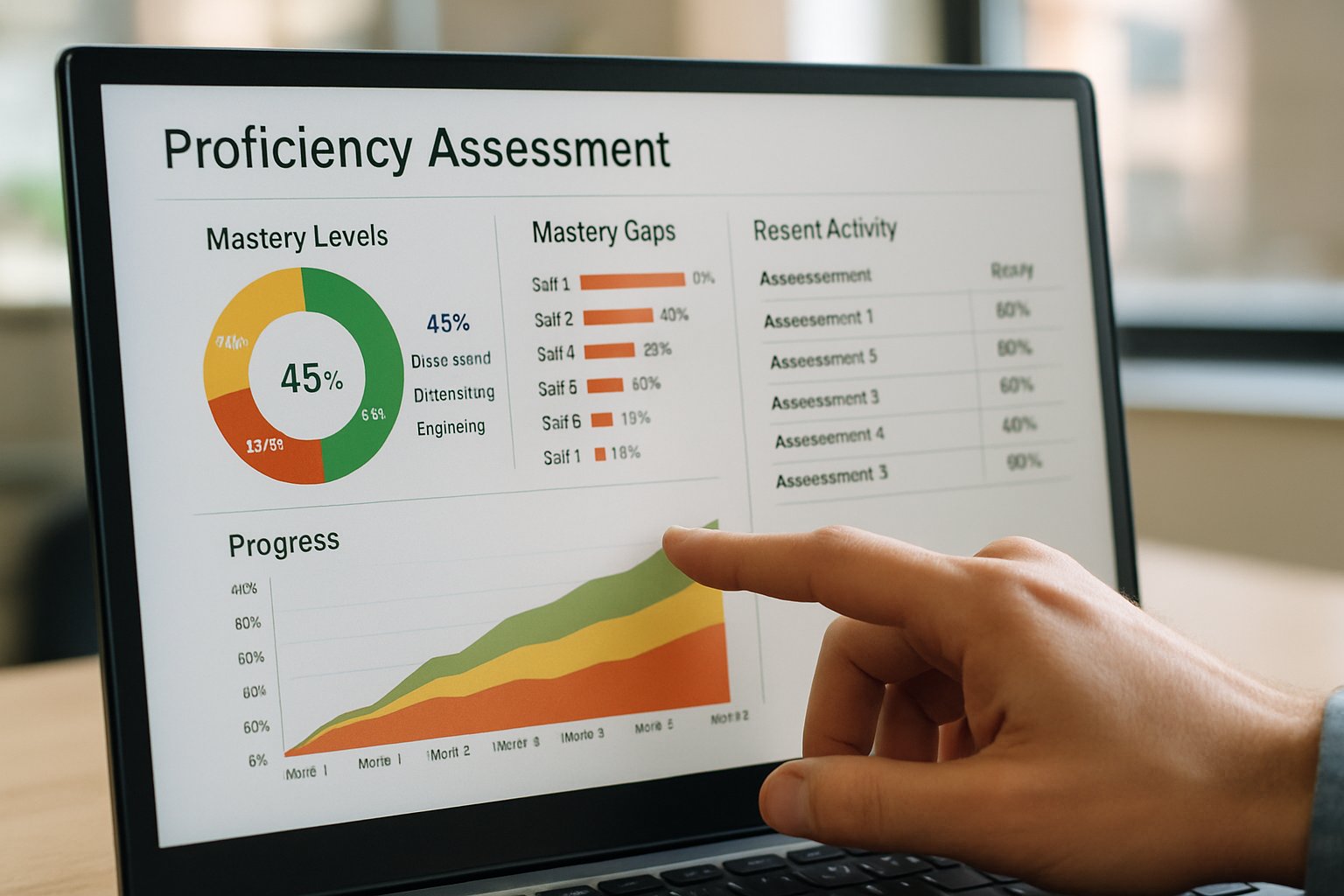
EdTech budgets face scrutiny, yet demand for measurable growth rises. Data dashboards now reveal immediate gaps, while adaptive quizzes reshape daily instruction. Consequently, district leaders increasingly pursue precision without added testing time. Proficiency Assessment Engines sit at the heart of this shift, diagnosing mastery and guiding each learner’s next step.
Moreover, global forecasts suggest explosive spending on adaptive technology this decade. Analysts project thirty percent compound growth, although estimates vary by source. Nevertheless, success depends on robust psychometrics, careful integration, and transparent evidence. This article unpacks engine mechanics, leading vendors, and current research. Finally, risks, privacy pressures, and deployment strategies receive equal attention.
EdTech Market Momentum Insights
Market watchers see adaptive tools moving from pilot to policy priority. Grand View Research places AI education at US$5.9 billion in 2024, rising to US$32.3 billion by 2030. Mordor Intelligence forecasts an even steeper climb toward US$41 billion. Consequently, investors back platforms promising faster mastery verification.
- 31% projected CAGR, 2025-2030 (Grand View)
- 3 million daily learners served by Learnosity APIs
- Thousands of districts using Edmentum Exact Path
However, funding alone cannot guarantee impact. District leaders now demand verified results from Proficiency Assessment Engines. Growing certification programs, including Digital Promise’s evidence badges, reflect this accountability shift.
These figures confirm significant momentum. In contrast, they also heighten scrutiny on vendor claims.
Core Engine Components Explained
Every engine combines five technical layers. Item banks map granular skills to standards. Adaptive algorithms, often IRT or Bayesian, select optimal questions. Scoring models convert responses into mastery probabilities. Content recommendation logic prescribes next steps. Finally, dashboards translate data into actionable insights. Therefore, educators receive continuous, low-stakes Learning Assessment without excessive testing time.
Edmentum’s Standards Mastery add-on illustrates this stack in action. The module injects short diagnostics, then routes practice to precise objectives. Similarly, Wiley’s Knewton Alta uses mastery thresholds to remediate higher-education gaps. Proficiency Assessment Engines thus convert raw responses into individualized pathways, advancing Education Personalization goals.
Understanding these layers clarifies procurement questions. Subsequently, leaders can prioritize validation studies and integration features.
Key Players Shaping Segment
Several companies now define expectations. Edmentum couples Exact Path with an Impact Report linking usage to growth. Instructure’s MasteryConnect adds Diagnostic Classification Models for quick standards checks. Imagine Learning secured ESSA Tier-3 proof for MyPath, signaling evidence maturity.
Embedded solutions thrive as well. Learnosity positions its assessment APIs as white-label infrastructure. Consequently, niche courseware teams integrate sophisticated Proficiency Assessment Engines without rebuilding psychometrics.
Professionals can enhance their expertise with the AI+ UX Designer™ certification. Designing respectful assessment interfaces demands such cross-disciplinary skill.
This competitive landscape drives rapid feature releases. However, independent evidence still lags behind marketing velocity.
Evidence And Ongoing Debates
Systematic reviews paint a mixed picture. BMJ Open meta-analysis reports positive yet heterogeneous effects from adaptive e-learning. RAND researchers observe modest gains alongside major implementation challenges. Nevertheless, vendors highlight district case studies with promising growth percentages.
Digital Promise’s certification roadmap attempts to bridge this gap. Imagine MyPath’s Tier-3 award required quasi-experimental research. Additionally, Edmentum’s real-time dashboard provides transparent correlation metrics. Despite progress, critics warn that many Proficiency Assessment Engines still rely on internal studies.
These tensions underscore the need for rigorous Learning Assessment design. Consequently, buyers now request raw datasets and third-party audits.
Critical Implementation Success Factors
Tools alone rarely deliver transformative results. Districts must secure curriculum alignment, teacher training, and data workflows. Integration with SIS and LTI lowers sign-on friction. Moreover, clear privacy policies reassure stakeholders.
Experts recommend four practical steps:
- Select engines with published psychometric validation.
- Embed dashboards within existing instructional routines.
- Provide sustained professional development on data use.
- Audit data governance annually.
Applying these steps unlocks the personalization promise. Subsequently, Education Personalization efforts can scale without eroding teacher capacity.
Risks Privacy And Fairness
Adaptive algorithms can misclassify students when item banks embed bias. Data retention policies also raise parental concerns. Furthermore, state regulations now mandate clearer consent language.
Districts therefore demand vendor transparency. Common Sense Privacy seals, independent pen tests, and breach notifications become procurement prerequisites. Proficiency Assessment Engines that expose explainable scores gain trust faster.
Risk mitigation preserves learner equity. Nevertheless, continuous monitoring remains essential as models evolve.
Future Outlook And Action
Market signals suggest broader adoption across K-12, higher-education, and corporate training. Engine embeddability will accelerate niche innovation, while certification schemes tighten evidence expectations. Meanwhile, privacy frameworks mature, forcing vendors to refine data stewardship.
Educators, designers, and policymakers should collaborate now. Robust Learning Assessment strategies combined with transparent algorithms can translate scale into equitable impact. Prospective practitioners can upskill through programs like the linked AI+ UX Designer™ credential.
Consequently, Proficiency Assessment Engines appear poised for mainstream status. Stakeholders who prepare thoughtfully will reap both performance gains and learner trust.
In summary, explosive market growth, evolving evidence standards, and advancing technology define today’s assessment landscape. However, disciplined deployment and vigilant oversight remain non-negotiable. Explore certifications, follow emerging research, and join the conversation shaping next-generation Education Personalization.
Disclaimer: Some content may be AI-generated or assisted and is provided ‘as is’ for informational purposes only, without warranties of accuracy or completeness, and does not imply endorsement or affiliation.


