

AI CERTs
3 months ago
Why Decision Intelligence Dashboards Outpace Traditional BI
Boards and C-suites are growing impatient with pretty charts that rarely change outcomes. Consequently, a new generation of Decision Intelligence Dashboards is taking center stage. These systems combine data, AI insights, and workflow automation to collapse the gap between awareness and action. Furthermore, executives increasingly demand conversational explanations rather than static graphs. Analysts note that executive analytics programs now anchor transformation budgets. Microsoft, ThoughtSpot, and specialist startups have therefore retooled roadmaps to satisfy this urgency. Grand View Research values the decision intelligence market at roughly USD 15 billion today. In contrast, ResearchAndMarkets projects more than USD 50 billion by 2030. Nevertheless, definitions vary, so most observers reference a wide range. Despite this variance, momentum is undeniable. Forward-looking enterprises see Decision Intelligence Dashboards as a practical route to measurable advantage.
Decision Intelligence Dashboards Rise
Gartner defines decision intelligence as engineering the path from data to action. Moreover, that definition elevates dashboards from passive lenses to dynamic command centers. Vendors embed generative copilots, decision models, and provenance logs directly inside the canvas. However, traditional BI still handles scheduled reports and regulatory filings. Many enterprises therefore run both styles during transition.
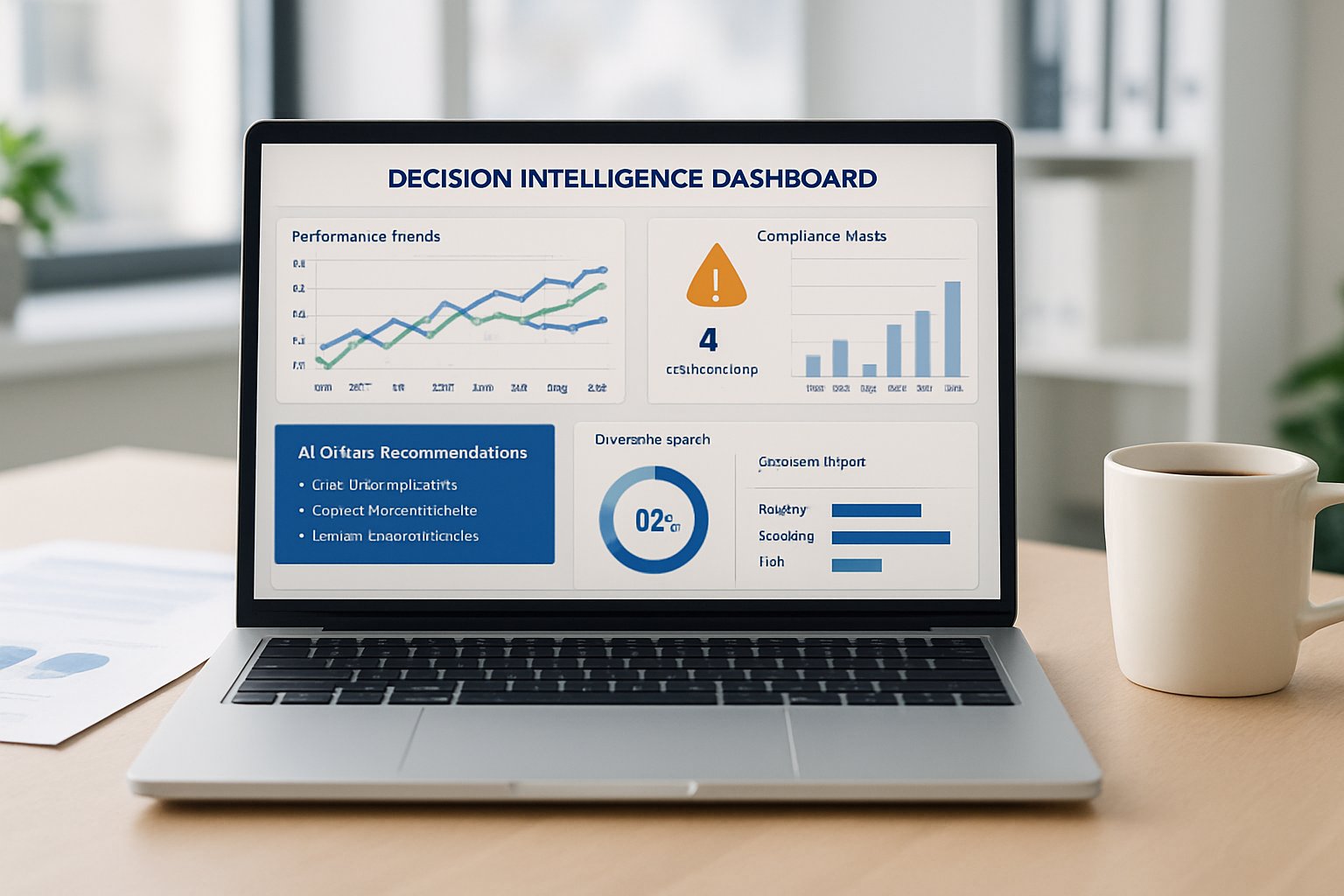
Adoption accelerates because natural-language chat lowers skill barriers. Consequently, frontline managers receive data-driven guidance without waiting for analysts. Forrester surveys show reduced “time-to-action” metrics by up to 30 percent in early pilots. The discipline also integrates prescriptive analytics, allowing users to simulate trade-offs before committing resources.
These shifts confirm that Decision Intelligence Dashboards now represent a distinct platform category. The next section reviews concrete market signals supporting that claim.
Market Momentum Signals Surge
Market estimates vary yet all point upward. Grand View Research estimates USD 15.22 billion revenue in 2024 with 15 percent CAGR. In contrast, ResearchAndMarkets predicts USD 50.1 billion by 2030, implying 24 percent CAGR. Both studies attribute growth to cloud upgrades, AI insights, and regulatory pressure for traceable decisions.
Notable milestones illustrate the surge:
- Microsoft repositioned Power BI as an AI-first decision platform throughout 2025.
- ThoughtSpot acquired Mode to accelerate natural-language analytics and decision playbooks.
- Gartner released its inaugural Market Guide for Decision Intelligence Platforms.
- EU AI Act milestones increased demand for governance features in Decision Intelligence Dashboards.
These signals suggest capital and talent are converging around the discipline. Consequently, leaders must grasp the underlying concepts before investing.
Core Concepts Redefined Quickly
Decision intelligence intertwines descriptive, predictive, and prescriptive analytics within explicit decision models. Additionally, platforms record inputs, rules, and outcomes to enable audits and learning loops. Explainability layers satisfy regulators and build stakeholder trust. Meanwhile, conversational copilots translate complex statistics into plain language recommendations.
Prescriptive analytics distinguishes the approach from historical dashboards. Users can test scenarios, receive optimized actions, and trigger workflows without leaving the screen. Therefore, Decision Intelligence Dashboards empower teams to validate options before execution.
Understanding these pillars prepares buyers to evaluate vendor offerings. The following section explores how suppliers are reshaping portfolios.
Major Vendors Shift Strategies
Microsoft leads with Copilot capabilities that write DAX, generate narratives, and launch Power Automate flows. Moreover, these features signal a pivot from visualization to orchestration. Google, Salesforce, and Qlik have similarly embedded AI insights inside their suites.
ThoughtSpot’s purchase of Mode demonstrates consolidation around code-first and search-first techniques. Consequently, hybrid workflows unite analysts, citizen developers, and executive analytics stakeholders on one canvas. Specialists like Cloverpop and FlexRule focus on decision modeling and governance, complementing cloud giants.
Because vendor roadmaps now emphasize automation and compliance, organizations can adopt Decision Intelligence Dashboards without stitching separate tools. However, choosing a stack requires clear use cases, as discussed next.
Executive Analytics Use Cases
Chief supply chain officers simulate rerouting strategies with live profit and risk projections. Meanwhile, finance leaders adjust real-time pricing based on margin alerts and regulatory constraints. Healthcare administrators balance staffing, compliance, and patient outcomes through conversational guidance. Each scenario demands immediate, explainable AI insights delivered through secure interfaces.
These examples confirm that executive analytics now extends beyond hindsight reporting. Consequently, organizations prioritize decision orchestration when selecting platforms. The next section quantifies the benefits realized so far.
Benefits Driving Rapid Adoption
Early adopters report measurable gains. Moreover, benefits appear across operational and strategic horizons.
- Shorter decision cycles: some pilots reduced analysis-to-action windows from hours to minutes.
- Higher decision quality: prescriptive simulations lowered inventory costs by up to 12 percent.
- Democratization: natural-language search widened executive analytics access beyond specialist teams.
- Governance: full provenance logs simplified EU AI Act compliance audits.
Because Decision Intelligence Dashboards integrate actions, organizations can embed approval workflows and trigger alerts instantly. Additionally, copilots surface AI insights with confidence scores, improving trust.
The collective impact boosts competitiveness and employee satisfaction. However, significant challenges remain, as the following section explains.
Barriers Temper Early Enthusiasm
Data debt frequently blocks progress. Many firms lack unified semantic models or timely event streams. Consequently, copilots hallucinate or return incomplete explanations, eroding credibility. Integration complexity also rises when legacy systems remain siloed.
Regulation adds further pressure. The EU AI Act classifies many decision scenarios as high risk. Therefore, organizations must maintain audit trails, human oversight, and fallback processes. Skills shortages compound matters because decision architects and modelers are scarce.
Vendor lock-in and shifting definitions also worry buyers. Market reports disagree on scope, making ROI calculations harder. Nevertheless, structured roadmaps can mitigate these issues, as outlined next.
Strategic Roadmap For Enterprises
Leaders should first inventory critical decisions that require speed, transparency, and repeatability. Subsequently, they must align data engineering plans with those priorities. Establishing a governed semantic layer ensures Decision Intelligence Dashboards draw from accurate sources.
Organizations should launch limited pilots focusing on one high-value workflow. Additionally, they ought to embed human-in-the-loop checkpoints to satisfy regulators. Professionals can enhance their expertise with the AI Engineer™ certification, gaining skills to design production-ready decision models.
Procurement teams must evaluate explainability, automation depth, and integration openness. Meanwhile, change-management leaders should train staff on interpreting AI insights responsibly. By staging adoption, enterprises build trust while unlocking value.
These roadmap steps convert strategic intent into measurable outcomes. The conclusion recaps key messages and offers next actions.
Decision Intelligence Dashboards are moving from hype to production reality. Moreover, organizations that act early gain speed, transparency, and compliant governance. Executive analytics teams receive timely AI insights rather than stale spreadsheets. Nevertheless, success depends on strong data foundations, responsible change management, and certified talent. Consequently, professionals should study emerging frameworks and pursue the AI Engineer™ credential. Adopt Decision Intelligence Dashboards methodically, and transform decisions into a sustainable competitive weapon. Meanwhile, vendors will keep adding governance features as the EU AI Act enforcement timeline approaches. Therefore, now is the optimal moment to pilot, measure, and scale these intelligent decision frameworks.


