

AI CERTS
2 months ago
Wayve’s Embodied Intelligence Lab Targets Robotics Beyond Driving
Therefore, industry stakeholders see strategic value far beyond passenger vehicles. This article dissects the lab's mission, resources, partnerships, and impact on embodied intelligence. Finally, we outline key risks and opportunities for professionals following the self-driving AI sector. Meanwhile, certification pathways offer readers concrete steps to capitalize on emerging robotics demands.
Wayve Vision Embodied Intelligence
Wayve frames its strategy around embodied intelligence learned from camera fleets. However, Alex Kendall emphasizes that true generalization demands agents that perceive, reason, and act together. Consequently, the firm rejects heavy HD maps and rule-based pipelines.
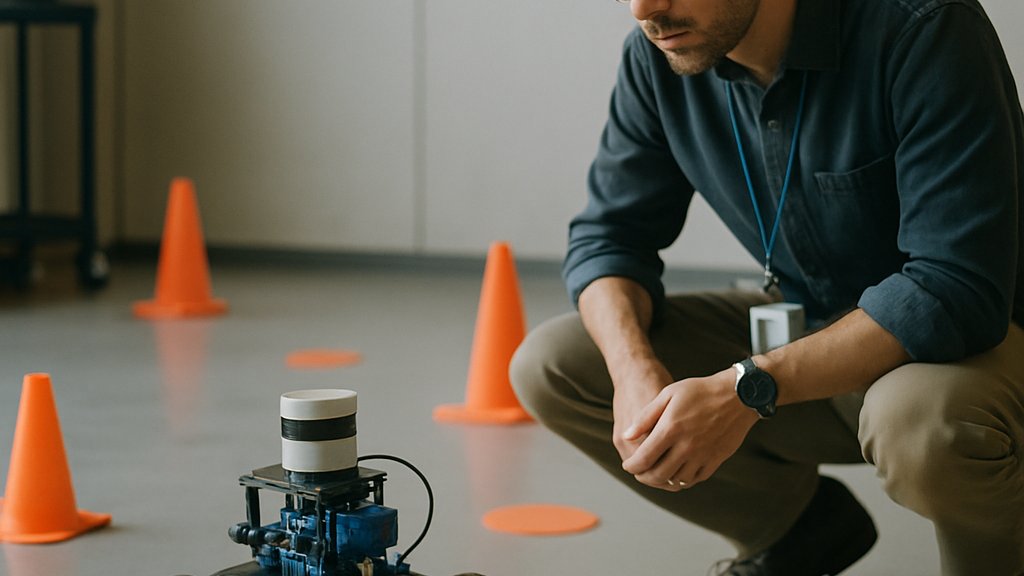
Instead, one foundation model ingests diverse global scenarios and outputs real-time control signals. In contrast, map-centric competitors tweak per-city code, slowing expansion and inflating cost. Wayve cites its zero-shot drives across Manila, Berlin, and Nairobi as early validation.
Furthermore, internal simulation tools, branded GAIA, synthesize scenes well beyond available road footage. These assets accelerate training while reducing risky on-road miles. Therefore, the vision sets the stage for cross-domain transfer into robotics warehousing or delivery.
Wayve's model-centric outlook positions it to scale faster than map-bound rivals. Such agility underpins the company's decision to formalize deeper exploratory work. Consequently, the Embodied intelligence lab became the vehicle for that exploration.
Embodied Intelligence Lab Mission
Shotton describes the Embodied intelligence lab as a sandbox untethered from quarterly product goals. Moreover, the unit will probe cause-effect reasoning, long-horizon planning, and self-supervised learning. Teams will publish foundational research and share datasets when safe and ethical.
Wayve executives note that abundant driving video, sensor traces, and compute can seed robotics breakthroughs. Consequently, the lab seeks transfer learning gains that shorten training for warehouse robots or drones. Self-driving AI failures will be replayed to teach agents about physical consequences.
Additionally, the research lab maintains an open science ethos, though some IP may remain proprietary. Regulatory transparency needs also motivate selective publication of safety metrics.
The mission blends academic freedom with corporate scale. Results could influence many embodied intelligence deployments beyond passenger cars. Meanwhile, sustained funding underwrites this ambitious charter.
Funding Fuels Research Ambition
Wayve closed a $1.2 billion Series D in 2026 at an $8.6 billion valuation. Moreover, investors like Microsoft, SoftBank, and NVIDIA view embodied intelligence as a massive addressable market.
- $1.2 billion Series D raised in 2026
- Post-money valuation near $8.6 billion
- $1.05 billion Series C closed in 2024
- Total disclosed capital about $1.5 billion
Previous rounds, including the $1.05 billion Series C, already bankrolled global driving deployments. Consequently, Wayve can allocate meaningful capital to blue-sky questions without starving commercialization.
Shotton receives latitude to hire interdisciplinary talent across perception, reinforcement learning, and safety engineering. Additionally, competitive salaries and London’s research ecosystem attract specialists away from traditional robotics labs.
Generous funding cushions the lab against near-term revenue pressure. Therefore, researchers may focus on long-horizon autonomy science. Next, we examine the data engines fueling that science.
Data Assets Power Learning
Wayve claims 70-country driving data captured by passenger vehicles and delivery vans. Furthermore, Uber collaborations add ride-hailing scenarios with challenging urban density.
GAIA world models augment real footage, producing synthetic edge cases like unusual pedestrians or sensor faults. In contrast, many competitors still rely on scripted simulators with brittle behavior trees.
Self-driving AI researchers crave such scale because rare events dominate safety risk. Consequently, the Embodied intelligence lab can train agents that anticipate low-probability hazards.
Additionally, the research lab will study how domain randomization increases robustness across geography and hardware.
Rich real and synthetic data improves generalization speed. That foundation empowers the lab to tackle broader robotics challenges. Talent will be critical to realizing those challenges.
Talent Led By Shotton
Jamie Shotton joined Wayve from Microsoft Research, where he pioneered body-tracking vision systems. Consequently, his background in depth sensing informs the lab's 3D perception work.
Moreover, Wayve has recruited alumni from DeepMind, CMU, and Imperial College. These scientists bring expertise spanning embodied intelligence, reinforcement learning, and hardware prototyping.
Mentorship structures pair new doctoral hires with senior industry engineers for rapid onboarding. Meanwhile, rotating secondments let vehicle program staff cross-pollinate ideas into the research lab.
Strong leadership and diverse hires safeguard innovation velocity. Consequently, Wayve expects cumulative knowledge gains across projects. Partnerships further multiply that knowledge.
Strategic Partnerships And Trials
Wayve partners with Microsoft for cloud compute and developer tools. Additionally, NVIDIA supplies GPU clusters optimized for foundation models.
OEM investors Nissan, Mercedes-Benz, and Stellantis deliver production vehicles and safety validation routes. Meanwhile, Uber runs London robotaxi trials that expose models to paying riders.
These collaborations generate feedback loops vital for embodied intelligence refinement. Consequently, lessons learned feed directly into the Embodied intelligence lab roadmaps.
Self-driving AI regulators will scrutinize such trials, demanding transparent disengagement numbers. In contrast, Wayve claims its model requires fewer scripted interventions than map-centric peers.
Partnership ecosystems de-risk technical bets while broadening deployment options. Therefore, continuous field data sharpens experimental focus inside the lab. Even with partners, risks remain.
Opportunities And Ongoing Risks
Safety verification tops the risk list for end-to-end networks. Furthermore, regulators may demand explainability tools that still lag research frontiers.
Wayve counters with offline testing in billions of simulated miles inside GAIA. Nevertheless, critics argue that synthetic performance cannot fully mirror human unpredictability.
Stakeholders also worry about hype outpacing validation of the 500-city zero-shot claim. Consequently, independent audits and open datasets will be critical credibility drivers.
Moreover, capital intensity could surge if prolonged safety pilots delay revenue. Yet, the Embodied intelligence lab provides optionality, enabling pivot toward profitable robotics niches.
Risks span technical, regulatory, and financial domains. However, proactive transparency and diversified applications can mitigate many concerns. The final section outlines that diversified future.
Roadmap Beyond Autonomous Driving
Wayve envisages warehouse pallet movers, agricultural drones, and sidewalk delivery bots running one shared model. Furthermore, learnings from self-driving AI can accelerate controls for these compact platforms.
Researchers plan to release annual benchmarks measuring transfer efficiency across tasks and form factors. Additionally, the Embodied intelligence lab will explore tactile sensing so agents reason with multimodal input.
Professionals can deepen expertise through the AI Robotics Specialist™ certification. Consequently, future job seekers will align with the lab’s emerging skill demands.
Wayve's roadmap positions it across mobility, logistics, and industrial robotics. Therefore, continuous model refinement will compound competitive advantage.
Conclusion And Outlook
Wayve's new research lab crystallizes its belief that real-world data fuels general machine autonomy. Generous capital, elite partnerships, and Jamie Shotton’s leadership create favorable conditions for breakthrough science. However, regulatory scrutiny and safety validation remain formidable hurdles. Nevertheless, cross-domain experiments could diversify revenue streams and steady investor confidence. Future milestones will include published benchmarks, open datasets, and additional autonomy pilots. Consequently, professionals tracking self-driving AI should monitor Wayve’s publications and deployment reports. Explore the linked certification to stay competitive as embodied machines permeate diverse industries.
Disclaimer: Some content may be AI-generated or assisted and is provided ‘as is’ for informational purposes only, without warranties of accuracy or completeness, and does not imply endorsement or affiliation.


