

AI CERTS
2 months ago
Stanford HAI’s New Era of AI Organizational Science
Meanwhile, HR and operations executives face growing pressure to adapt Talent strategies responsibly. This article unpacks the lab’s mission, partnerships, and implications for practitioners.
Stanford Lab Launch Details
The lab opened on May 13, 2026 at Stanford HAI. Melissa Valentine, associate professor of Management Science & Engineering, directs the effort. Additionally, faculty advisers include Amir Goldberg, Beth Bechky, and Sara Singer, with Bob Sutton as senior advisor. Launch support came from Google.org, underscoring deep industry interest. In contrast, the lab maintains academic governance to protect research integrity.
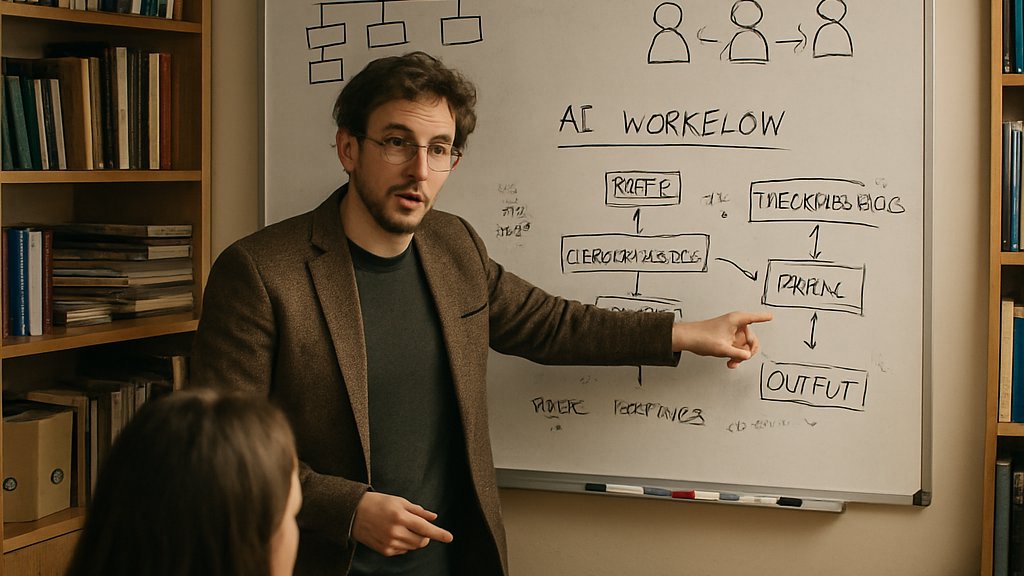
These facts anchor the initiative’s credibility. However, understanding its research mandate requires deeper exploration.
Research Mission And Focus
The lab’s mission is clear: establish an empirical science explaining how AI reshapes coordination, decision rights, and performance. Moreover, researchers will integrate organizational theory, behavioral science, and machine learning to study live workplaces. Field experiments will analyze how AI tools reallocate Talent time, alter team dynamics, and influence culture. Therefore, outputs should help executives deploy systems that augment human capability rather than replace it.
This focus promises actionable frameworks for Org Science scholars and managers. Subsequently, attention shifts to the Grand Challenge that seeded many research ideas.
Grand Challenge Highlights Overview
Prior to the lab’s debut, Stanford HAI and DeepMind ran the AI for Organizations Grand Challenge. More than 200 teams from 156 universities submitted proposals. Ultimately, 13 finalists pitched in person for a $100,000 prize plus engineering support at DeepMind. The winning concept, a “large coordination model,” used transformer architectures to predict effective team sequences. Consequently, the challenge showcased global appetite for advancing AI Organizational Science.
These outcomes validate the lab’s collaborative model. Nevertheless, leadership matters, so let us examine the people and sponsors involved.
Faculty And Industry Partners
Core faculty blend deep Org Science expertise with data skills. Amir Goldberg studies social network analytics, while Beth Bechky investigates workplace learning. Furthermore, Sara Singer focuses on health-care operations, providing cross-sector insight. On the industry side, DeepMind offers compute resources, and Google.org funds program growth. Nevertheless, critics note potential conflicts when corporate backers influence research scope. Therefore, Valentine has pledged transparent protocols and independent Institutional Review Board oversight.
This governance aims to balance speed with rigor. Meanwhile, professionals wonder how findings translate into day-to-day practice.
Opportunities For Skilled Practitioners
Managers can apply early insights to redesign workflows and upskill staff. For example, the lab’s forthcoming executive programs will teach data-driven AI adoption. Additionally, professionals can enhance their expertise with the AI Learning & Development™ certification. Such credentials help Talent teams assess readiness and build shared vocabulary. Moreover, Org Science consultants gain new metrics for measuring coordination gains. Consequently, companies reduce risky trial-and-error deployments.
- Evidence-based playbooks for AI rollouts
- Benchmarks on job redesign impact
- Access to cross-industry case studies
These benefits underscore the lab’s practical value. In contrast, unresolved ethical risks demand equal attention.
Risks And Ethical Considerations
Deploying workplace AI raises privacy, surveillance, and fairness issues. Moreover, corporate funding may skew research questions or limit negative findings. The lab addresses these concerns through open publications, data governance charters, and multi-stakeholder advisory boards. Nevertheless, observers urge disclosure of DeepMind agreements and dataset protections. Therefore, continuous external review will be crucial for sustaining public trust in AI Organizational Science.
These safeguards set a responsible foundation. Subsequently, stakeholders will watch future research milestones closely.
Future Research Watchpoints Ahead
Upcoming studies will track AI’s effect on employee well-being, creative output, and equitable Talent mobility. Furthermore, Grand Challenge papers will enter peer review, and code releases could enable replication across sectors. Stanford HAI also plans short courses translating findings for policy makers. Consequently, Org Science communities should prepare to integrate fresh metrics and methodologies. Additionally, the lab may publish comparative analyses of DeepMind deployments versus other corporate contexts.
These deliverables will refine practice standards. However, sustained collaboration will determine whether insights truly scale.
Conclusion
Stanford HAI’s new lab positions the university at the forefront of AI Organizational Science. Furthermore, partnerships with DeepMind and top faculty promise robust, actionable research. Org Science leaders gain empirical playbooks, while Talent teams access new development pathways. Nevertheless, ethical vigilance remains essential. Ultimately, informed practitioners can leverage these insights and pursue advanced learning through the linked certification. Act now to future-proof your organization and career.
Disclaimer: Some content may be AI-generated or assisted and is provided ‘as is’ for informational purposes only, without warranties of accuracy or completeness, and does not imply endorsement or affiliation.


