

AI CERTS
2 hours ago
Samsung Boosts AI Server SSDs for Next-Gen Data Centers
Such throughput rewrites workflow economics for inference clusters and HPC servers alike. Therefore, hyperscalers are rushing to lock supply before rivals do.
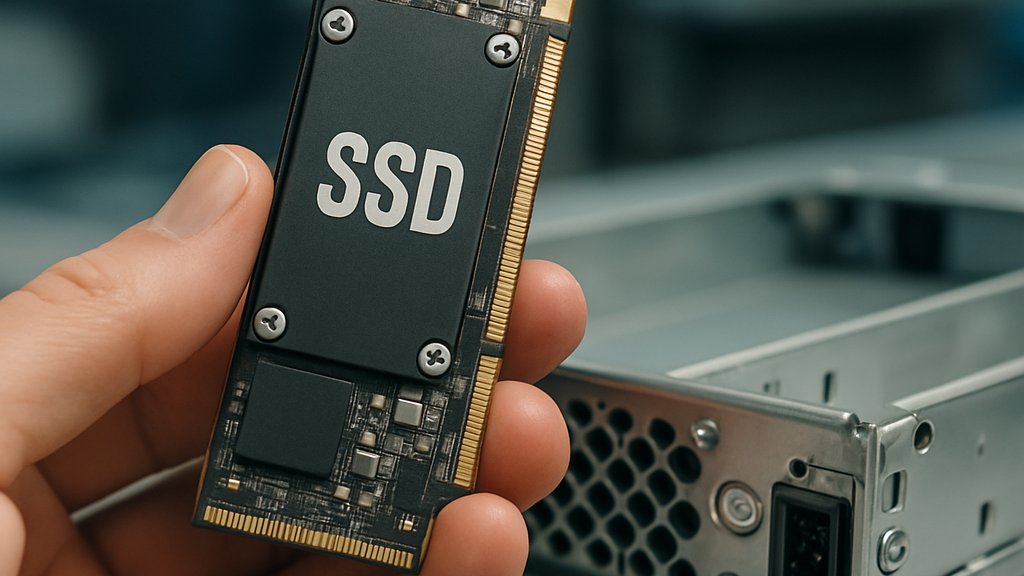
In contrast, previous PCIe 5.0 drives peaked near 14 GB/s, forcing array level striping. Meanwhile, analysts at TrendForce estimate enterprise storage revenue rose 28 percent year-on-year due to AI demand. Consequently, the PM1763 could amplify that trajectory and reshape procurement strategies across global AI infrastructure. Furthermore, Samsung showcased the drive beside HBM4 modules within NVIDIA’s Vera Rubin platform, underlining ecosystem momentum.
Enterprise Market Drivers Surge
Demand for generative models has exploded across fintech, biotech, and media workflows. Moreover, training parameters now enter the trillion scale, which multiplies checkpoint sizes. TrendForce notes that global enterprise storage shipments topped 85 exabytes in 2025. Consequently, capacity alone no longer suffices; predictable latency now decides revenue.
Therefore, hyperscalers prioritise SSDs that maximise data throughput per watt. PCIe 6.0 doubles link bandwidth, making single-drive upgrades attractive. Additionally, AI Server SSDs reduce rack count, freeing power budgets for accelerators. Nevertheless, supply remains constrained, intensifying competition between cloud leaders.
These forces elevate storage from supporting role to headline act. Consequently, vendors race to deliver faster silicon. Next, we examine how Samsung positions its latest drive.
Samsung PM1763 Key Details
Samsung’s PM1763 enters mass production barely four months after engineering samples surfaced at GTC. Furthermore, the drive employs ninth-generation V-NAND stacked 236 layers deep and a new 4 nm controller. Sequential reads peak at 28,400 MB/s, while writes reach 21,900 MB/s on the 16 TB model. Therefore, a 40 GB large language model loads in about 1.4 seconds.
- Interface: PCIe 6.0 x4, NVMe 2.1 compliance.
- Capacities: 4 TB, 8 TB, 16 TB.
- Random read IOPS: 5.6 million, Samsung preliminary.
- Power efficiency: 1.8× improvement versus PM1753.
- Post-quantum cryptography, TEE, TDISP support.
Moreover, Samsung designed the module for direct-to-chip liquid cooling. Consequently, sustained workloads avoid thermal throttling common with legacy air-cooled bays. The firm positions its AI Server SSDs as the storage pillar of Vera Rubin reference racks.
PM1763 blends headline speed with enterprise resilience. Consequently, Samsung hopes to define the reference standard for AI Server SSDs. Meanwhile, Micron plans to contest that claim.
Micron Response Intensifies Competition
Micron entered volume production of its 9650 PCIe 6.0 SSD during March 2026. Additionally, the company touts 28 GB/s reads and 5.5 million random IOPS. In contrast, Micron focuses on dense liquid-cooled racks serving HPC servers running advanced simulations. Consequently, analysts expect price pressure as both suppliers court the same hyperscale accounts.
Micron chief business officer Sumit Sadana emphasised integrated platform engineering with GPU vendors. Moreover, Micron’s simultaneous HBM4 ramp strengthens that narrative. Therefore, procurement teams may favour dual-sourcing to hedge supply volatility. The firm also markets its AI Server SSDs aggressively to differentiate on service levels.
Competition secures innovation and moderates contract pricing. Nevertheless, qualification cycles will decide ultimate market share. Next, we explore integration hurdles delaying mainstream rollouts.
Complex Platform Integration Hurdles
New transport speeds demand fresh motherboard traces, retimers, and firmware validation. Furthermore, PCIe 6.0 introduces PAM4 signalling with forward-error correction, raising design complexity. Therefore, many OEMs postpone adoption until second-generation server platforms arrive. Gen6 AI Server SSDs impose new engineering requirements that few systems yet satisfy.
Thermal design also complicates rollouts. In contrast with prior generations, Gen6 SSDs often require liquid loops routed beside accelerators. Additionally, power supply units must handle transient peaks without sagging voltage rails.
Platform readiness will limit near-term drive allocation. Consequently, consumer trickle-down remains distant. Next, we assess cooling and efficiency gains once integrations complete.
Advanced Cooling And Efficiency
Direct-to-chip cold plates sit atop the PM1763 controller and hot NAND packages. Moreover, Samsung’s lab measurements show 1.8× better watts per gigabyte moved versus its predecessor. Consequently, operators can shift identical data throughput while shaving rack energy budgets.
Meanwhile, liquid loops lower inlet temperatures for adjacent GPUs, extending boost clocks. Therefore, holistic cooling elevates overall AI infrastructure utilisation.
Effective cooling transforms raw bandwidth into reliable service levels. Subsequently, security also influences deployment decisions.
Enhanced Security And Compliance
Samsung enables post-quantum cryptography algorithms alongside traditional AES-256 XTS. Additionally, trusted execution environments enforce runtime isolation for multi-tenant AI workloads. Therefore, cloud providers can meet forthcoming regulatory frameworks on data sovereignty.
Professionals can validate their skills with the AI Cloud Architect™ certification. Moreover, independent credentials accelerate hiring for zero-trust storage initiatives.
Security features future-proof capital investments. Consequently, strategic outlooks now dominate boardroom conversations.
Strategic Industry Outlook Ahead
TrendForce projects enterprise storage revenue will surpass US$24 billion in 2027, driven by AI Server SSDs demand. Furthermore, controller vendors predict NAND shortages as hyperscalers reserve capacity two years ahead. Therefore, early movers gain allocation priority.
Consequently, Samsung, Micron, and SK hynix race to secure preferred-supplier agreements. Additionally, NVIDIA’s Vera Rubin platform aligns storage, memory, and compute into pre-validated stacks, shortening deployment cycles.
Data throughput improvements will eventually permeate edge appliances. Nevertheless, PCIe 6.0 rollouts will remain datacenter-centric until cost, cooling, and power designs mature.
The storage landscape is entering a high-velocity phase. Therefore, proactive planning ensures enterprises capture competitive advantage.
Samsung’s PM1763 announcement signals a pivotal moment for AI Server SSDs. Moreover, the leap to PCIe 6.0 doubles data throughput and slashes latency for enterprise storage. However, platform readiness, cooling complexity, and supply constraints temper immediate ubiquity. Nevertheless, competitive pressure from Micron and others guarantees rapid optimisation. Consequently, decision makers should audit workload bottlenecks, engage vendors early, and leverage certified talent.
Professionals can act now by pursuing the AI Cloud Architect™ credential to guide next-gen AI infrastructure. Furthermore, early adoption secures priority in NAND allocation during projected shortages. Therefore, organisations that move decisively will capture outsized performance gains and cost savings.
Disclaimer: Some content may be AI-generated or assisted and is provided ‘as is’ for informational purposes only, without warranties of accuracy or completeness, and does not imply endorsement or affiliation.


