

AI CERTS
6 months ago
Rockwell Maturity Pyramid Powers Autonomous Operations
This article dissects market forces, technical layers, academic critiques, and practical roadmaps for leaders. Moreover, we highlight readiness tips and certification resources to accelerate capability building. Read on to understand costs, benefits, and governance considerations before automating control loops. Meanwhile, analyst forecasts predict explosive growth for AI in manufacturing over the next decade. However, surveys reveal many plants remain stuck at early data aggregation stages. Therefore, understanding each maturity layer is paramount for realistic planning and investment prioritization.
Market Forces Accelerating Adoption
Several macro trends compel industrial executives to examine smarter production architectures. Additionally, Precedence Research values the AI-in-manufacturing market at USD 5.94 billion in 2024. The firm expects USD 230 billion by 2034, indicating a 44.2% CAGR. In contrast, Deloitte’s 2025 survey shows only 29% of facilities applying AI broadly. Nevertheless, 77% of Rootstock respondents already fund AI pilots and plan budget increases. Governments also subsidize digital retrofits through green manufacturing grants.
Consequently, plants upgrading energy monitoring earn tax rebates and publicity benefits. Meanwhile, supply chain disruptions continue pressuring leaders to localize agile production. Consequently, boardrooms demand roadmaps such as the Rockwell Maturity model to rationalize spend. Moreover, rising energy prices amplify interest because autonomy can trim consumption. Cyber concerns also drive investments in modern, monitored operations and control stacks. These economic and risk vectors jointly accelerate adoption initiatives across global industries. Thus, understanding market momentum contextualizes each maturity milestone.
The data confirms aggressive growth yet uneven deployment. Subsequently, leaders seek structured guidance toward scalable autonomy.
Unpacking Pyramid Stages Clearly
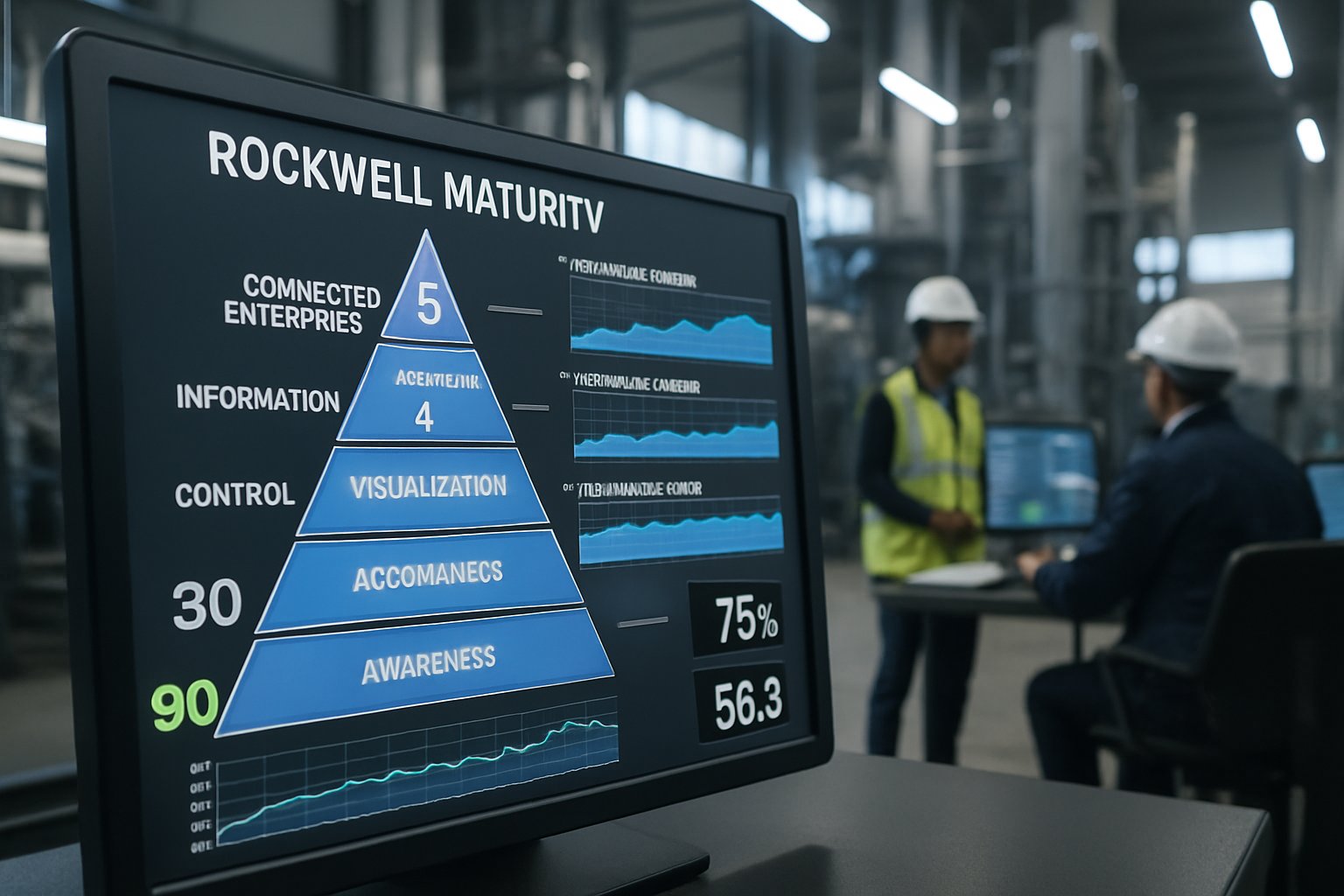
Rockwell presents a four-layer ladder linking data capture to closed-loop control. Because layers build sequentially, gaps at one stage stall progress upward. The Rockwell Maturity pyramid simplifies that progression for cross-functional stakeholders. Below, each tier is summarized.
- Observation: contextualize sensor data for human dashboards.
- Inference: deploy analytics models predicting failure or quality drift.
- Decisioning: utilize prescriptive engines and MPC to recommend control moves.
- Action: enable autonomous controllers that execute validated operations with supervision.
Furthermore, Rockwell links specific technologies to each tier, including edge devices, cloud historians, and embedded MPC. Industrial partners like Microsoft and NVIDIA supply scalable compute for inference workloads. Meanwhile, established control vendors integrate decisioning outputs into PLC logic. This architecture embodies autonomous ambitions while protecting existing capital investments. Consequently, the Rockwell Maturity roadmap often resonates during early design workshops.
Each layer delivers incremental ROI and risk reduction. Therefore, teams should benchmark current capabilities before advancing upward.
Model Predictive Control Gains
Key MPC Outcome Metrics
Decisioning hinges on optimized control, and MPC often leads this charge. Kalypso cites typical throughput uplifts between 4% and 7% for consumer-packaged plants. Yield improvements average 0.25% to 0.5%, while energy drops 2% to 5%. Moreover, Rockwell Maturity advocates highlight how validated MPC models let teams trust automated adjustments. In contrast, manual tuning often lags process drift, eroding efficiency. Consequently, early MPC wins build sponsorship for higher autonomy investments. However, robust data governance remains essential because bad models can propagate errors rapidly.
MPC offers quantifiable benefits supporting the decisioning layer. Subsequently, leaders can justify pilot expansion toward autonomous action.
Comparing Academic Maturity Views
Academic Safety Emphasis Explained
Academia frames autonomy using broader taxonomies than vendor pyramids. For example, Mo et al. describe five levels tied to self-configuration, healing, optimization, and protection. Additionally, the authors stress continuous human oversight regardless of autonomy grade. In contrast, Rockwell Maturity literature mainly spotlights business value and implementation paths. Nevertheless, both frameworks agree that measurable capability checkpoints are indispensable. Moreover, security and safety gating should accompany every stage advancement. Industrial consortia increasingly publish guidance aligning both perspectives. Therefore, blending academic rigor with vendor pragmatism yields balanced governance.
The academic lens complements Rockwell’s business narrative. Consequently, enterprises get a richer checklist for audits and certifications.
Challenges Hindering Full Autonomy
Progress along the ladder is rarely linear. Data silos, legacy protocols, and inconsistent tagging often block inference accuracy. Moreover, skills gaps leave teams unable to tune models or maintain pipelines. In contrast, younger engineers expect modern tooling, creating retention challenges. Therefore, upskilling initiatives become both a technical and HR imperative. Cybersecurity risk also grows because expanded attack surfaces accompany interconnected assets. Additionally, operators may mistrust black-box recommendations, slowing handover to automated controllers. Rockwell Maturity advocates recommend change-management programs and phased validation gates. Nevertheless, even careful pilots can stall without executive sponsorship and clear ROI baselines.
Technical, human, and governance gaps persist. Subsequently, structured roadmaps become critical to sustain momentum.
Roadmap For Scalable Success
Companies should start with a candid capability assessment mapped to pyramid stages. Next, craft a data foundation project that unifies historians, MES, and ERP feeds. Therefore, later inference models receive clean, contextualized inputs. Subsequently, pilot MPC on a constrained process where KPIs are well understood. Document throughput, yield, and energy impacts to build an internal business case.
Moreover, pair pilots with operator training to maintain situational awareness. Professionals can enhance expertise with the AI Prompt Engineer™ certification. Additionally, mentoring circles should review certification concepts during weekly sprints. Consequently, knowledge diffusion speeds pilot replication across sites. Consequently, stakeholder confidence grows, easing governance approvals. Finally, establish a cross-functional steering committee overseeing metrics, cybersecurity, and regulatory compliance. The Rockwell Maturity framework can anchor those scorecards and phase-gate criteria. Therefore, incremental wins compound toward stable autonomous operations.
A disciplined roadmap reduces risk and accelerates ROI. Meanwhile, aligned governance sustains performance across diverse assets.
Conclusion And Next Steps
Rockwell Maturity offers a pragmatic lens for phasing digital transformation. However, market data shows many firms still navigate early observation challenges. Industrial innovators capturing MPC gains prove that disciplined pilots unlock tangible value. Furthermore, academic insights remind leaders to embed safety and cybersecurity at every tier. Consequently, integrating both viewpoints strengthens operational governance. Rockwell Maturity will remain a reference point as standards evolve. Autonomous aspirations succeed only when people, process, and technology mature together. Therefore, use the roadmap, measure progress, and pursue certifications to upskill teams. Start today and move your operations toward scalable, resilient, and profitable autonomy.
Disclaimer: Some content may be AI-generated or assisted and is provided ‘as is’ for informational purposes only, without warranties of accuracy or completeness, and does not imply endorsement or affiliation.


