

AI CERTs
4 months ago
Pattern Recognition Scanners Reshape Fashion Trend Forecasting
Runway images now circulate worldwide within minutes. Consequently, data scientists have armed algorithms to watch every pixel. Their most powerful weapon is Pattern Recognition Scanners. These systems scan social feeds, glossy editorials, and retail catalogues without fatigue. Moreover, retailers trust the machines to spot next-season prints long before human eyes. The resulting speed is rewriting Fashion Trend Forecasting economics. This article unpacks the technology, players, risks, and rewards for executives seeking fresh Industry Insights. Additionally, we highlight certification options for professionals building competitive advantage. Global apparel sales hinge on anticipating demand accurately. Therefore, misjudged trends fuel costly overstock and markdowns. Pattern Recognition Scanners promise earlier clarity by quantifying millions of visual signals in real time. In contrast, conventional forecasters need weeks of manual collation. Subsequently, brands using AI platforms report shorter design cycles and leaner inventories. The next sections explore how the scanners work and where value emerges.
AI Scanners Rise Rapidly
Until recently, trend forecasting relied on seasonal trade shows and expert intuition. However, October 2025 marked a tipping point when NPR profiled Heuritech’s computer-vision pipeline. Major outlets subsequently syndicated the story, validating the technology for cautious merchandisers. Meanwhile, vendors like EDITED and Depop launched joint dashboards that quantified color and pattern acceleration weekly.
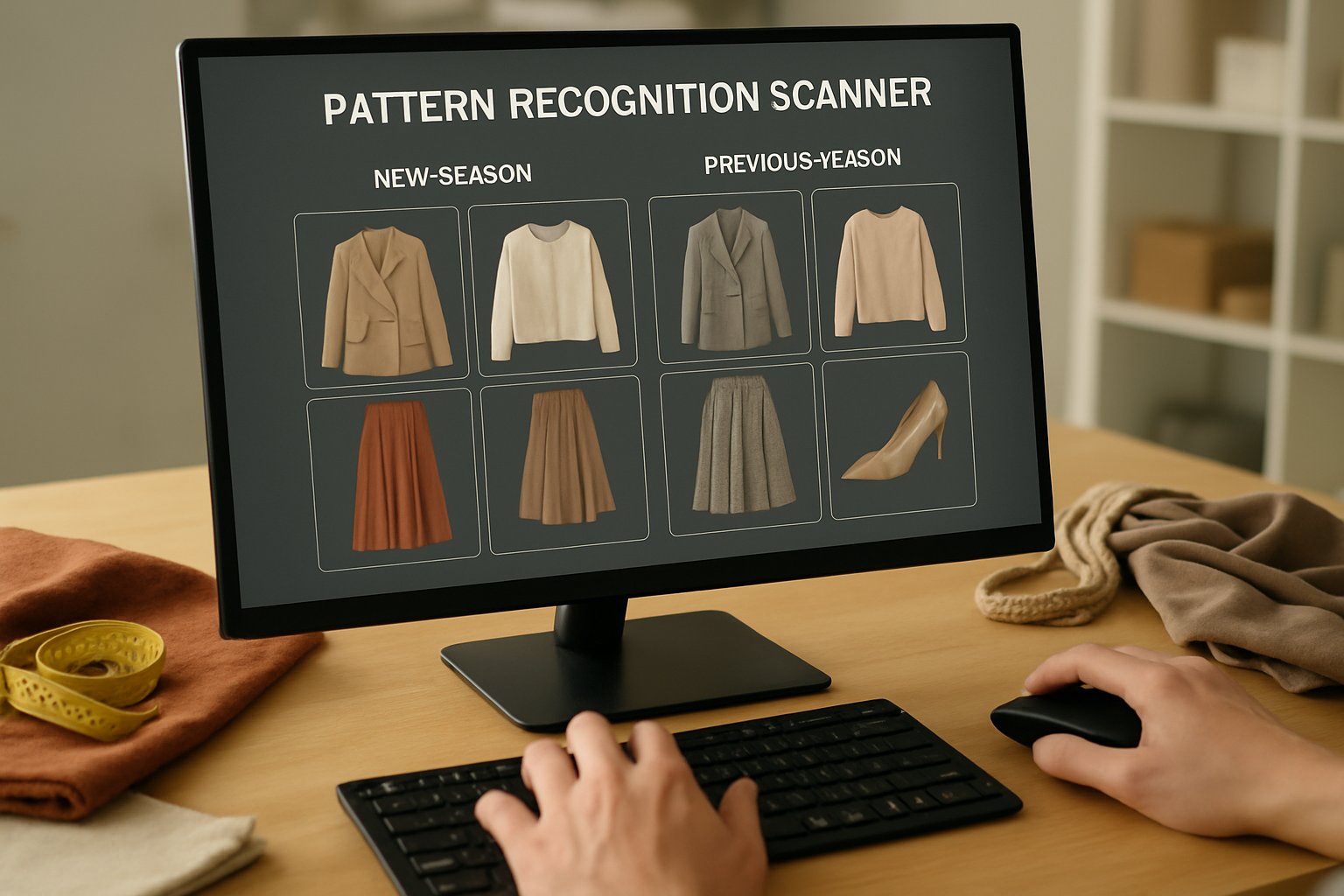
Market researchers echo the buzz. Precedence Research projects the AI-in-fashion market will reach sixty billion dollars by 2034. Consequently, investors now see Pattern Recognition Scanners as core retail infrastructure instead of experimental add-ons. Industry Insights suggest adoption curves mirror earlier e-commerce analytics rollouts.
Nevertheless, consolidation is accelerating. Heuritech, Stylumia, and Trendalytics pursue strategic partnerships with legacy houses such as WGSN. Therefore, competitive differentiation now depends on data breadth, algorithmic transparency, and client service. Pattern Recognition Scanners that explain predictions win executive trust faster.
These developments confirm mainstream momentum. However, understanding the underlying mechanics remains essential.
How Systems Detect Patterns
Computer-vision pipelines begin with massive image ingestion. Millions of Instagram, runway, and catalogue pictures stream into cloud storage every hour. Subsequently, convolutional networks label silhouettes, prints, colors, fabrics, and accessories. Each attribute becomes a time-series signal linked to geography and influencer tier.
Trend modules then forecast acceleration or decline using short-term ARIMA and longer deep-learning models. Additionally, human analysts review outliers to curb viral noise. Francesca Muston of WGSN stresses rigorous validation before commercial release. Consequently, brands receive probability scores for each emerging microtrend.
Pattern Recognition Scanners package these scores into self-serve dashboards or API feeds. Fashion Trend Forecasting teams integrate the feeds with PLM and ERP software within days. Meanwhile, data engineers schedule nightly refreshes to maintain real-time relevance.
The technical pipeline converts messy images into actionable probabilities. Therefore, the next question concerns financial impact.
Business Value And Numbers
Executives care most about revenue, margin, and sustainability. Recent case studies illustrate tangible wins.
- Heuritech claims 20-40% overstock reduction for mid-tier apparel brands.
- EDITED reports 25-50% sales uplift in selected categories after AI adoption.
- Depop analytics added six-figure incremental revenue by surfacing niche prints early.
Moreover, accurate allocation reduces markdown pressure, improving gross margin by several points. Pattern Recognition Scanners contribute by quantifying demand peaks geographically, allowing granular buys. Fashion Trend Forecasting data feeds also highlight slow movers for early course correction.
Analysts still caution that vendor success metrics come from controlled pilots. Consequently, leaders should demand third-party audits before scaling budgets.
Financial evidence appears promising but remains uneven. In contrast, operational benefits show clearer patterns, explored next.
Opportunities For Fashion Teams
Designers gain early visibility into silhouettes trending on Gen-Z social channels. Subsequently, they sketch collections aligned with quantified appetite. Merchandisers employ dashboards to decide how many units to commit per region. Furthermore, e-commerce teams plug visual tags into recommendation engines, improving click-through rates.
Pattern Recognition Scanners also support sustainability goals by minimizing fabric waste. Therefore, CSR officers can link AI investment to ESG reporting. Industry Insights indicate rising consumer preference for responsible production transparency.
Professionals can enhance their expertise with the AI Cloud Architect™ certification. Such credentials improve collaboration between data engineers and creative leads.
Adoption spreads when each role sees direct benefit. However, potential pitfalls deserve equal attention next.
Risks And Ethical Considerations
False positives remain the most cited technical issue. Viral memes may spike social metrics without corresponding purchase intent. Nevertheless, human trend auditors can down-weight these anomalies.
Dataset bias presents deeper challenges. Models trained on Western imagery often overlook non-Western silhouettes and body shapes. Consequently, inventory decisions may exclude significant customer groups.
Privacy advocates warn that scraping public photographs blurs consent boundaries. In contrast, vendors argue images remain publicly accessible. Governance frameworks, such as those proposed by the FashionBrain project, recommend clear opt-out paths.
Pattern Recognition Scanners also accelerate design copying, intensifying intellectual-property disputes. Therefore, legal teams must update monitoring and response playbooks.
Ethical diligence fosters trust and long-term value. Subsequently, market projections become more credible.
Market Outlook And Next
Analysts agree on growth but disagree on exact figures. Precedence Research forecasts compound annual growth near forty percent through 2034. Meanwhile, The Business Research Company projects a smaller yet still robust path.
Wide ranges reflect differing definitions of Fashion Trend Forecasting platforms. Some analysts include supply-chain AI suites, while others count pure SaaS scanners. Industry Insights recommend examining methodology notes before quoting any headline value.
Nevertheless, the directional signal remains clear. Consequently, boardrooms treating AI as optional risk strategic irrelevance.
Pattern Recognition Scanners will likely integrate deeper with inventory management and pricing engines. Furthermore, multimodal models may soon combine text sentiment with visual cues for richer predictions.
Future roadmaps point toward unified demand sensing platforms. Actionable guidance now matters most for decision makers. Therefore, the final section outlines immediate priorities.
Action Steps For Readers
Start by auditing existing data quality across social and sales channels. Then, request pilot access to at least two vendors for comparative evaluation. Moreover, define success metrics beyond vanity accuracy percentages.
Second, secure cross-functional champions from design, merchandising, and IT teams. In contrast, siloed adoption often stalls due to change fatigue.
Third, map legal and ethical guardrails early. Consequently, public backlash risk diminishes.
Finally, build internal capability through targeted education. Professionals may pursue the previously mentioned AI Cloud Architect™ certification for applied mastery.
These steps convert hype into disciplined practice. However, continual measurement ensures lasting returns.
Pattern Recognition Scanners have moved from novelty to necessity across fashion value chains. They accelerate Fashion Trend Forecasting, reduce waste, and empower data-literate creatives. Meanwhile, balanced governance counters bias, privacy, and IP threats. Consequently, companies that act decisively secure earlier signals and stronger margins. Moreover, readers seeking deeper Industry Insights should invest in skills and certifications immediately. Take the first step now by booking a discovery workshop with your analytics team. Then, explore the linked certification to anchor career growth. Nevertheless, measure pilot outcomes rigorously and refine models frequently. Therefore, sustainable competitiveness will follow data-driven creativity.
Disclaimer: Some content may be AI-generated or assisted and is provided ‘as is’ for informational purposes only, without warranties of accuracy or completeness, and does not imply endorsement or affiliation.


