

AI CERTs
5 months ago
Nvidia AI weather platform reshapes forecasting
Wildfires, floods, and heatwaves keep breaking records worldwide.
Consequently, demand for faster and more precise weather insight is soaring.
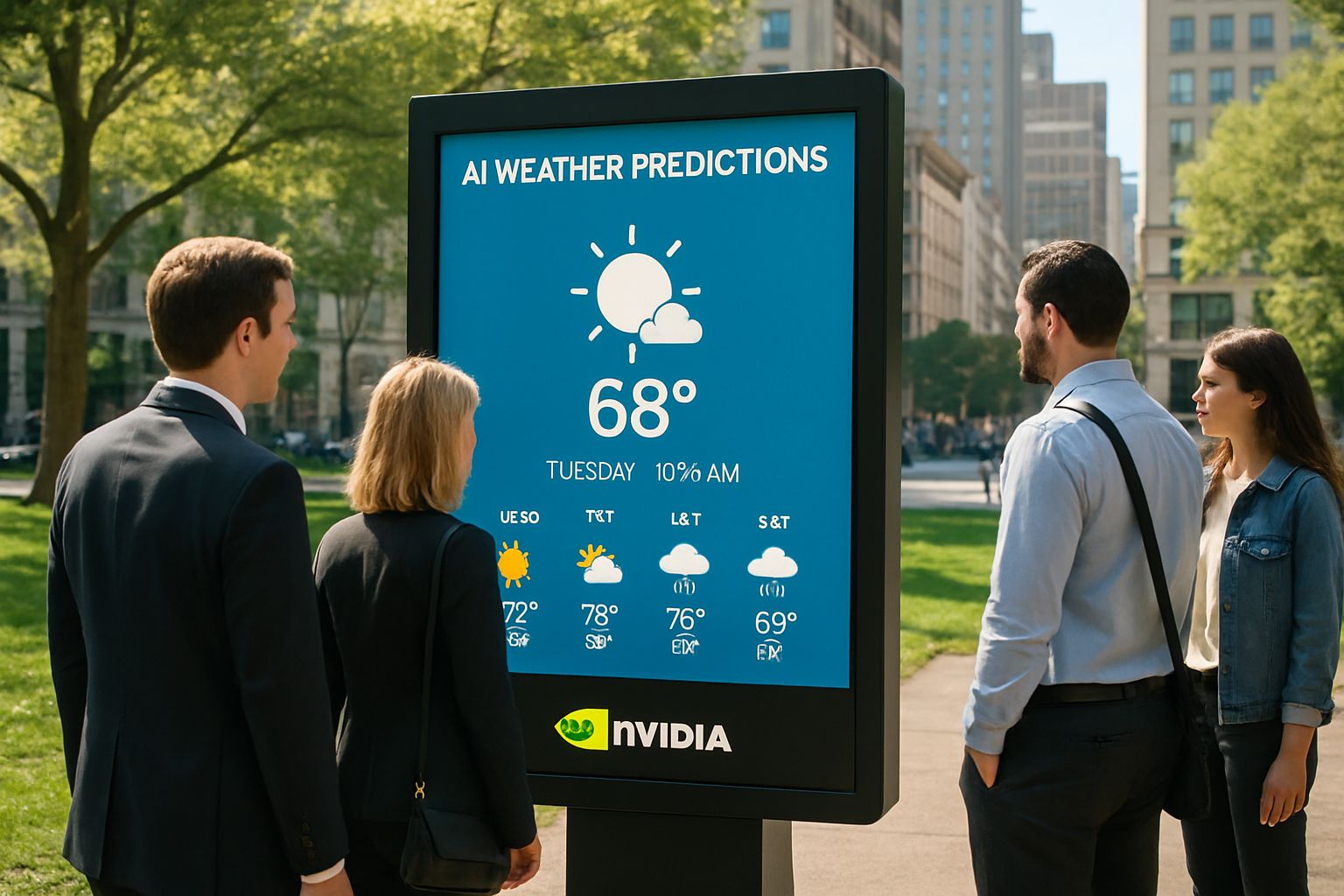
Enter Nvidia AI weather, the GPU-accelerated platform that promises kilometre-scale forecasts in minutes.
The Earth-2 stack, unveiled through 2025 and early 2026, combines open models, cloud APIs, and immersive visualization.
Moreover, it targets dramatic energy savings compared with classical numerical weather prediction.
This article dissects how Earth-2 works, who is adopting it, and why sceptics still urge caution.
Furthermore, we map upcoming benchmarks that will decide whether AI displaces traditional physics models or merely supplements them.
Technical leaders, investors, and forecasters will gain a balanced view supported by vendor data and independent commentary.
Meanwhile, professionals can deepen expertise with the AI Researcher™ certification referenced later.
Let us explore how open-source momentum meets industrial pragmatism inside Earth-2.
Platform Origins Explained Clearly
March 2024 marked Nvidia’s first pledge to create a digital twin of Earth’s climate.
However, the concept matured quickly into Earth-2, a full software and cloud stack.
Subsequently, January 2026 announcements expanded the vision to include open models, microservices, and Omniverse blueprints.
Therefore, the platform now spans data assimilation, nowcasting, medium-range prediction, and interactive risk visualization.
At its core, Earth-2 exploits tens of thousands of NVIDIA GPUs hosted on DGX Cloud or partner supercomputers.
Nvidia AI weather relies on large pre-trained neural nets, enabling rapid inference once observations arrive.
Moreover, code and weights live on GitHub and Hugging Face, aligning with Open-source weather forecasting AI goals.
Earth-2 therefore represents a paradigm shift from heavy physics solvers to data-driven surrogates.
However, the next question concerns model performance and verifiable claims, which we now examine.
Core Models And Claims
NVIDIA released several specialized architectures under the Earth-2 umbrella.
Atlas tackles medium-range prediction up to 15 days.
StormScope handles nowcasting for the next six hours using generative diffusion.
HealDA builds initial atmospheric states within seconds, while CorrDiff performs super-resolution downscaling.
FourCastNet3 extends earlier work, delivering large ensembles with minimal latency.
Notable performance metrics include:
- Nvidia AI weather FourCastNet demo produced 1,000 ensemble trajectories 21 days long in one-tenth traditional runtime.
- CorrDiff generated 12.5× higher resolution outputs 1,000× faster and 3,000× more energy efficient.
- Open-source weather forecasting AI advocates applaud GitHub availability supporting independent replication of these numbers.
Nevertheless, ECMWF scientists remind users that vendor tests rarely mirror operational workloads.
Consequently, figures above should be treated as provisional until broader verification.
These mixed signals underscore both excitement and uncertainty.
Next, we examine who is already betting on the technology.
Industry Adoption Momentum Grows
Early adopters span private, public, and hybrid organizations.
The Weather Company plans to fuse proprietary radar feeds with Earth-2 microservices.
Meanwhile, satellite operator Spire built medium-range products on an Omniverse Blueprint.
Taiwan’s Central Weather Administration experiments with typhoon landfall localization using GPU ensembles.
Nvidia AI weather demonstrations at the American Meteorological Society inspired many of these pilots.
Insurance specialist JBA Risk Management tests flood-risk maps derived from CorrDiff downscaled precipitation.
Energy giants explore renewable scheduling informed by rapid ensemble uncertainty fields.
Moreover, G42 and Tomorrow.io advertise commercial offerings built on the same stack.
Nvidia AI weather therefore already influences real revenue streams.
However, national agencies have not yet retired physics codes.
Most blend AI output with traditional models during operational pilots.
With adoption patterns clear, we now analyze competitive advantages claimed by GPU forecasting.
Benefits Outweigh Past Limitations
Speed leads the value narrative.
GPU inference lets meteorologists rerun scenarios minutes before issuing warnings.
Consequently, decision makers receive fresher probability fields during fast evolving storms.
Energy efficiency matters too, especially as sustainability goals tighten data-center budgets.
Advocates highlight several quantifiable gains:
- Thousand-member ensembles previously impossible now execute on a single DGX cluster overnight.
- High-resolution flood maps reach insurers 24 hours earlier, reducing exposure.
- Open-source weather forecasting AI lowers entry barriers for universities lacking supercomputers.
Moreover, Omniverse visualizations improve comprehension for non-technical stakeholders.
Advocates say Nvidia AI weather slashes hardware costs for small agencies.
These benefits appear persuasive, yet sceptics flag unresolved issues.
Therefore, let us weigh the principal risks.
Risks Demand Rigorous Validation
Operational reliability tops the risk list.
AI models sometimes miss rare extremes not well represented in training data.
In contrast, physics solvers handle unseen events through governing equations, though at higher cost.
ECMWF urges keeping AI forecasts beside heritage systems until confidence grows.
Nvidia AI weather marketing lists dramatic 1,000× savings, yet methodologies vary.
Another concern involves vendor energy claims.
Independent labs must replicate savings using standardized workloads and transparent metric definitions.
Additionally, compute sovereignty matters for governments wary of foreign cloud dependence.
Explainability and governance also require progress before warnings rely solely on generative output.
These risks demand structured audits, open datasets, and published error statistics.
Nevertheless, proactive validation is already underway, as we outline next.
Roadmap And Future Benchmarks
NVIDIA promises quarterly model refreshes and expanded open data releases.
Furthermore, a community leaderboard will compare Earth-2 runs against ECMWF high-resolution control forecasts.
Researchers expect first independent reports during the 2026 hurricane season.
Meanwhile, Open-source weather forecasting AI hackathons aim to stress-test Atlas and StormScope on extreme cases.
Nvidia AI weather results will headline those workshops if early numbers stand.
Policy watchers should track whether NOAA or EUMETSAT integrate Earth-2 outputs into official chains.
Consequently, those decisions may influence funding for public supercomputers.
Professionals can gain advantage through the AI Researcher™ certification.
Upcoming benchmarks will clarify whether Nvidia AI weather delivers on its disruptive promise.
Therefore, market watchers should monitor published error scores and energy audits closely.
Conclusion And Next Steps
Nvidia AI weather has shifted forecasting conversations from petaflop counts to millisecond inference.
Open-source weather forecasting AI momentum ensures transparency and collaborative improvement.
Industry pilots already show economic value, yet rigorous validation remains essential.
Moreover, governance, data equity, and sovereignty questions cannot be ignored.
Consequently, leaders should engage with ongoing benchmarks and invest in relevant skills.
Explore Earth-2 repositories, join testbeds, and secure the AI Researcher™ certification to stay ahead.
Disclaimer: Some content may be AI-generated or assisted and is provided ‘as is’ for informational purposes only, without warranties of accuracy or completeness, and does not imply endorsement or affiliation.


