

AI CERTs
5 months ago
Microsoft Rho-alpha Unveils Tactile Robotics Foundation Model
Robots are leaving fenced production lines and entering offices, warehouses, and hospitals. However, manipulating everyday objects still frustrates many commercial machines. Microsoft Rho-alpha is Microsoft’s latest answer to that challenge. Announced on 21 January 2026, the VLA+ foundation model marries vision, language, and tactile sensing. Consequently, it promises bimanual dexterity that past architectures rarely achieved outside controlled labs. The launch signals a strategic push to bring large multimodal models from computer screens into physical workspaces. Moreover, early access invitations show Microsoft’s eagerness to gather partner feedback before broader distribution through Foundry. Industry analysts view the move as pivotal, given forecasts of a booming global robotics sector. This article unpacks the technology, training pipeline, market context, and competitive stakes behind the debut. It also outlines practical next steps for enterprises evaluating tactile-aware automation.
Tactile Robotics Model Debut
Microsoft presented the model in a blog titled “Advancing AI for the physical world.” The post declared, “Today, we are announcing Rho-alpha, our first robotics model derived from Phi.” Unlike earlier VLA systems, Rho-alpha integrates tactile signals, earning Microsoft’s internal label VLA+. Therefore, the model can feel contact forces while interpreting visual scenes and natural-language instructions. Microsoft Rho-alpha targets dual-arm tasks such as plug insertion and toolbox packing.
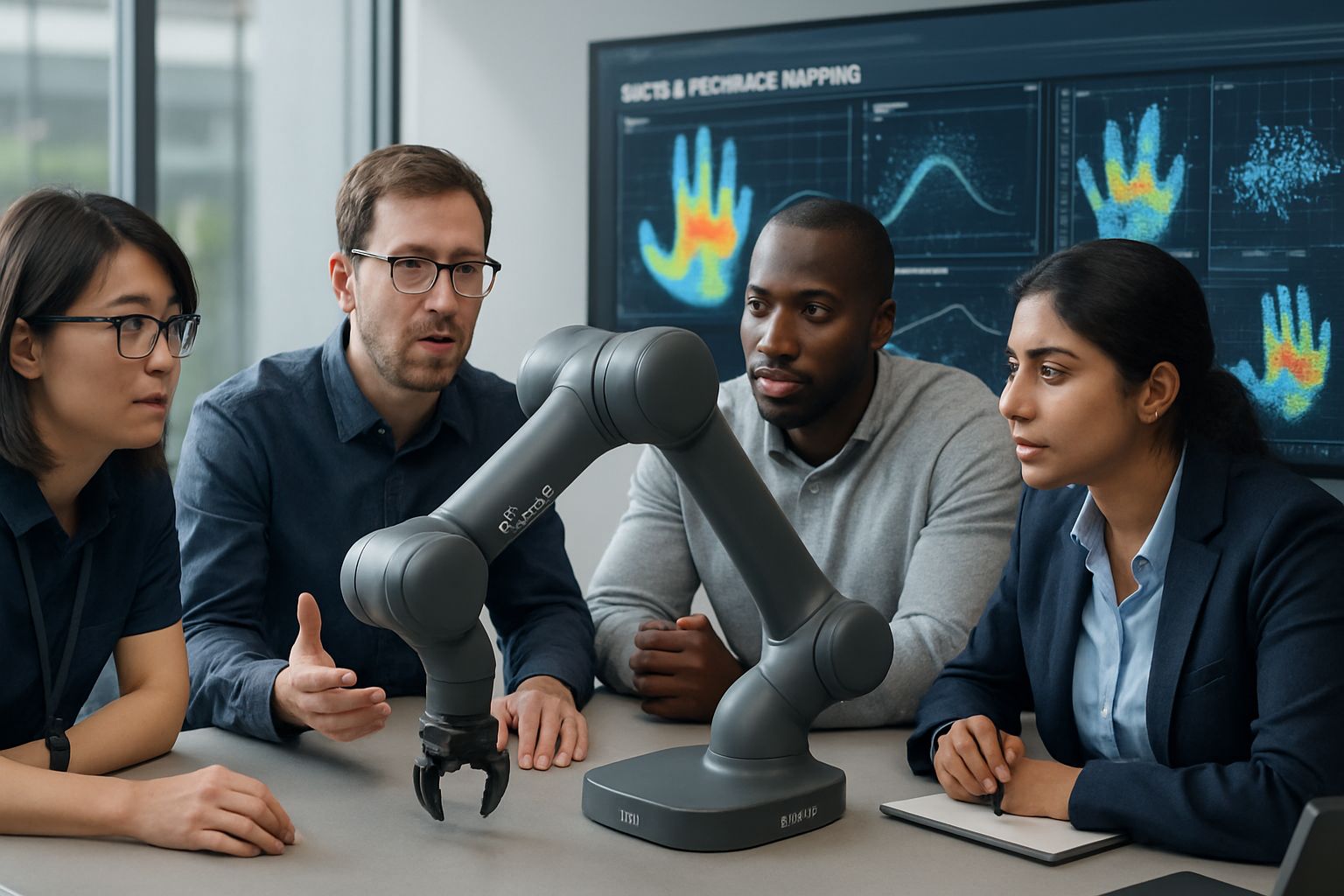
Furthermore, the company opened a Research Early Access Program to laboratories and integrators. Selected partners will test capabilities, supply corrective demonstrations, and report safety observations. Subsequently, Microsoft plans general availability via the Foundry service built on Azure. The staged rollout mirrors software preview cycles yet acknowledges tougher physical deployment risks.
In short, tactile perception makes the launch stand out among recent foundation models. However, training strategy determines whether that perception translates into reliable dexterity, which the next section explores.
Robotics Co-training Data Strategy
Collecting large tactile datasets is expensive and slow. Consequently, Microsoft Research blended three data sources. First, engineers recorded human teleoperation trajectories on real hardware. Second, they generated synthetic demonstrations with NVIDIA Isaac Sim and reinforcement learning running on Azure clusters. Third, they injected web-scale visual question-answering images to strengthen semantic grounding. Microsoft Rho-alpha benefits directly from this tri-source curriculum.
Moreover, the team co-trained trajectories and images using a shared transformer backbone. Gradient updates from simulation reduced the need for risky physical iterations. Meanwhile, tactile channels were calibrated using a smaller but critical subset of real contacts. This approach echoes sim-to-real best practices emerging across the Robotics AI Model community.
The hybrid pipeline promises scale without sacrificing realism. Next, we examine how that promise appears in hardware demonstrations.
Hardware Demos And Benchmarks
Microsoft showcased the model on a dual UR5e setup equipped with tactile skins. Additionally, a humanoid platform is under evaluation, though details remain sparse. In video clips, Microsoft Rho-alpha inserted an electrical plug with gentle alignment. It also completed a BusyBox benchmark requiring coordinated button presses and lever pulls. Developers noted Microsoft Rho-alpha maintained stable orientation throughout prolonged grasps.
Observers noted smooth gripper motion and rapid error recovery. Nevertheless, quantitative success rates were absent from the announcement. Microsoft Research promised a technical document in coming months to share metrics. Until then, external validation depends on early access partners releasing independent reports.
- Exact model size and parameter count
- Failure rates across unseen household tasks
- Force thresholds during human-robot interaction
- Comparative scores against Google RT-2
These open questions underline the importance of peer-reviewed benchmarks. Consequently, market traction depends on transparent performance data, leading us to market outlook.
Global Robotics Market Outlook
Market researchers foresee surging demand for dexterous automation. IMARC estimates a USD 53.2 billion robotics market in 2024, growing to USD 178.7 billion by 2033. Future Market Insights projects similar double-digit compound growth for service and industrial segments. Therefore, investors expect Physical AI portfolios to expand quickly.
Microsoft Rho-alpha arrives as organizations confront labor shortages and safety mandates. In contrast, traditional industrial robots require painstaking motion scripting. A mature Robotics AI Model could cut integration times, unlocking new vertical applications. Consequently, vendors able to supply pretrained brains may capture disproportionate share.
Analysts agree that time-to-value advantages will sway purchasing decisions. However, customers must weigh benefits against unresolved risks discussed next.
Opportunities And Remaining Risks
The strongest upside of a Robotics AI Model is improved dexterity across varied tasks. Moreover, language interfaces simplify reprogramming, reducing downtime for line changes. Microsoft Rho-alpha can absorb corrective feedback, fostering continuous improvement. Additionally, Foundry distribution may democratize advanced robotics for mid-sized integrators.
Nevertheless, safety remains paramount. Unexpected contact forces could harm workers or damage inventory. Therefore, Microsoft embeds teleoperation fallbacks and alignment tooling. Regulators will likely revisit ISO 10218 standards as tactile robots proliferate. Microsoft Rho-alpha will face strict certification audits before operating near humans.
Data scarcity and sim-to-real gaps also persist. In contrast, huge web corpora rarely teach precise torque limits. Consequently, Microsoft Research continues refining synthetic tactile simulators. Professionals can enhance their expertise with the AI Data Robotics™ certification.
Balancing these risks and rewards will shape deployment timelines. The competitive landscape now reveals additional pressures.
Competitive Landscape Quick Snapshot
Google DeepMind’s RT-2 set an early bar for VLA performance. However, it lacks built-in tactile sensing. Startups such as RLWRLD and Hexagon Robotics are racing to add similar modalities. Industrial incumbents ABB and FANUC invest in proprietary motion stacks but monitor foundation models closely.
Meanwhile, NVIDIA benefits whichever model prevails, because Isaac Sim underpins much synthetic training. Microsoft Research and NVIDIA already collaborate on cloud simulation pipelines. Consequently, platform lock-in concerns appear when compute, simulation, and deployment reside under one provider.
Vendors know speed matters in winner-takes-most AI races. Therefore, the final section distills actionable insights for teams evaluating Microsoft Rho-alpha today.
Conclusion Insights And CTA
Microsoft Rho-alpha bundles vision, language, and tactile sensing into a single Robotics AI Model capable of bimanual manipulation. Co-training synthetic and real trajectories lets the model scale without intolerable field downtime. Hardware demos impress, yet quantitative benchmarks must follow to confirm reliability across unseen tasks. Market forecasts suggest massive upside for suppliers who solve dexterous automation first. Meanwhile, safety, regulation, and platform dependence demand vigilant risk management. Consequently, decision makers should monitor upcoming technical papers and early access feedback. Professionals can deepen robotics data fluency through the linked certification and prepare for tactile-first deployments. Explore the program today and stay ahead of the Physical AI curve.
Disclaimer: Some content may be AI-generated or assisted and is provided ‘as is’ for informational purposes only, without warranties of accuracy or completeness, and does not imply endorsement or affiliation.


