

AI CERTS
5 months ago
Meta’s bold Manus AI acquisition reshapes agent landscape
Meanwhile, technical leaders wonder how the deal changes tooling for autonomous planning and independent action. Industry observers emphasise that Manus already claims $100 million ARR. Therefore, integration could accelerate Meta’s broader agent roadmap while igniting new scrutiny. Ultimately, the acquisition positions Meta to challenge rivals in the ongoing AI agent race.
Deal Signals Market Shift
Meta confirmed the Manus AI acquisition on 29 December 2025. Subsequently, coverage spanned every major outlet within hours. Mark Zuckerberg framed the deal as essential for delivering general-purpose agents across Messenger, WhatsApp, and Instagram. Nevertheless, precise terms remain undisclosed. Several insiders quoted a $2B price, underscoring Meta’s appetite for agentic talent. In contrast, earlier funding placed Manus at a $500 million valuation, highlighting a rapid value jump. Furthermore, Meta pledged to wind down Manus’s China footprint and remove all Chinese ownership stakes. This commitment aims to dampen Washington’s security concerns.
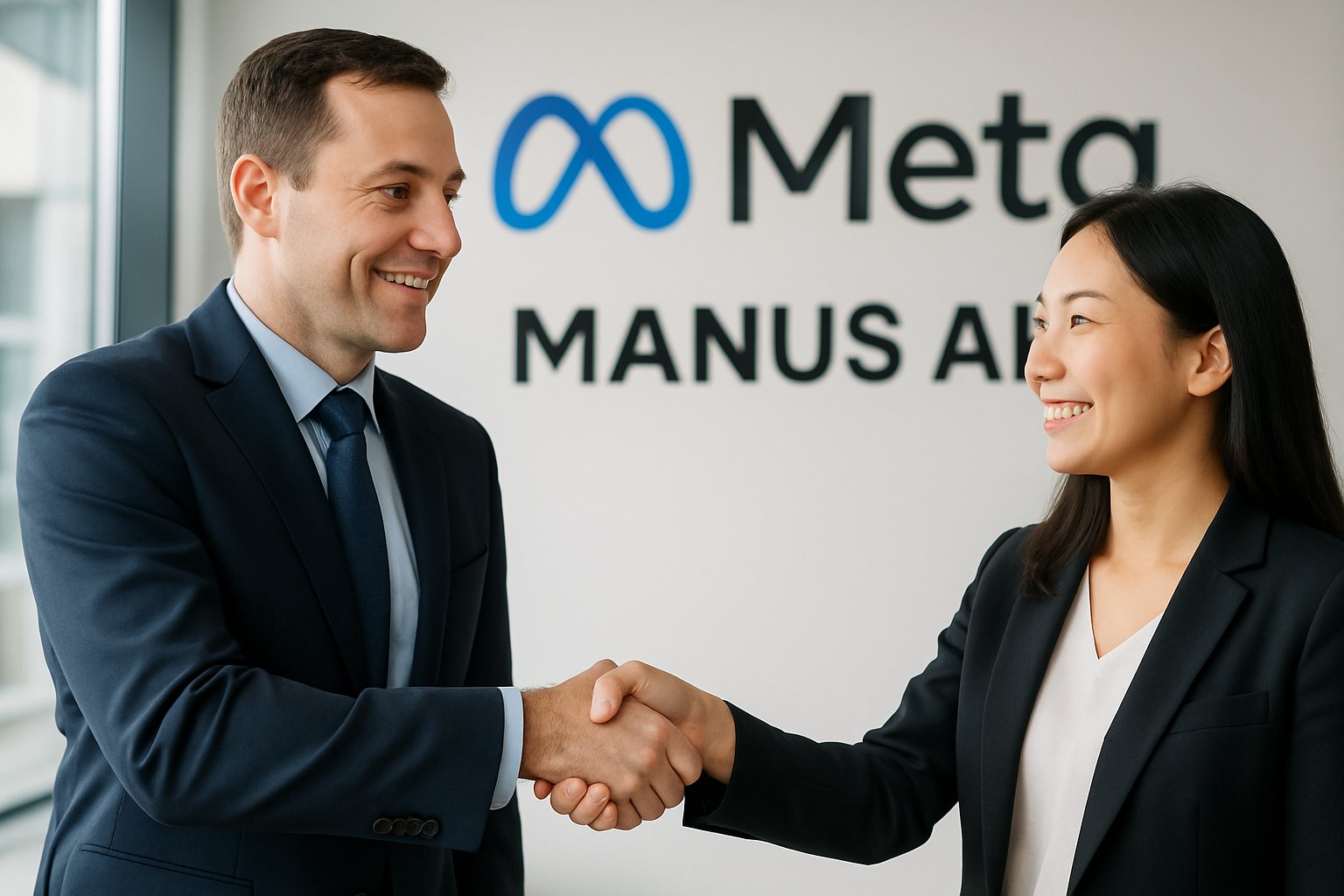
The following timeline captures critical moments:
- 2022 – Manus founded in China; pivots to agents.
- Mid-2025 – Headquarters moves to Singapore.
- Dec 2025 – Manus AI acquisition announcement.
- 2026 – Planned integration into Meta AI portfolio.
These milestones reveal Meta’s urgency to commercialise agent tech. However, geopolitical complexities could still delay closing. Consequently, stakeholders watch regulatory bodies for signals.
The strategic timeline highlights accelerated momentum. Meanwhile, forthcoming financial filings should clarify final terms.
Key Financial Metrics Snapshot
Numbers underpin every transformative deal. Manus reported bold, though self-disclosed, traction. Analysts therefore scrutinise each claim carefully.
- Annual recurring revenue: ~US$100 million.
- Token processing volume: 147 trillion tokens.
- Virtual computers launched: 80 million instances.
- Recent venture round: US$75 million led by Benchmark.
- Estimated $2B price in the current transaction.
Meta’s scale multiplied by Manus capability could expand ARR swiftly. Nevertheless, integration costs may offset early gains. The Manus AI acquisition still excites investors expecting long-term synergy.
These metrics establish impressive momentum. However, verification will depend on future Meta earnings reports.
Inside Manus Agent Tech
Manus positions itself as a general-purpose agent platform. It orchestrates perception, autonomous planning, tool execution, and result verification. Additionally, the system employs dynamic model selection rather than a single proprietary foundation model. Critics therefore dub Manus a sophisticated “wrapper.” In contrast, supporters argue orchestration represents the hard part. Manus also touts sandboxed “virtual computers” that allow independent action without risking host systems. Moreover, geo-gating safeguards sensitive data by restricting regional model access.
Technical diagrams describe three cooperating sub-agents: planner, executor, and verifier. Consequently, complex tasks such as market research or code refactoring complete without tight human loops. Manus claims these flows reduce task time by up to 70 percent. However, early reviewers reported hallucinations and execution failures under edge cases.
Agent architecture continues evolving. Nevertheless, Meta’s compute budget could refine reliability quickly.
Competitive AI Agent Race
Google, Anthropic, and OpenAI already sprint in the AI agent race. Further, Microsoft backs similar initiatives through Copilot. Therefore, Meta needed a catalyst. The Manus AI acquisition supplies matured orchestration and paying customers. Moreover, a Singapore base helps Meta tap Asian developer ecosystems while avoiding immediate U.S.–China flashpoints.
Competition will intensify as each platform merges chat, autonomous planning, and execution. However, distinct approaches remain. OpenAI favours model-centric agents, whereas Manus emphasises multi-tool orchestration. Consequently, users may blend offerings depending on workflows.
Rivalry ensures rapid innovation. Meanwhile, consolidation may narrow independent choices.
Strategic Fit For Meta
Meta has invested billions in Llama models, yet lacked production-ready agents. Therefore, the Manus AI acquisition plugs an immediate capability gap. Furthermore, Manus’s subscription product aligns with WhatsApp’s growing SMB services. Barton Crockett at Rosenblatt called the pairing “a natural fit.” Additionally, Meta gains a seasoned team skilled in independent action orchestration. Consequently, development cycles could shorten.
Talent retention forms another benefit. Manus engineers receive resources they previously dreamed about. Meanwhile, Meta avoids building identical infrastructure from scratch. As a result, shareholders may applaud long-term cost avoidance despite a steep $2B price.
Professionals eager to build such systems can validate skills through the AI Prompt Engineer™ certification. Moreover, certified experts often command premium compensation in today’s tight labour market.
Strategic advantages appear immediate. However, leadership must still manage complex integration work.
Regulatory And Risk Landscape
National-security sentiment shapes every cross-border technology deal. Consequently, Meta pre-emptively promised zero continuing Chinese ownership. Nevertheless, senator John Cornyn already voiced concerns. Additional CFIUS review seems probable. Moreover, agentic systems amplify data-privacy worries. Manus processes large customer datasets during autonomous planning. Therefore, Meta’s geo-gating pledge will face audits.
Product reliability also draws attention. Independent testers found occasional misfires when tasks demanded nuanced judgement. In contrast, Manus boasts rapid patch cycles. Still, widespread deployment across billions of Meta users magnifies risk. Furthermore, cost structures could shift if underlying model providers raise prices, jeopardising profitable independent action flows.
Risks remain substantial. Nevertheless, Meta’s compliance apparatus offers experience navigating complex oversight.
Outlook And Next Steps
Observers expect integration milestones throughout 2026. Subsequently, Meta will likely bundle Manus agents into enterprise offerings. Analysts predict new revenue streams that extend beyond ads, especially within WhatsApp commerce. Meanwhile, Google and OpenAI may counter with acquisitions of their own, intensifying the AI agent race. Additionally, developers anticipate fresh APIs enabling deeper autonomous planning capabilities.
Meta’s investor call next quarter should reveal further detail on synergy tracking. The broader market, however, will judge results by user adoption. Ultimately, the Manus AI acquisition stands as a pivotal experiment in scaling independent action to mainstream audiences.
Future announcements will clarify progress. In contrast, rivals will not remain idle.
Conclusion
Meta’s latest gamble underscores an industry sprint toward practical agents. The Manus AI acquisition offers mature orchestration, bold revenue, and vital talent. Moreover, a reported $2B price signals confidence in agent monetisation. However, regulatory, reliability, and geopolitical hurdles persist. Consequently, success hinges on seamless technical integration and transparent governance. Professionals watching this space should deepen skills in prompt design and autonomous planning. Therefore, consider earning the AI Prompt Engineer™ certification to stay competitive. Act now, join the conversation, and prepare for the next phase of agent-powered innovation.
Disclaimer: Some content may be AI-generated or assisted and is provided ‘as is’ for informational purposes only, without warranties of accuracy or completeness, and does not imply endorsement or affiliation.


