

AI CERTS
34 minutes ago
Food Physical AI: Chef Robotics’ Bi-Manual Kitchen Leap
Meanwhile, investors watch whether scale, reliability, and margins can finally align for food robotics. This article unpacks the technology, metrics, and market implications for operational leaders. Additionally, it contrasts past ventures that faltered. Readers will leave with clear next steps and certification resources to deepen expertise.
Market Momentum Builds Rapidly
Global appetite for automated kitchens keeps rising. IMARC pegs the food robotics market at USD 3 billion today. Furthermore, the firm forecasts USD 6.4 billion by 2034, an 8.95% CAGR. Grand View Research predicts an even steeper climb to USD 6.81 billion by 2030. In contrast, MarketsandMarkets offers a conservative USD 4 billion estimate by 2026. These projections highlight growing capacity for platforms such as the company.
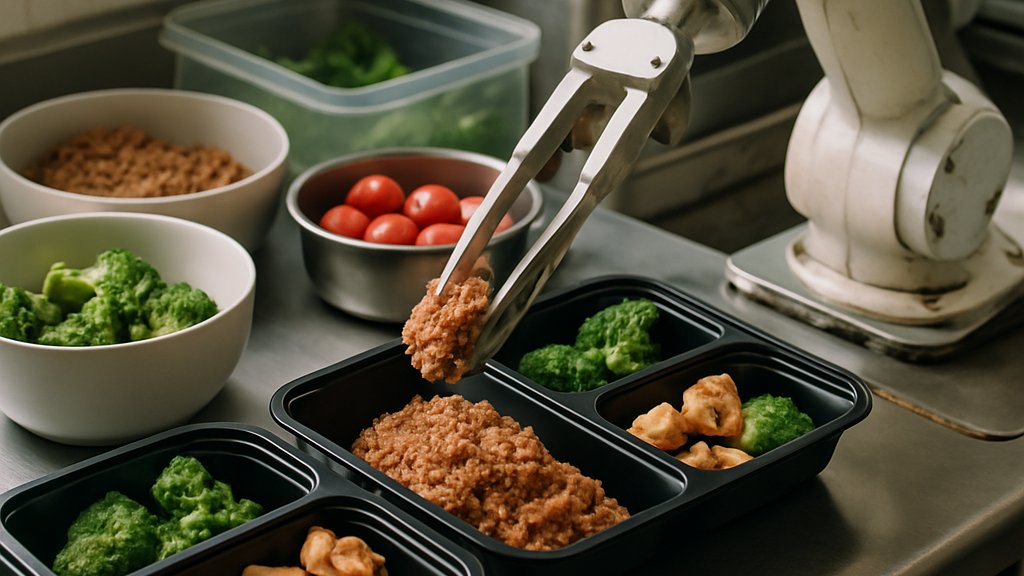
Industry growth alone does not guarantee adoption. However, the company reports an impressive 100 million production servings as proof of traction. Each serving equals one precise deposit, not an entire meal. Consequently, large data streams now feed model improvements. Operators view data-driven iteration as essential for real kitchen reliability. Together, market pull and data supply set the stage for Food Physical AI expansion.
Strong forecasts and deployment milestones suggest momentum is genuine. Therefore, the next step is understanding how the underlying model actually works.
Inside Food Foundation Model
FFM serves as the perception and reasoning brain inside the company's platforms. The company trains FFM through Imitation Learning rather than scripted rules. It ingests synchronized camera streams and builds a dynamic scene graph for ingredients. Moreover, the model predicts what to pick, where to place, and in which order. Language prompts trigger high-level decisions that cascade to motion layers. This architecture mirrors software foundation models but handles messy, deformable food items. Consequently, developers avoid hand-coding endless if-then rules.
Training relied on only 26 hours of human demonstrations compiled over eight days. Nevertheless, the system achieved a 75% full-task success rate in burger tests. Sub-tasks, such as grasping patties, reached 81% success. Food Physical AI continues learning from every field deployment, closing residual gaps. Engineers expect compounding improvements as data volume scales. Such flywheel dynamics attracted customers across institutional kitchens seeking consistency.
FFM converts vision and language into reliable motion primitives. Subsequently, the focus shifts to the new bi-manual hardware that exploits those capabilities.
Bi-Manual Systems Debut Now
Chef Robotics unveiled its bi-manual prep-table system on May 18. Importantly, the design tackles lower-volume, higher-complexity stations like ghost kitchens and airlines. Two coordinated robotic arms mimic human line cooks across a stainless workspace. Moreover, sensors maintain sub-centimeter alignment while avoiding ingredient bruising. The system shares the core Food Physical AI engine that powered earlier Food Assembly lines. Therefore, customers can transfer skills across SKUs without retraining from scratch.
Rajat Bhageria said the goal is handling real-world, unstructured workspaces gracefully. Additionally, sealed and wash-down components meet stringent food safety rules. Integration targets schools, hospitals, and fast-casual brands facing tight labor budgets. Bi-manual Systems also extend coverage to chopped salads and mixed bowls requiring dexterity. Early pilots reportedly assemble a full burger in under one minute. Time savings directly reduce queue congestion during lunch peaks.
Bi-manual Systems bring adaptable hardware to previously manual prep zones. Consequently, training approaches deserve closer examination.
Imitation Learning Advantage Showcased
Unlike rule-based programming, the company leans on Imitation Learning for skill acquisition. Operators guide arms through tasks while the network records vision, torque, and position traces. Subsequently, the algorithm generalizes across ingredient shapes, lighting, and utensil layouts. This data-centric cycle beats manual calibration when menus change weekly. Moreover, chefs can author new recipes by simply demonstrating once. Such speed accelerates return on investment for multi-site chains.
Imitation Learning also reduces total annotation burden because actions act as self-labels. Meanwhile, Food Physical AI ingests the demonstrations and updates policy weights overnight. Resulting policies roll out via cloud updates similar to smartphone apps. Therefore, operators need no on-premises machine-learning expertise. That capability differentiates the platform from earlier single-purpose robots. Nevertheless, maintaining stable grasps on slippery lettuce remains challenging.
Imitation Learning provides rapid adaptability without expensive programming. The next metric question is whether performance meets industrial thresholds.
Operational Metrics Matter Today
Decision makers evaluate throughput, yield, and uptime before purchasing automation. The firm shared several concrete numbers during its technical release. Furthermore, the April burger demo delivered 75% full-task and 81% sub-task success rates. Those figures emerged after just 26 training hours, a promising productivity ratio. However, operators typically demand 95% or higher reliability for sustained deployment. Company executives acknowledge ongoing improvement cycles driven by additional data.
- 100M production servings completed as of April 2026
- 75% burger task success after 26 training hours
- 8.95% forecast CAGR for global food robotics
Those servings came from high-volume Food Assembly cells already active in manufacturing plants. Bi-manual Systems will require stringent cleaning protocols to sustain those promising numbers. Consequently, scale statistics impress investors, yet consistent uptime will convince skeptical operators. Food Physical AI must therefore close the last tens of percentage points soon. Third-party audits could validate claims and accelerate adoption. Professionals can deepen assessment skills through the AI Robotics Specialist™ certification. That program covers data, robotics, and safety frameworks relevant to kitchen deployments.
Early metrics suggest momentum but highlight remaining reliability gaps. Next, consider how competitors shape customer expectations.
Competitive Landscape Shifts Fast
Food automation history is littered with ambitious failures. In contrast, Chef Robotics claims revenue growth instead of prototypes alone. Chowbotics and Zume exited the market after burn rates outpaced sales. Meanwhile, Miso Robotics focuses on frying lanes with its Flippy arm. The company differentiates by scaling a single Food Physical AI stack across hardware. Moreover, the company monetizes deployments early, feeding data back into models.
Analysts still warn about hardware costs, cleaning complexity, and menu variance. Nevertheless, 100 million servings offer concrete evidence of progress. Customers like Amy’s Kitchen and Sunbasket reportedly continue expanding pilots. Consequently, rivals must match both technical depth and operational cadence. Supply chain partners may soon bundle robots with ingredient contracts, shifting buying dynamics. Market watchers therefore expect consolidation over the next five years.
Competitive dynamics remain fluid but increasingly data-driven. The final section explores adoption pathways for cautious buyers.
Road Ahead For Adoption
Enterprise kitchens weigh capital costs, staff acceptance, and menu diversity before signing contracts. Pilot programs usually begin with a single station and clear success metrics. Subsequently, fleet expansion follows validated payback periods under 18 months. The vendor supports Robotics-as-a-Service plans to lower upfront investment. Additionally, cloud analytics dashboards expose yield, waste, and machine health in real time. Food Physical AI updates deploy through that pipeline without service interruptions.
Integrators recommend staff training sessions that emphasize food safety and routine cleaning. Moreover, ergonomic station design reduces human-robot collision risks. Regulators may soon issue new guidelines as Bi-manual Systems become commonplace. Nevertheless, early adopters gain branding advantages and operational data edges. Therefore, hesitating firms risk falling behind more efficient competitors. Professionals considering deployment should benchmark against peers and pursue certifications for credibility.
Adoption will hinge on clear ROI, standards, and continuous model improvement. Finally, the trajectory circles back to the evolving Food Physical AI core.
Conclusion
Chef Robotics is pushing automated kitchens beyond novelty and toward entrenched infrastructure. Its Food Physical AI framework, reinforced by imitation learning and bi-manual hardware, underpins that push. Market projections, early metrics, and 100 million servings suggest legitimate momentum. However, reliability thresholds above 90% remain the decisive hurdle for mainstream rollouts. Consequently, every new serving supplies data to narrow that gap gradually. Operators evaluating options should track independent audits and invest in relevant training. Explore the linked certification to build internal expertise and drive successful robotics adoption.
Disclaimer: Some content may be AI-generated or assisted and is provided ‘as is’ for informational purposes only, without warranties of accuracy or completeness, and does not imply endorsement or affiliation.


