

AI CERTS
6 months ago
Knee Forecast AI Outpaces Imaging Benchmarks
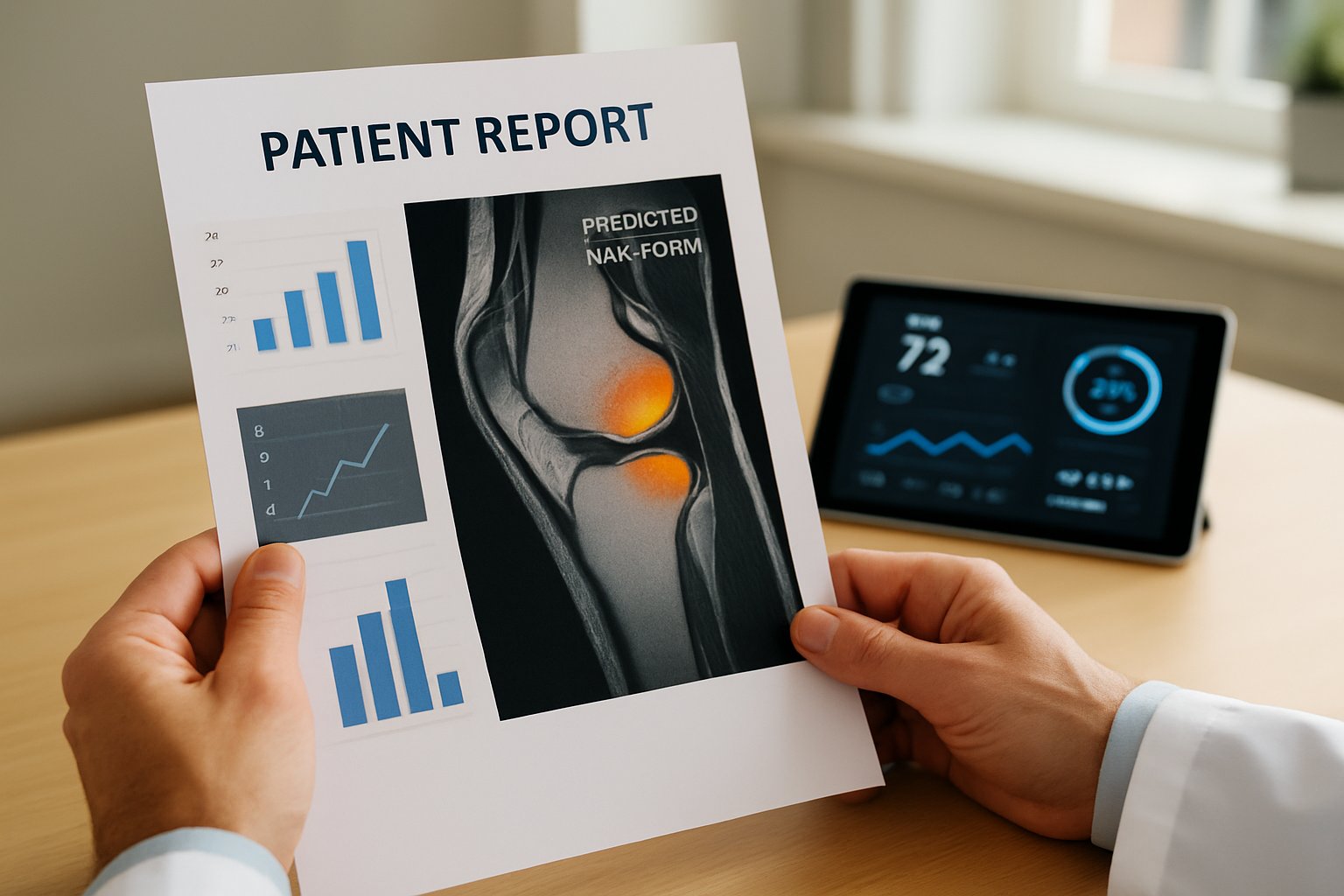
Consequently, the system pairs a synthetic future X-ray with a numerical Risk score. Such dual output could transform osteoarthritis counselling, workflow efficiency, and patient motivation. This article dissects the technology, evidence, benefits, and challenges for busy imaging professionals.
Diffusion Model Core Overview
At its core, the Surrey team combined a VQ-VAE encoder with a conditional diffusion network. Furthermore, the encoder compresses each baseline X-ray into discrete tokens, reducing computation. Meanwhile, the diffusion process iteratively denoises that latent to craft a plausible follow-up image.
Developers integrated the logic into Knee Forecast AI without excessive GPU demand. The model then predicts sixteen anatomical landmarks, highlighting joint regions expected to deteriorate. Consequently, radiologists receive visual cues rather than opaque heat maps.
Additionally, a classifier estimates baseline and future Kellgren-Lawrence grades from shared features. The Risk value equals the probability that the grade increases within twelve months. In short, diffusion beats older GAN styles by producing sharper cartilage boundaries.
These mechanics underpin later performance gains. Therefore, the next section reviews empirical results.
Performance And Speed Gains
Reliable metrics matter for deployment decisions. In contrast, many prototypes exaggerate capability. Surrey validated its pipeline on the Osteoarthritis Initiative, featuring almost 50,000 images.
Moreover, Knee Forecast AI achieved an AUC of 0.71 for progression Risk. That figure edges the 2022 StyleGAN benchmark of 0.69. Subsequently, inference proved approximately nine times faster than the prior benchmark. Therefore, large batch triage may finish during a single clinic session. Every generated X-ray also passed qualitative quality checks by two radiologists.
- AUC improved by roughly 2% over published SOTA.
- Inference latency dropped from 900 ms to nearly 100 ms per image.
- Training relied on 4,796 participants, ensuring strong statistical power.
In sum, the numbers reveal practical gains, not just theoretical novelty. However, benefits mean little without clear patient advantages, discussed next. Knee Forecast AI therefore positions itself as a scalable triage companion for radiology departments.
Visual Forecasting Benefit Scope
Visual communication often persuades patients more than decimals. Consequently, Knee Forecast AI delivers a side-by-side X-ray comparison of present and predicted morphology. Furthermore, the landmark overlay guides discussion about specific cartilage gaps or osteophytes.
Patients with early osteoarthritis readily grasp why lifestyle changes matter when seeing cartilage thinning. Clinicians also appreciate interpretability because medicolegal scrutiny grows. In contrast, black-box scores alone invite skepticism.
- Shared decision making improves when forecasts look tangible.
- Adherence to exercise programs rises with concrete imagery.
- Multidisciplinary teams align faster around unified Risk visuals.
These communication gains complement diagnostic accuracy improvements. Meanwhile, safety considerations remain crucial, as outlined next.
Safety And Limitations Discussed
Nevertheless, generative medicine carries unique hazards. Hallucinated bone structures could misdirect treatment if unnoticed.
In contrast to static classifiers, Knee Forecast AI synthesizes pixels that might appear convincing yet false. Therefore, the team inserted landmark-based sanity checks and human review loops.
Additionally, the training cohort skews toward North American imaging protocols. Consequently, real-world performance may drop in overseas clinics. Experts urge external validation across scanners, ethnicities, and acquisition settings. Regulatory oversight will mandate bias audits and ongoing monitoring.
Continuous auditing dashboards inside Knee Forecast AI could flag anomalous outputs before clinicians act. In summary, caution tempers enthusiasm. Subsequently, developers must navigate evolving governance pathways, examined below.
Regulatory Path And Governance
Medical software cannot bypass compliance checkpoints. Therefore, the team plans to seek Software as a Medical Device clearance.
The FDA's Predetermined Change Control Plan outlines update guardrails for adaptive tools like Knee Forecast AI. Moreover, the EU Artificial Intelligence Act will classify high-risk systems and impose transparency duties.
Practitioners hoping to champion adoption can deepen knowledge. They may pursue the AI+ Healthcare™ certification for governance expertise.
Effective regulation balances innovation with safety. Future research directions illustrate that balance in practice.
Future Research And Translation
The research group already tests transfer to mammography and chest imaging. Additionally, they envisage cloud endpoints where Knee Forecast AI plugs into picture archiving.
Prospective clinical trials will track symptom relief and activity scores after forecast counselling. In contrast, earlier studies rarely linked radiographs to functional outcomes.
Open-sourcing code could accelerate peer review and reveal hidden biases. Moreover, federated training may address data-sharing constraints while protecting privacy. A mobile version of Knee Forecast AI may someday support community screening.
In brief, collaborative engineering and prospective evidence will determine mainstream success. Consequently, stakeholders should monitor the forthcoming multi-site validation study announced by the consortium.
Generative imaging has moved beyond novelty into measured clinical promise. The new diffusion pipeline shows that images and probabilities can coexist for clearer decisions. The 0.71 AUC, swift inference, and visual clarity mark a tangible upgrade over StyleGAN predecessors.
However, external validation, bias audits, and hallucination safeguards remain essential before routine osteoarthritis monitoring. Professionals should follow upcoming trials and strengthen governance skills through the AI+ Healthcare™ certification. Ready teams will guide responsible innovation while maximizing patient benefit.
Consequently, early adopters can gain workflow efficiency and stronger patient engagement. Take the initiative now and join the governance conversation. Meanwhile, policy makers must craft adaptable rules that encourage safe diffusion across imaging specialties.
Disclaimer: Some content may be AI-generated or assisted and is provided ‘as is’ for informational purposes only, without warranties of accuracy or completeness, and does not imply endorsement or affiliation.


