

AI CERTS
1 month ago
IBM Confluent Deal Fuels Real-Time AI
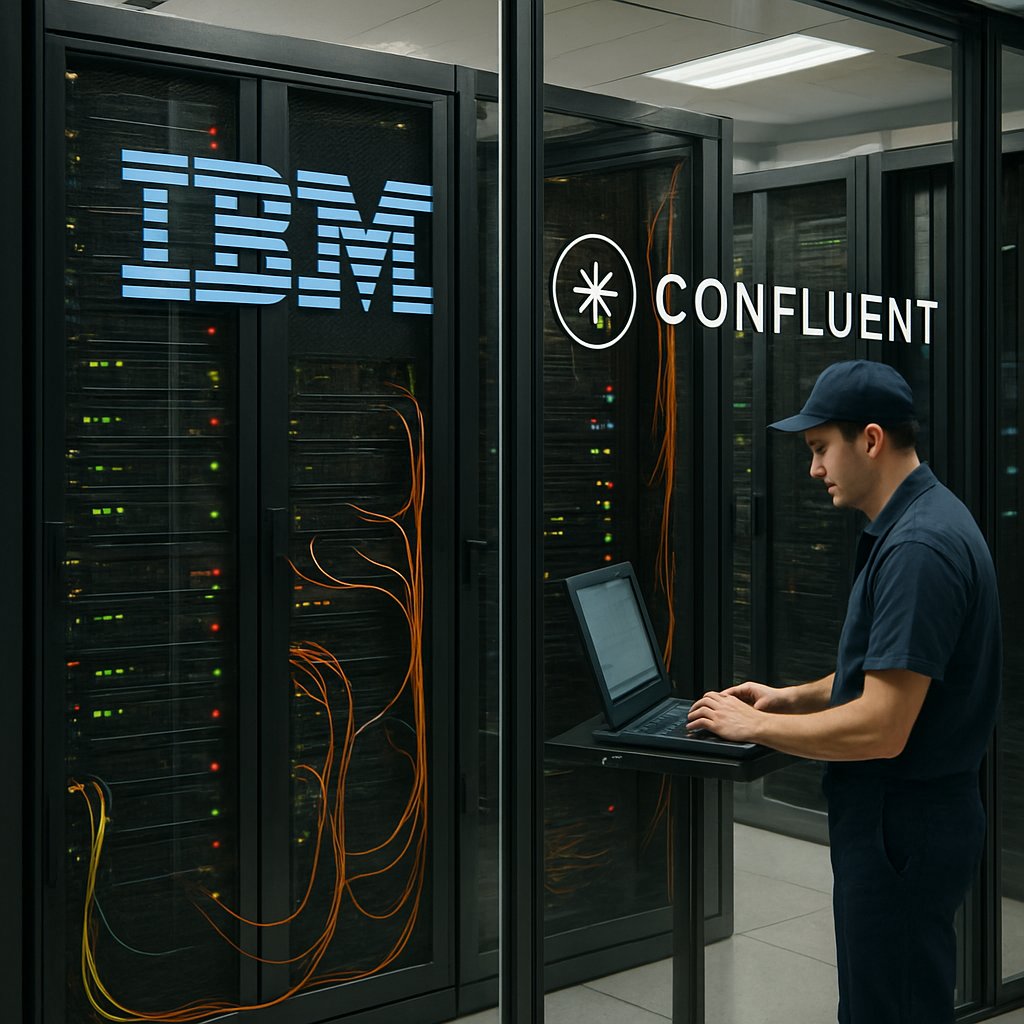
However, questions persist about integration pace, customer pricing and open-source stewardship. This article examines the facts, risks and opportunities behind the acquisition.
Meanwhile, we explore market drivers such as growing streaming adoption, rising Kafka skill demand, and the hunt for context. Readers will gain a concise roadmap for evaluating IBM Confluent in their own architectures.
Consequently, executives tasked with real-time analytics can benchmark projected returns, compare alternative platforms and pursue recognised certifications. Professionals can enhance their expertise with the AI+ Data Robotics™ certification.
Acquisition Signals Strategic Shift
Initially, IBM offered $31 per share, valuing Confluent near $11 billion. Therefore, the purchase gave IBM Confluent immediate scale with 6,500 customers and access to 40 percent of the Fortune 500.
Shareholders approved the cash offer after an expedited proxy process. In contrast, rivals such as AWS and Microsoft rely on proprietary streaming services that lack Confluent’s connector depth.
Consequently, industry observers view the acquisition as a bid to fuse IBM’s hybrid-cloud software with proven Kafka expertise. These financial and strategic fundamentals establish the commercial baseline.
Moreover, they explain why governance boards approved the transaction despite macroeconomic caution. With the deal context clear, we can assess IBM’s product vision.
Smart Platform Vision Explained
Rob Thomas, IBM Software chief, states that decisions must match transaction speed. Subsequently, the company pitches a smart platform that unifies historical warehouses with live event flows.
IBM Confluent will supply the real-time layer, while watsonx feeds models and governance controls lineage. Furthermore, survey findings show 86 percent of IT leaders call streaming strategic and 44 percent report five-fold ROI.
The total addressable market reportedly doubled to $100 billion between 2021 and 2025, signaling sustained demand.
- Continuous governance across hybrid clouds
- Low-latency Kafka pipelines for AI agents
- Mainframe change capture offloaded to zIIP engines
These pillars describe IBM’s architectural ambition. Nevertheless, execution hinges on rapid technical integration. The next section reviews initial product moves.
Technical Integrations Day One
On closing day, IBM Data Gate for Confluent moves Db2 changes from Z systems into Kafka topics. IBM claims up to 96 percent of processing shifts to zIIP engines, cutting mainframe CPU usage.
Additionally, watsonx.data ingests Confluent streams so models learn from operational events in seconds. Developers configure low-code connectors through a graphical console.
Moreover, existing IBM MQ and webMethods brokers can publish messages to the same streaming fabric. These early connectors prove technical momentum for IBM Confluent.
Next, we examine practical enterprise scenarios.
Real-Time Enterprise Use Cases
Financial institutions already pilot fraud detection that evaluates card swipes against Kafka events and AI models within milliseconds. Meanwhile, manufacturing groups employ streaming sensor readings to optimise supply chains in near real time.
Retailers feed customer context into conversational agents that adjust promotions during the same shopping session. Airlines adjust crew assignments when weather disruptions enter the event pipeline.
- Fraud scoring under 100 ms
- Predictive inventory adjustments
- Personalised support assistants
These scenarios reveal tangible business returns for IBM Confluent adopters. Stakeholder reaction offers another dimension.
Market Response And Risks
Forrester analyst Noel Yuhanna called the deal strategically significant yet warned about roadmap transparency. Nevertheless, some open-source advocates worry that control over Kafka innovation may centralise.
In contrast, customers welcome consolidated support rather than juggling multiple vendors. Regulators did not impose material conditions, yet they signalled ongoing monitoring for fair access.
IBM Confluent executives promise continued open licensing and community collaboration. These mixed viewpoints underscore execution hazards.
Consequently, organisations should set measurable milestones before expanding deployments. Skill gaps remain the final hurdle.
Skills And Certification Path
Enterprises need engineers who grasp event modelling, security policies and mainframe change capture. Consequently, professionals can validate expertise through the AI+ Data Robotics™ certification, which emphasises reliable event architectures.
Moreover, IBM Confluent provides self-paced labs that mirror production clusters. Structured learning shortens adoption curves and reduces production incidents.
Workforce planning should include cross-functional workshops that blend development and operations perspectives. These programs address the human dimension.
Therefore, talent development strengthens the overall business case.
IBM Confluent now underpins IBM’s hybrid-cloud AI narrative. Furthermore, the acquisition couples proven event pipelines with a governance-driven data platform vision.
Nevertheless, successful outcomes require measured roadmaps, performance benchmarks and sustained community engagement. Executives should pilot high-value scenarios, monitor latency metrics and nurture certified talent.
Explore the referenced certification and watch for upcoming performance reports to stay ahead.
Disclaimer: Some content may be AI-generated or assisted and is provided ‘as is’ for informational purposes only, without warranties of accuracy or completeness, and does not imply endorsement or affiliation.


