

AI CERTs
5 months ago
How AI Job Displacement Forecast Models Guide Workforce Strategy
Boards worldwide now demand hard numbers on future staffing. Consequently, analysts are rushing to quantify how artificial intelligence will reshape roles. These efforts rely on AI job displacement forecast models, which translate technical possibilities into headcount scenarios. The stakes are high, because budgets, skill investments, and social contracts depend on these projections.
However, fascination with headline statistics can obscure practical questions. Which modeling approaches work best? How do planners use results responsibly? This article answers those questions for executives, HR strategists, and finance partners who need clear guidance.
Models Reshape Board Decisions
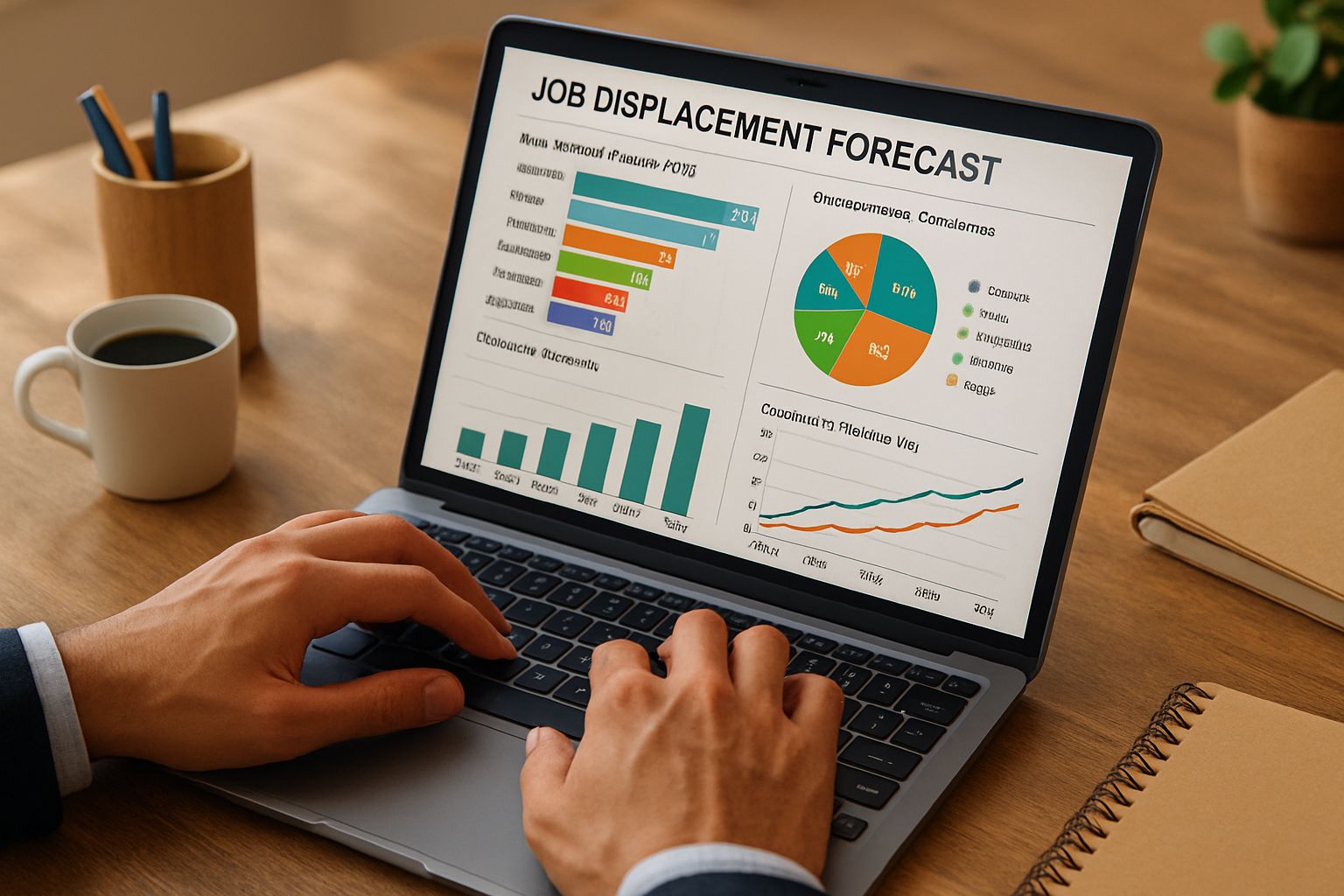
Executives increasingly embed AI job displacement forecast models inside annual operating plans. Forrester expects six percent of United States jobs automated by 2030. Meanwhile, the World Economic Forum predicts twenty-two percent of global roles will change. Firms cite these numbers when debating hiring targets.
Moreover, internal analytics teams build bespoke scenarios to test local realities. They combine macro forecasts with company adoption plans and cost curves. Therefore, each board meeting now includes a slide showing potential staff savings, retraining budgets, and productivity gains.
These activities rely on robust labor impact analytics to convert task exposure scores into dollar terms. Leadership teams then align cash flow projections with headcount moves. Consequently, transition planning becomes a finance conversation rather than an HR footnote.
Boards have learned one additional lesson. Aggressive cuts based solely on optimistic automation assumptions risk expensive reversals. Forrester warns that over-automation can force rehiring once tools underperform. This caution tempers initial enthusiasm.
In summary, senior leaders treat forecast outputs as directional signals, not absolute truths. Nevertheless, results still anchor multi-year workforce budgets. The next section explores technical foundations behind those critical numbers.
Methodologies Behind Exposure Scores
Most AI job displacement forecast models follow a task-based methodology. Researchers decompose occupations into granular tasks using O*NET and PIAAC data. Subsequently, machine learning or expert panels rate each task for automatable probability within a specific timeframe.
In contrast, older occupation-level approaches assigned one risk score to an entire job. That simplification produced sensational headlines but weak guidance for training programs. Task methods now dominate labor impact analytics because they match skills with technology capabilities.
However, methodological uncertainties remain. Estimates vary widely when analysts tweak adoption rates or economic demand assumptions. Therefore, corporate planners often run Monte Carlo simulations to bracket likely outcomes.
Key Global Forecast Statistics
Multiple institutions supply headline numbers supporting strategic debate:
- Forrester: 10.4 million U.S. roles automated by 2030; 20 percent augmented within five years.
- World Economic Forum: 92 million jobs displaced, 170 million created worldwide by 2030.
- IMF: 40 percent of global employment exposed to AI, rising to 60 percent in advanced economies.
These figures offer scale, yet each study uses unique model settings. Consequently, planners must cite sources and dates whenever presenting results.
Task-based rigor improves precision, but uncertainty persists. Therefore, executives maintain flexible transition planning budgets that scale with adoption speed. Next, we examine how vendors operationalize these insights.
Vendor Tools Reach HR
Human Capital Management giants now embed scenario engines within their suites. Workday, Oracle, SAP, and UKG ship AI agents that link skills inventories to automation probabilities. Consequently, HR managers can model staffing, training, and scheduling inside one interface.
Workday claims candidate screening times fall seventy percent in early deployments. Additionally, contract cycle time reportedly drops sixty-five percent. Such metrics help CFOs justify licenses and reskilling funds.
Furthermore, analytics dashboards expose labor impact analytics in real time. Managers watch exposure scores decline after employees complete targeted courses. Professionals can enhance their expertise with the AI Robotics™ certification, ensuring internal talent keeps pace with evolving tasks.
Nevertheless, buyers must verify vendor claims. Independent audits remain scarce, and early success stories may not generalize. Firms should request raw baseline data before approving large transformations.
To summarize, tool vendors translate academic methods into clickable workflows. However, governance and data quality still determine forecast credibility. The following section addresses risks that executives must manage.
Risks And Ethical Concerns
Forecast misuse poses financial, legal, and social threats. Over-confident AI job displacement forecast models may prompt premature layoffs. Subsequently, morale dips, and rehiring costs rise if automation lags expectations.
Data bias is another problem. Models often infer skills from digital footprints, raising privacy and discrimination issues. Regulators already scrutinize algorithmic HR decisions. Therefore, ethics boards should review every model release.
Additionally, unequal adoption can widen income gaps, as IMF research suggests. Companies operating in multiple regions must monitor how automation choices affect local communities.
Practical Transition Planning Steps
Balanced strategies reduce these risks. Leading firms:
- Pair forecast scenarios with robust upskilling roadmaps.
- Involve finance, legal, and worker councils early.
- Set trigger thresholds before executing staff reductions.
- Track live performance metrics to validate model assumptions.
These measures protect both workers and shareholders. Nevertheless, even strong safeguards require continuous review as technology matures.
In short, responsible governance anchors successful transition planning. The next brief section contrasts displacement and augmentation to reinforce that nuance.
Balancing Automation And Augmentation
AI automates tasks, yet it also enhances human productivity. Effective AI job displacement forecast models therefore include augmentation scenarios. This dual framing helps identify roles where collaboration, not substitution, drives value.
Moreover, labor impact analytics reveal skills adjacencies. For instance, an accounts clerk may pivot into data stewardship with modest training. Modeling these pathways supports smoother workforce transitions.
Consequently, planners allocate funds across automation, reskilling, and hiring freezes rather than focusing solely on cuts.
To conclude this section, organizations that integrate augmentation insights create more resilient talent pipelines. The final section synthesizes lessons and offers next steps.
Disclaimer: Some content may be AI-generated or assisted and is provided ‘as is’ for informational purposes only, without warranties of accuracy or completeness, and does not imply endorsement or affiliation.


