

AI CERTS
39 minutes ago
Figure AI Intern Upsets Humanoid Robot Benchmarks
Consequently, researchers and investors gained a rare, unfiltered view into machine endurance and human resilience. Moreover, the event reignited debates about Physical AI replacing repetitive warehouse labor. This article dissects performance numbers, technical claims, and industry reactions with a focus on practical implications. Additionally, professionals will find guidance on upskilling through recognized robotics certifications.
Figure AI's CEO, Brett Adcock, even declared, "This is the last time a human will ever win." Nevertheless, skeptics demand independent validation before rewriting warehouse staffing models. Before exploring the finer points, we outline the headline outcome that surprised many observers.
Figure AI Intern Victory
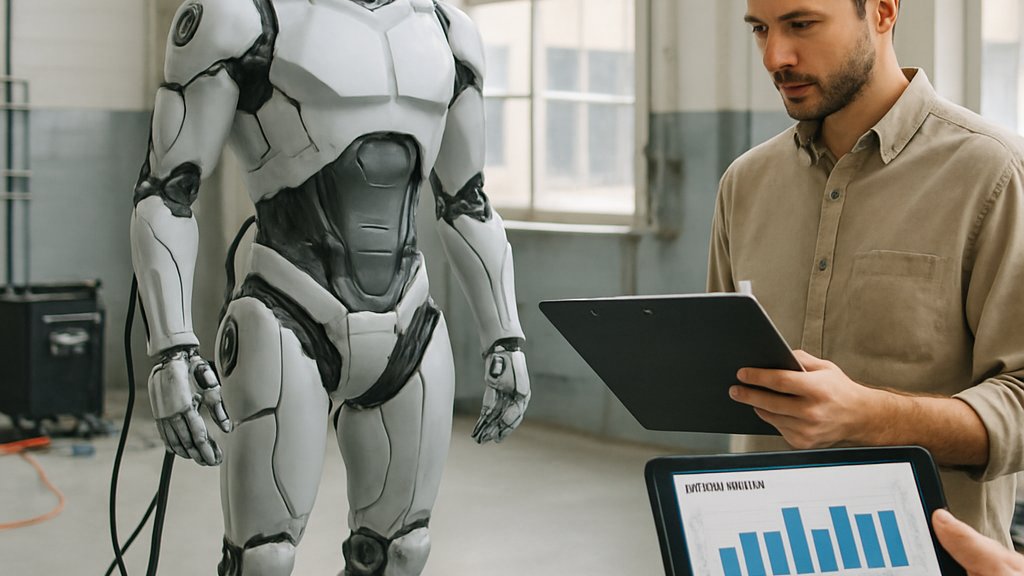
Aime, the Figure AI Intern, sorted 12,924 packages within 10 hours, averaging 2.79 seconds per box. Meanwhile, the Helix-02 powered F.03 processed 12,732 units, trailing by 192 packages despite flawless mechanical execution. Observers noted that the human benefitted from occasional bursts of speed during low cognitive load intervals. In contrast, the robot maintained consistent cadence without fatigue, signalling rapid Machine Performance improvements. Observers emphasized ergonomic station design that possibly favored the Figure AI Intern during intense intervals. Nevertheless, the slim margin highlights how Machine Performance gains are converging with human adaptability.
- Intern total: 12,924 packages
- Robot total: 12,732 packages
- Margin: 192 packages
- Average human cadence: 2.79 seconds
- Average robot cadence: 2.83 seconds
These figures enrich practical Humanoid Robot Benchmarks for repetitive logistics workflows. However, deeper throughput studies offer broader perspective.
Key Throughput Data Insights
Subsequently, Figure extended the livestream to demonstrate 24-hour autonomous shifts processing roughly 28,000 parcels. Glitchwire later reported multi-day runs exceeding 50,000 items without a recorded failure. Consequently, audience confidence in sustained Machine Performance rose, even as critics questioned the controlled environment. Figure claims all inference occurs onboard, eliminating network latency that previously hindered continuous Robotics Benchmarks. Engineers noted automated grip checks every 100 cycles, a detail absent from earlier Robotics Benchmarks.
- 8-hour pilot: 14,000 packages
- 24-hour run: 28,000 packages
- 72-hour stretch: 50,000+ packages
Nevertheless, no raw logs have been released for third-party verification. Therefore, analysts urge publication of time-stamped datasets to standardize future Humanoid Robot Benchmarks. Public data remains scarce, limiting statistical confidence for consistent Humanoid Robot Benchmarks. These challenges highlight critical gaps. However, emerging solutions are transforming the market landscape.
Core Technology Behind Helix
Helix-02 merges vision, language, and action into a single transformer policy running entirely on the robot's computers. Furthermore, the model consumes raw camera pixels and proprioceptive vectors, producing synchronized whole-body joint commands. The approach removes many handcrafted state machines that historically complicated Robotics Benchmarks. Meanwhile, Figure touts an autonomous reset routine that triggers when out-of-distribution scenarios arise. Industry veterans view on-device inference as a milestone for Physical AI deployment economics.
Custom silicon allegedly delivers 500 inferences per second at 200 watts, according to leaked specs. Nevertheless, power consumption figures remain undisclosed, which complicates cost modeling. Professionals can enhance their expertise with the AI Robotics™ certification. Helix-02 shows promise yet still requires transparent efficiency metrics to join authoritative Humanoid Robot Benchmarks. Competitive context further clarifies the significance.
Benchmarking Against Robot Rivals
Agility Robotics, Tesla Optimus, and Apptronik also release impressive numbers, though direct comparisons remain tricky. In contrast, Figure supplies unedited livestreams rather than edited highlight reels, earning goodwill with Robotics Benchmarks enthusiasts. However, each manufacturer selects tasks tailored to its current capabilities, reducing metric portability. Therefore, the community calls for standardized Humanoid Robot Benchmarks spanning dexterity, endurance, and safety. Researchers at Carnegie Mellon propose a public leaderboard using common warehouse simulation scenarios.
Shared repositories would let startups iterate against live Humanoid Robot Benchmarks rather than marketing narratives. Moreover, rival datasets seldom share raw torque curves, complicating balanced comparisons. Subsequently, vendors could submit trace logs rather than marketing videos. Cross-firm metrics would accelerate learning for the entire Physical AI sector. Yet, unresolved doubts continue to shadow the demos.
Skepticism And Remaining Limitations
TechRadar highlighted concerns about hidden teleoperation, citing unusual pauses during the livestream. Moreover, the task involved uniform packages with clear barcodes, unlike chaotic real warehouses. Critics warn that premature marketing can distort emerging Humanoid Robot Benchmarks. Skeptics argue that such conditions inflate Machine Performance by limiting perception edge cases. Nevertheless, Figure invited independent observers to future demos, though details remain vague.
Economic variables also matter, including unit price, maintenance schedules, and energy cost per shift. Consequently, potential customers wait for audited total cost of ownership studies. Independent labs petition Figure for direct network packet captures to disprove remote intervention theories.
- Teleoperation safeguards and disclosures
- Energy consumption per package
- Fail-safe and reset statistics
- Third-party safety certification status
These gaps temper market enthusiasm for Physical AI rollouts. Independent verification remains the missing piece. Figure's public roadmap offers clues about that timeline.
Future Roadmap And Verification
Brett Adcock announced plans to release a technical whitepaper with telemetry snapshots later this quarter. Subsequently, Figure intends to pilot F.03 units at a BMW plant under real material-handling conditions. A comparable Figure AI Intern may join the pilot, offering a matched human baseline. Furthermore, the company is reportedly raising new capital toward scaling production capacity. Investors value the startup at $39 billion, according to Glitchwire, though filings are unavailable.
Therefore, transparent benchmarks could reassure financial backers and early adopters alike. Meanwhile, standards bodies like IEEE explore accreditation frameworks to formalize Humanoid Robot Benchmarks. Consequently, a dedicated API will let researchers subscribe to anonymized telemetry in real time. A clear roadmap plus peer review will shape trustworthy Humanoid Robot Benchmarks worldwide. We close with practical next steps for practitioners.
Conclusion And Actionable Steps
Figure's intern victory narrows the performance chasm between humans and robots. However, replication across messier tasks and sites remains unproven. Comprehensive Humanoid Robot Benchmarks, open logs, and cost transparency will determine investor confidence and social acceptance. Meanwhile, engineers can upskill via the earlier linked certification, strengthening their evaluation skills.
Consequently, early adopters gain talent ready to vet vendor claims objectively. Professionals should monitor planned BMW pilots, upcoming whitepapers, and independent lab studies. Act now by reviewing certification curriculums and preparing your warehouse data for rigorous robotic trials.
Disclaimer: Some content may be AI-generated or assisted and is provided ‘as is’ for informational purposes only, without warranties of accuracy or completeness, and does not imply endorsement or affiliation.


