

AI CERTS
1 week ago
AI, Advanced Air Mobility, and eVTOL Innovation Highlight Why AI Training Is Becoming Essential for the Future of Aviation
As these technologies continue to evolve, the need for AI-trained professionals is growing rapidly across the aviation ecosystem.
Advanced Air Mobility refers to next-generation transportation systems that integrate electric, autonomous, and highly connected aircraft into existing airspace networks. These aircraft are designed to transport passengers and cargo more efficiently while reducing congestion and environmental impact. Industry experts believe that the coming years will see significant progress in the deployment of eVTOL aircraft, supported by advancements in artificial intelligence, automation, and digital aviation infrastructure. AAM is increasingly viewed as a practical transportation solution rather than a futuristic concept.
The Growing Role of AI in Aviation Transformation
Artificial intelligence is becoming the intelligence layer that enables advanced air mobility systems to function safely and efficiently. As eVTOL aircraft and autonomous flight systems move closer to commercial deployment, AI is expected to play a critical role in route optimization, predictive maintenance, air traffic management, operational analytics, and real-time decision-making.
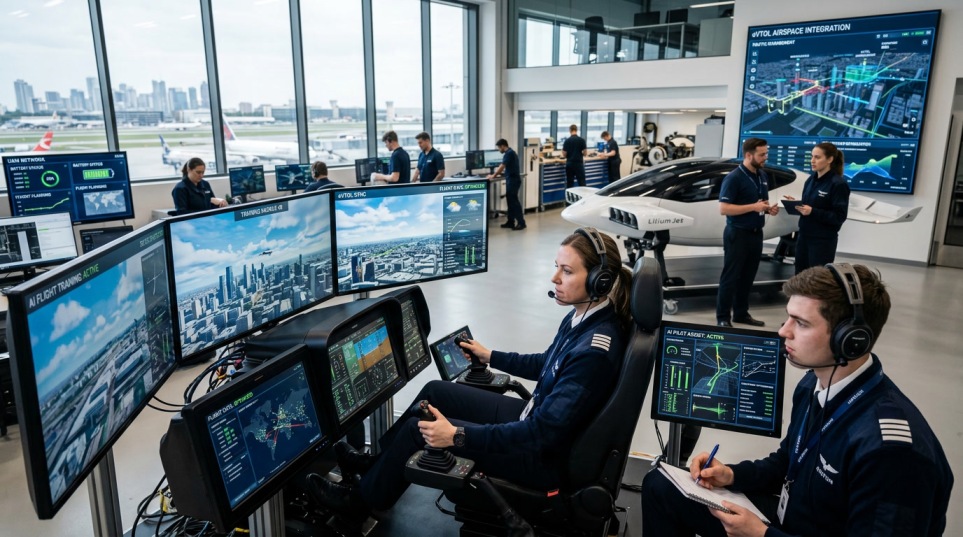
Industry developments in 2026 indicate that aviation leaders are moving from experimentation toward practical implementation. Regulatory agencies, manufacturers, and technology providers are working together to establish the infrastructure required for large-scale AAM operations. This transition requires intelligent systems capable of processing vast amounts of operational data and responding to dynamic flight conditions. AI provides the computational power needed to support these complex environments.
The future aviation ecosystem will depend on AI not only for efficiency but also for maintaining safety standards as airspace becomes more crowded with traditional aircraft, drones, and eVTOL vehicles. Experts increasingly recognize that managing this complexity manually would be extremely difficult without advanced AI-driven systems.
Why eVTOL and AAM Success Depends on AI Skills
The success of advanced air mobility extends beyond aircraft design. It requires professionals who understand how AI integrates with aviation systems, data networks, digital twins, predictive models, and autonomous operations.
Research in the AAM sector shows that AI is already being used to simulate flight operations, optimize traffic flow, validate safety scenarios, and improve decision-making processes. AI-powered test environments are helping organizations develop and evaluate the performance of next-generation mobility systems before they enter commercial service. These capabilities are accelerating innovation while reducing risk.
As aviation companies invest in AI-powered platforms, the workforce must evolve alongside the technology. Engineers, aviation managers, safety specialists, operations leaders, and technology professionals need practical knowledge of AI to effectively support future aviation systems. Without adequate AI expertise, organizations may struggle to maximize the benefits of these emerging technologies.
Key Lessons Organizations Can Learn from Aviation’s AI Evolution
One of the most important lessons emerging from the AAM and eVTOL movement is that technological innovation alone is not enough. Success depends on having people who can understand, manage, and optimize AI-driven systems.
Another lesson is the importance of interdisciplinary knowledge. Modern aviation increasingly combines AI, cybersecurity, data analytics, automation, digital infrastructure, and operational management. Professionals who possess skills across these areas will be better positioned to lead innovation and navigate complex technological environments.
The aviation industry's focus on AI also demonstrates the growing importance of continuous learning. New regulations, technologies, and operational models are emerging rapidly. Organizations that invest in AI education and workforce development will be more prepared to adapt to these changes and maintain a competitive advantage.
Security is another critical consideration. As aircraft become more connected and autonomous, AI-driven systems must be designed and managed with strong cybersecurity principles. Recent research highlights the importance of addressing vulnerabilities in next-generation air mobility systems through intelligent monitoring, risk management, and secure AI implementation.
Bridging the Gap Between Aviation Innovation and AI Training
The rapid advancement of AI-powered aviation technologies is creating a significant skills gap across industries. While organizations are eager to adopt intelligent systems, many professionals lack the specialized knowledge required to support these innovations effectively.
AI training helps bridge this gap by providing practical skills in machine learning, data analysis, automation, AI governance, predictive modeling, and intelligent decision-making. These competencies are becoming increasingly valuable not only in aviation but also in manufacturing, healthcare, logistics, cybersecurity, transportation, and public infrastructure.
As advanced air mobility moves closer to mainstream adoption, organizations will need professionals who can confidently work with AI-enabled platforms and contribute to digital transformation initiatives. AI education is therefore becoming a strategic investment rather than simply a professional development option.
Conclusion
Organizations and professionals looking to prepare for the next generation of AI-powered innovation can benefit from partnering with an Authorized Training Partner (ATP) from AI CERTs. Through industry-focused AI training and certification programs, ATPs help learners develop practical AI skills that support emerging technologies such as advanced air mobility, automation, intelligent transportation systems, and digital transformation initiatives. Learn more at https://www.aicerts.ai/authorized-training-partner/
Frequently Asked Questions
What is Advanced Air Mobility (AAM)?
Advanced Air Mobility refers to next-generation transportation systems that use technologies such as eVTOL aircraft, automation, and digital infrastructure to move people and cargo more efficiently.
How is AI used in eVTOL aircraft operations?
AI supports route optimization, predictive maintenance, airspace management, safety monitoring, operational analytics, and autonomous decision-making.
Why is AI important for the future of aviation?
AI helps aviation organizations manage increasingly complex airspace environments, improve safety, enhance operational efficiency, and support autonomous technologies.
What skills are needed for AI-driven aviation careers?
Professionals benefit from skills in AI fundamentals, machine learning, data analytics, automation, cybersecurity, and AI governance.
How can AI training help professionals stay future-ready?
AI training equips professionals with practical knowledge and certifications that enable them to work effectively with intelligent technologies and support digital transformation across industries.
Disclaimer: Some content may be AI-generated or assisted and is provided ‘as is’ for informational purposes only, without warranties of accuracy or completeness, and does not imply endorsement or affiliation.


