

AI CERTs
3 months ago
AI Recruitment Ethics: Navigating Bias Audits, Laws, and HR Risk
Recruiters once sifted resumes by hand.
Today, however, machine intelligence ranks thousands of candidates before a human opens a profile.
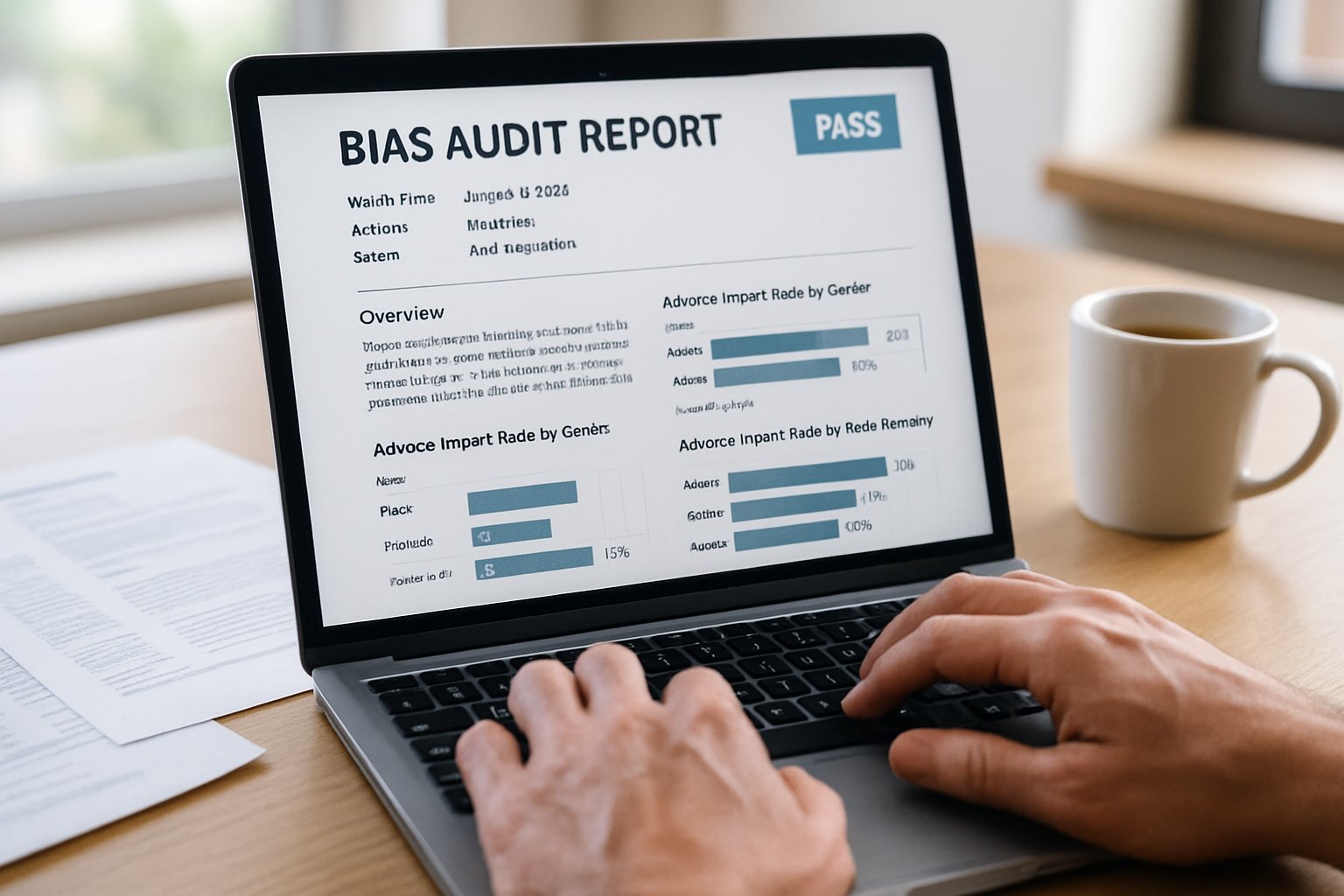
The shift promises speed yet exposes organisations to unseen legal and reputational danger.
Central to this tension is AI Recruitment Ethics, the discipline ensuring automated screening treats applicants fairly.
Moreover, regulators worldwide now test algorithmic tools against decades-old civil-rights law.
Meanwhile, vendors market polished dashboards, claiming objective skill matching and improved Diversity outcomes.
Consequently, HR leaders must balance innovation with compliance, reputation, and workforce equity.
This article investigates risks, rules, and practical safeguards guiding responsible deployment.
Readers will gain concrete steps and certifications to strengthen governance.
Current AI Bias Landscape
Vendor HireVue reports 72% of HR professionals used AI screeners in 2025, up from 58%.
Independent surveys still place overall enterprise adoption nearer 50%, yet the trajectory remains clear.
Nevertheless, most organisations lack mature risk controls or dedicated AI Recruitment Ethics programmes.
Recent audits show multimodal screeners misclassify non-native accents and over-penalise older candidates.
In contrast, some tools reduce resume keyword bias when configured for skills, not pedigree.
Overall, Fairness remains inconsistent, especially when organisations lack continuous monitoring.
These findings confirm systemic risk across platforms.
However, understanding the rulebook is the next critical step.
Evolving Regulatory Patchwork Map
Global lawmakers now treat AI Recruitment Ethics as a traditional employment test.
For instance, the U.S. EEOC settled the iTutorGroup case after software rejected older applicants.
Therefore, employers remain liable even when a vendor supplies the algorithm.
NIST’s AI Risk Management Framework offers voluntary guidance on measurement, governance, and Fairness.
Meanwhile, New York City Local Law 144 mandates annual independent bias audits and candidate notice.
Other states, including California, are drafting similar rules covering HR automation.
Jurisdictional variation challenges multi-state companies.
Nevertheless, core anti-discrimination statutes remain constant, guiding the next discussion on Hiring harms.
Documented Bias Harms Evidence
Researchers have quantified several concrete harms.
An Australian team found speech-to-text errors doubled for non-native speakers during video Hiring interviews.
Additionally, personality scoring models depressed ratings for autistic applicants, harming Diversity and inclusion.
Private litigation against Workday alleges adverse impact based on race, sex, and age.
Consequently, legal scholars expect precedent that clarifies algorithmic disparate impact analysis.
Charlotte Burrows of the EEOC stated, ‘Employers stay responsible even when technology discriminates’.
Evidence from labs and courts now aligns.
Therefore, business leaders must evaluate systems at market scale.
Business Scale And Adoption
Moreover, the recruitment software market now exceeds USD 2.5 billion, says IMARC.
Growth projections show double-digit CAGR as AI modules embed within broader HR suites.
Subsequently, Talent acquisition teams face vendor pitches promising cheaper, faster, and fairer selection.
Yet buyers rarely receive transparent audit results.
In contrast, some enterprises demand explainability documentation before signing multiyear Hiring contracts.
Market pressure toward disclosure is growing, driven by procurement teams and investor ESG mandates.
Adoption momentum will not slow.
However, robust governance tools can steer AI Recruitment Ethics at scale.
Mitigation And Audit Strategies
To address risk, organisations can blend technical and organisational controls aligned with AI Recruitment Ethics.
First, validate each model for job-related predictive power using structured adverse-impact testing.
Furthermore, run subgroup performance analysis quarterly, not yearly, to capture drift.
Second, establish Human-in-the-Loop reviews that empower recruiters to override questionable scores.
Nevertheless, automation bias can still sway decisions, so documentation must explain each override.
Third, publish audit summaries and Fairness metrics externally to build stakeholder trust.
- 72% HR adoption reported by HireVue (2025).
- $365K EEOC settlement signals enforcement costs.
- Video transcriptions halve accuracy for accents in recent study.
- New York City requires annual independent audits.
Additionally, recruiters can upskill through targeted programmes.
Professionals boost expertise via the AI+ UX Designer™ certification.
Continuous audits and skills development reinforce ethics programmes.
Consequently, compliance actions become operational habits, not one-off exercises.
Practical Compliance Checklist Guide
Therefore, practitioners should follow a structured AI Recruitment Ethics checklist.
Start by mapping every Hiring tool and identifying protected characteristics possibly affected.
Next, perform adverse-impact analysis using the four-fifths rule across race, sex, age, and disability.
Document data provenance, feature importance, and model versioning for each release.
Meanwhile, retain candidate notices and accommodation records for regulatory review.
Finally, update governance boards quarterly and report metrics to HR leadership and investors.
These checklist items convert abstract principles into daily practice.
However, forward-looking leaders also watch emerging trends.
Looking Ahead Next Steps
Looking ahead, several forces will shape the debate.
Federal agencies may streamline guidance, yet state laws will expand audit mandates.
Moreover, large language models could introduce self-preference bias, rewarding resumes generated by similar systems.
Security teams also brace for deepfake interviews that spoof identity and speech.
Nevertheless, maturing standards such as NIST RMF foster shared measurement language for Fairness and risk.
Forward-leaning firms will invest in Diverse Talent analytics to monitor long-term outcomes.
Change will accelerate across technical and legal arenas.
Consequently, grounding strategies in AI Recruitment Ethics remains fundamental.
Ultimately, robust governance delivers measurable benefits.
Teams that prioritise AI Recruitment Ethics reduce legal exposure and build candidate trust.
Moreover, AI Recruitment Ethics supports Diversity goals by exposing hidden barriers inside data pipelines.
Consequently, organisations attract richer Talent pools and strengthen brand resilience.
Nevertheless, vigilance remains essential because models, laws, and threats evolve rapidly.
Act now: embed AI Recruitment Ethics principles, audit regularly, and pursue advanced certifications to lead responsibly.
Disclaimer: Some content may be AI-generated or assisted and is provided ‘as is’ for informational purposes only, without warranties of accuracy or completeness, and does not imply endorsement or affiliation.


