

AI CERTS
2 months ago
AI Copyright Revolt: 10k Writers Brandish an Empty Book Protest
Media quickly dubbed the coordinated action the latest flashpoint in the AI Copyright Revolt. Meanwhile, policymakers, developers, and creators now face hard choices over data access and remuneration. Kazuo Ishiguro, Richard Osman, and other literary stars joined the cause, amplifying the conversation worldwide. Furthermore, 10k writers placed their names inside the empty pages, turning a list into a billboard. This article unpacks the protest, policy context, and emerging business models that could defuse the standoff.
Empty Pages Signal
First, the format itself carries symbolic weight. Additionally, the stunt adds fresh imagery to the AI Copyright Revolt. Moreover, blank pages evoke a future where original storytelling dries up as machines churn out derivative text. Authors argue that unlicensed training strips value and could leave shelves filled with algorithmic echoes. Newton-Rex said the industry is being built on "stolen work" that already undermines livelihoods.
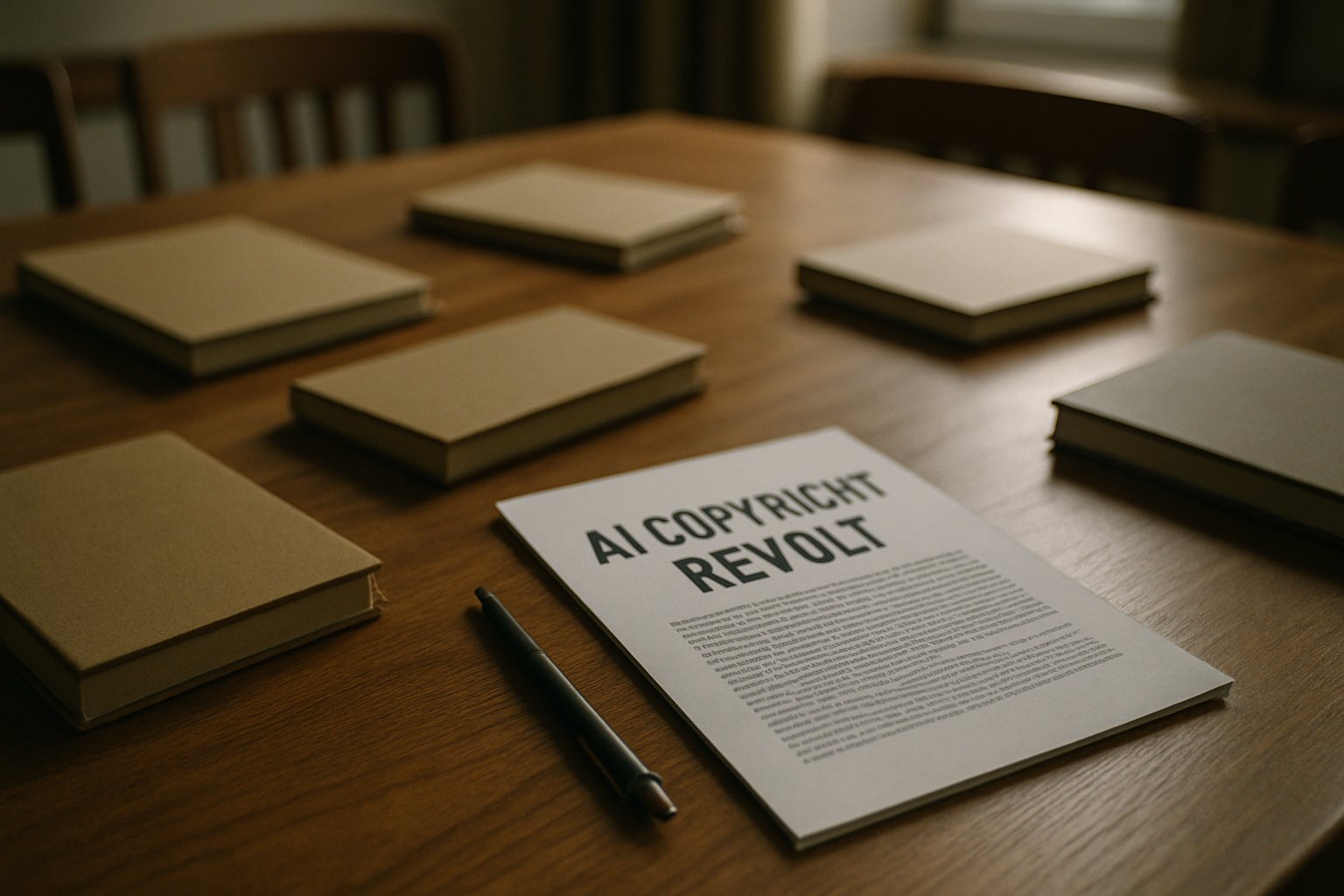
The empty paperback visualises cultural loss in stark fashion. Readers grasp the threat without needing technical diagrams. Against that backdrop, timing of the protest proved equally strategic.
Protest Timing Pressure Point
The book drop coincided with the London Book Fair, a calendar highlight for global publishing. Consequently, international media amplified the protest beyond the exhibition halls. Meanwhile, UK ministers face a March 18 statutory deadline to release an impact assessment on copyright and AI. Stakeholders therefore expect Whitehall decisions within days, heightening tension. Regulatory outcomes will steer investment, market confidence, and future author protections. Kazuo Ishiguro reiterated that authors simply want fair pay, not special treatment. Reports counted 10k writers attached to the volume, a mass rarely seen in publishing disputes. Observers quickly folded the demonstration into the broader AI Copyright Revolt narrative dominating creative headlines.
Schedule alignment magnified the protest’s visibility and policy relevance. Decision makers cannot easily ignore an empty novel thrust into their own trade show. Next, consider how many voices unified behind that slim spine.
10k Writers Unite Loudly
Collective action defined this campaign in sheer scale. Furthermore, roughly 10k writers ranging from debut poets to Nobel laureates endorsed the statement. Signatures spanned crime, romance, fantasy, and children’s literature, signalling cross-genre solidarity. Ishiguro, Malorie Blackman, and Alan Moore featured prominently on early press releases. Nevertheless, many lesser-known names welcomed the spotlight, saying AI outputs already cannibalise midlist income.
- Approximately 10k writers appear in the printed roster.
- Consultation on copyright and AI attracted 11,500 formal responses.
- The protest book circulated during 10–12 March at the London event.
Consequently, the campaign evidences a broad constituency that ministers must address. Author unity sends a rare, powerful signal to policymakers. The figure dwarfs many traditional petition drives. However, numbers alone do not solve revenue allocation questions, which turn on licensing mechanics.
Collective Licensing Paths Emerge
While courts deliberate, industry groups pursue market solutions. Publishers’ Licensing Services launched a collective scheme offering AI developers a lawful content pipeline. Additionally, Authors’ Licensing and Collecting Society backs the initiative, promising transparent payouts. Consequently, negotiations have started between rights holders and several model builders seeking predictable costs. Analysts note that the $1.5 billion Anthropic settlement pushed firms toward licensed datasets. The proposal aims to channel the energy of the AI Copyright Revolt into pragmatic revenue sharing.
Professionals can enhance their expertise through the AI Ethics Business™ certification. Moreover, such credentials help stakeholders evaluate complex training proposals and negotiate equitable deals. Collective arrangements promise revenue and clarity for authors. Implementation, however, depends on widespread buy-in from both sides. Therefore, government policy choices will either accelerate or undermine these frameworks.
Policy Stakes Intensify Now
Parliamentary committees already advised ministers to prioritise a licence-first approach over blanket exceptions. Nevertheless, sections of the tech sector lobby for a "commercial research" carve-out. In contrast, authors fear that wording could legitimise wholesale scraping for profit. Therefore, the March report will reveal whether compromise emerges or conflict deepens. Observers recall similar flashpoints from music streaming debates, where delayed clarity hurt smaller artists. The AI Copyright Revolt now frames the consultation as a referendum on cultural sovereignty.
Upcoming government analysis will set the tone for years. Industry plans hinge on the policy direction chosen. Meanwhile, courtroom trends provide additional pressure.
Litigation Shapes AI Landscape
Courtrooms continue to influence negotiations around training data. Subsequently, Anthropic’s proposed $1.5 billion settlement shocked many venture investors. Moreover, plaintiffs argued the payout underscored the true market value of literary datasets. In contrast, tech counsel warned that protracted trials may stall model releases and global competitiveness. Nevertheless, settlements supply precedents that nudge companies toward licensed content arrangements. Legal briefs increasingly cite the AI Copyright Revolt when arguing for injunctive relief. Ishiguro cited the case while urging decision makers to avoid endless legal attrition.
Judicial risk is raising the cost of non-compliance. Every verdict shifts bargaining power toward organised rights holders. Consequently, strategic forecasting now turns to potential future scenarios.
Plausible Future Scenarios Ahead
Analysts sketch three plausible outcomes for the coming year. First, government could adopt explicit fair-pay licensing rules, satisfying many authors. Second, ministers might endorse a narrow exception, inviting more lawsuits under international venues. Third, policymakers could delay again, perpetuating uncertainty and chilling investment. Moreover, collective licensing infrastructure would struggle without policy endorsement. Investors therefore monitor the AI Copyright Revolt as a barometer of political will.
Each scenario bears distinct revenue, risk, and innovation implications. Proactive planning requires clear statutory guidance soon. Finally, stakeholders must synthesise these threads into actionable next steps.
The empty book protest crystallised concerns that algorithms may hollow out literary ecosystems. However, the AI Copyright Revolt also spotlights constructive paths toward paid data access. Collective licence models, targeted exceptions, and judicial guidance each offer partial relief. Moreover, 10k writers have shown they will mobilise whenever their work fuels unremunerated computation.
Therefore, policymakers and developers should engage transparently, pay fairly, and document usage. Ethical leaders can validate skills via the AI Ethics Business™ credential. Consequently, the AI Copyright Revolt may yet end in sustainable collaboration rather than endless litigation. Engage now, download the protest text, and join the dialogue before policy hardens.
Disclaimer: Some content may be AI-generated or assisted and is provided ‘as is’ for informational purposes only, without warranties of accuracy or completeness, and does not imply endorsement or affiliation.


