

AI CERTS
2 hours ago
AI Automation Reshapes India’s Life Sciences Sector
Funding backs AI, Automation, and digital twins across research, manufacturing, and supply chains. Meanwhile, private giants like Dr Reddy’s, Sun Pharma, and Biotech upstarts pilot generative models. This feature examines progress, gaps, and next steps, drawing on data from 2024-25 reports.
Policy Drives AI Shift
Firstly, government action anchors the transformation. The Promotion of Research and Innovation in Pharma-MedTech commits ₹4,250 crore to industry R&D and ₹700 crore to Centres of Excellence. Furthermore, PRIP guidelines emphasise Genomics, Automation, and blockchain for secure supply chains. In contrast, earlier incentives focused mainly on capacity expansion. Now, Life Sciences policy links funding to digital innovation milestones and local talent development. Consequently, National Institute of Pharmaceutical Education and Research campuses are upgrading curricula for AI skills. These moves signal sustained commitment. However, disbursement speed and project governance remain under scrutiny.
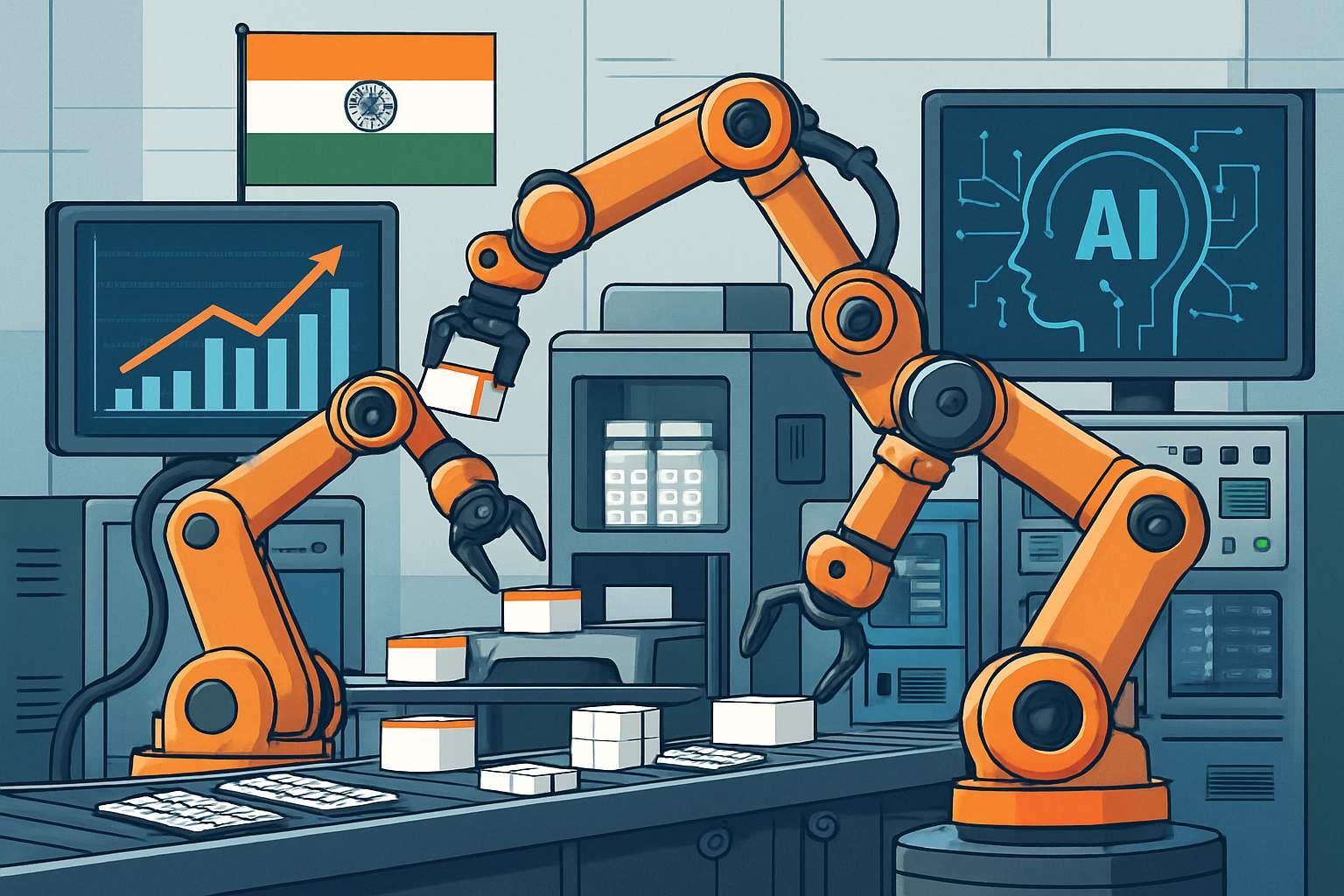
These initiatives create a supportive runway. Nevertheless, effective monitoring will decide impact.
Subsequently, private adoption momentum shows early proof of concept.
Industry Adoption Momentum
Corporate data confirms rising interest. EY research finds half of Indian Pharma companies now invest in AI projects. Additionally, one quarter already run GenAI systems in production. Dr Reddy’s reports an AI platform delivering US$1.75 million value across 40 molecules. Moreover, Sun Pharma and Cipla showcase smart-plant pilots during industry conferences. Tech providers such as Microsoft, NVIDIA, and Kyndryl supply cloud and GPU stacks. Consequently, cost barriers are falling for mid-tier Biotech firms. Importantly, Life Sciences boards demand measurable returns, not pilots alone. Therefore, adoption roadmaps increasingly include full-scale Manufacturing Execution Systems with predictive analytics.
Momentum is visible, yet enterprise-wide coverage is rare. However, lessons learned feed the next wave.
Consequently, attention shifts to factory floors.
Smart Manufacturing Impact
Digital twins now simulate batch reactions before a single valve turns. Meanwhile, robots handle sterile packaging, reducing contamination risks. Predictive maintenance algorithms cut downtime by 15 percent at pilot sites, according to internal Dr Reddy’s data. Furthermore, IIoT sensors stream Diagnostics data for real-time quality checks. EY forecasts 30–40 percent productivity gains when GenAI augments these Automation layers. Industry executives also highlight reduced deviation investigations and faster regulatory audits. Additionally, blockchain pilots trace active ingredients, tackling counterfeit threats that plague Genomics supply chains.
Key quantified gains include:
- Up to 20 percent faster batch release cycles
- Roughly 10 percent lower energy consumption per unit output
- Fewer human errors during electronic batch record reviews
These metrics attract investment. Nevertheless, data and talent constraints could stall scale-up.
Therefore, the next section explores those gaps.
Data And Talent Gaps
High-quality datasets remain scarce. Moreover, legacy systems often silo critical process parameters. In contrast, AI models thrive on curated, interoperable streams. Consequently, integration projects consume time and budgets. Cybersecurity adds another layer, as connected plants widen attack surfaces. Additionally, skilled data engineers, computational biologists, and regulatory specialists are limited. Government scholarships help, yet demand outpaces supply within Life Sciences. Professionals can enhance their expertise with the AI Customer Service™ certification, which builds cross-functional AI fluency.
These constraints slow momentum. Nevertheless, clearer rules may accelerate investment.
Subsequently, regulators are modernising oversight frameworks.
Regulatory Framework Evolves
India’s Central Drugs Standard Control Organisation signals lighter oversight for validated algorithms. Furthermore, draft guidance on software-as-medical-device covers adaptive learning systems. Rajeev Raghuvanshi, the Drugs Controller General, states that AI tools can shorten review queues. However, liability and change-control procedures for self-updating models still lack detail. Meanwhile, industry players seek alignment with FDA and EMA processes to streamline export approvals. Consequently, collaborative sandboxes are proposed to test Pharmacovigilance Automation and Diagnostics algorithms under regulator supervision.
Progress appears promising. Nevertheless, definitive timelines will reassure investors.
Therefore, organisations calculate future payoffs carefully.
Future Outlook And ROI
Market analysts project India’s pharmaceutical value to hit US$88.9 billion by 2030. Additionally, global Pharma 4.0 spend grows at a 17 percent CAGR, positioning Indian vendors for exportable solutions. Moreover, Life Sciences executives now budget digital investments alongside capacity expansions. Genomics startups leverage cloud HPC to design antibodies, while Diagnostics firms pilot AI triage tools for rapid test interpretation. EY’s maturity framework shows companies moving from experimentation to orchestration phases. Consequently, those achieving scale expect double-digit margin improvements within three years.
Benefits appear tangible. However, sustained collaboration will convert potential into nationwide advantage.
Thus, an integrated ecosystem remains the final ingredient.
Conclusion
India’s journey toward AI-enabled Life Sciences leadership is well underway. Government funding, corporate pilots, and evolving rules create fertile ground. Moreover, Automation, Genomics innovation, and real-time Diagnostics promise significant productivity gains for Pharma and Biotech alike. Nevertheless, data quality, skills, and regulatory clarity demand collective focus. Consequently, professionals should upskill swiftly to capture emerging opportunities. Consider enrolling in specialised certifications and monitor policy updates closely. The next breakthrough may come from your own digitally empowered laboratory.


