

AI CERTS
4 months ago
AI Content Flood Reshapes Creative Economy
Nevertheless, executives also see unprecedented efficiency gains. McKinsey values generative AI’s annual upside at up to USD 4.4 trillion. Therefore, creators, platforms, and regulators must recalibrate fast or risk falling behind.
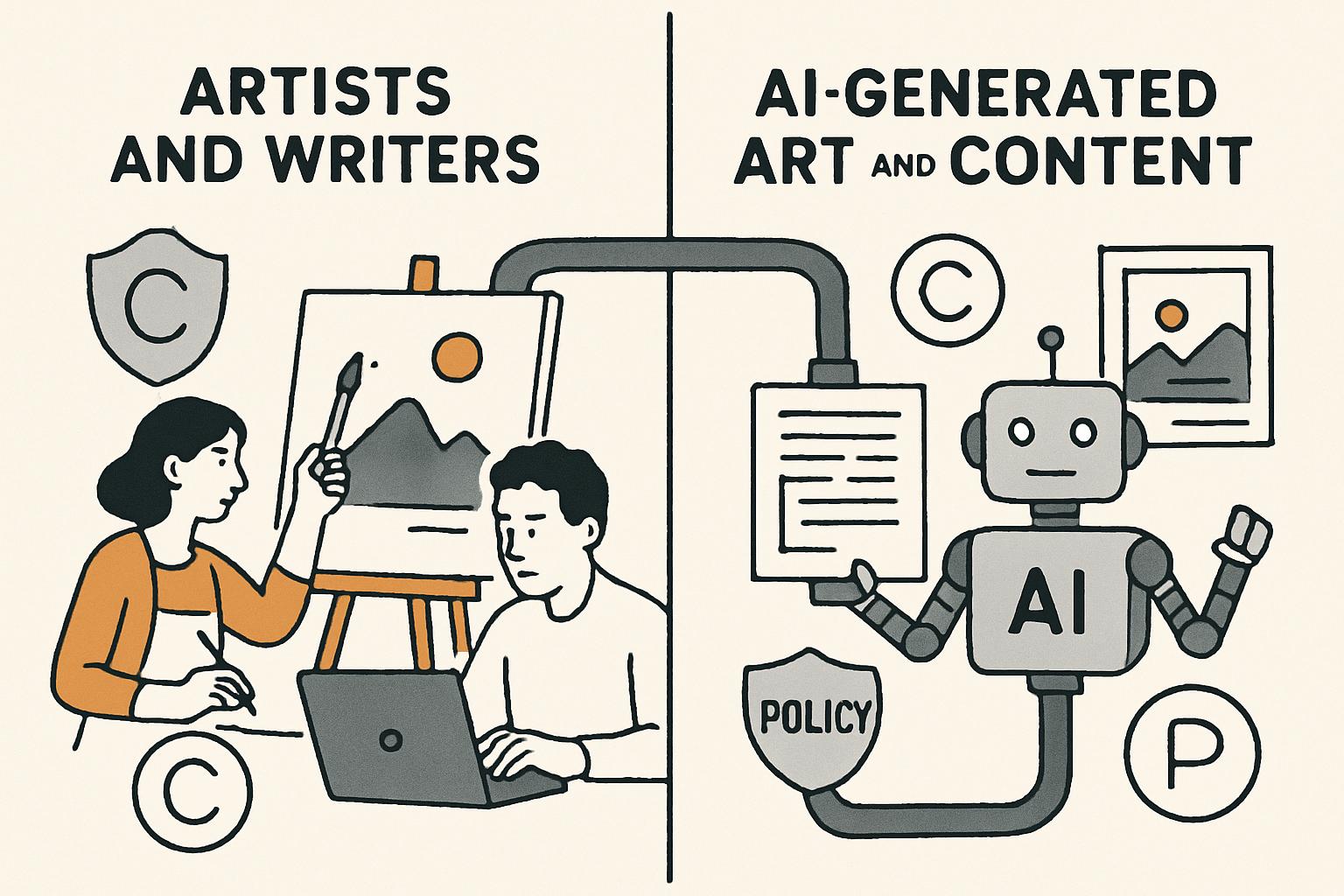
AI Content Surge Impacts
Industry data shows a relentless surge. Graphite’s Common Crawl study revealed AI articles crossed the 50% threshold in late 2024 and plateaued near 52% through mid-2025. Furthermore, Ahrefs analysts declared that “AI content creation is becoming the default.”
This expanded volume reshapes discovery. Google’s March 2024 policy warns that scaled abuse aiming to manipulate rankings is spam. Meanwhile, AI Overviews reduce clicks to external sites, squeezing publisher margins.
Advertising feels similar pressure. Low-value pages add inventory but drag down yield and brand safety. Consequently, agencies adjust placement filters to avoid AI slop.
These market tremors already influence the Creative Economy. However, savvy teams leverage AI to localize campaigns at record speed. This duality defines the current moment. Therefore, stakeholders must assess exposure before strategic planning.
Market Data Highlights 2025
Numbers reveal the magnitude:
- 74.2% of 900,000 new pages included AI content (Ahrefs, May 2025).
- The AI-generated content market hit USD 12.879 billion in 2024 (Grand View Research).
- Projected market size reaches USD 53.79 billion by 2033, a 17.3% CAGR.
- Generative AI could add USD 2.6–4.4 trillion yearly across sectors (McKinsey).
Additionally, detector variance clouds precision. Surfer tools showed false-positive rates near 4.2%, illustrating methodological caveats.
Nevertheless, every credible study confirms staggering volume growth. That expansion threatens to obliterate low-margin content niches while elevating scarce expert analysis.
These highlights underscore why the Creative Economy needs rigorous measurement standards. Consequently, investors and policymakers require transparent methodology disclosures.
Market Winners And Losers
Winners emerge where productivity outpaces commoditization. Content teams producing verified research scale faster and cheaper. Moreover, agencies offering prompt engineering services command new premium fees.
Stock platforms adapt too. Getty launched a proprietary generator after litigation over model training. Meanwhile, Stability AI hailed a UK ruling that limited major Copyright claims, boosting synthetic image momentum.
Conversely, freelancers in routine copywriting face rate erosion. In contrast, investigative journalists retain pricing power because authentic reporting resists automation.
The Creative Economy thus stratifies. Value shifts toward unique insight and trusted Human Creation. Consequently, organizations must map offerings against automatable tasks.
Legal And Policy Shifts
Regulation races to keep pace. The UK High Court largely dismissed Getty’s core Copyright complaint on November 4 2025, yet trademark issues survived. Additionally, the European Union drafts AI Act provisions governing synthetic media disclosures.
Google’s evolving spam Policy tightens enforcement on scaled AI abuse. Therefore, publishers must balance volume with originality to avoid penalties.
Moreover, antitrust agencies watch platform consolidation. The proposed Getty-Shutterstock merger faces competition scrutiny, reflecting worries that scale may obliterate independent suppliers.
These legal currents reshape incentives across the Creative Economy. Consequently, leaders should monitor cross-border jurisprudence before deploying large datasets.
Quality And Detection Gaps
Detection tools struggle as models improve. False negatives allow AI text to pass as Human Creation. Moreover, false positives risk mislabeling genuine work.
Ahrefs uses a one-page-per-domain sample, while Graphite scans Common Crawl. In contrast, Surfer analyzes top-SERP content. Therefore, prevalence percentages diverge.
Quality issues extend beyond text. Deepfake imagery spreads misinformation and brand dilution. Consequently, verification workflows now consume larger editorial budgets.
Nevertheless, new standards emerge. Google emphasizes E-E-A-T signals over origin. Additionally, watermark research promises cryptographic provenance.
These gaps highlight urgent research opportunities. Subsequently, partnering with academia could accelerate robust detection benchmarks.
Creative Economy Future Outlook
Market momentum remains undeniable. Grand View Research forecasts sustained double-digit growth through 2033. Furthermore, McKinsey expects three-quarters of economic gains inside marketing, customer service, software, and R&D.
Strategic actions can capture upside:
- Invest in prompt design and domain datasets.
- Adopt human-led fact-checking pipelines.
- Secure training data licenses to mitigate Copyright risk.
- Pursue upskilling via certifications such as the AI Engineer™ program.
- Engage policymakers to shape balanced AI Policy frameworks.
Additionally, diversified revenue shields firms from algorithm shocks. However, leaders must avoid complacency because rapid volume shifts can obliterate comfort zones.
The next two years will test resilience across the Creative Economy. Therefore, proactive governance and ethical guidelines will differentiate trusted brands.
These considerations reveal both peril and promise. Nevertheless, collaboration between creators, platforms, and regulators can ensure sustainable innovation.
Consequently, the Creative Economy could flourish if stakeholders embed transparency, quality, and fair compensation at its core.
Conclusion
Generative AI already commands a majority share of new online content. Furthermore, data confirms explosive volume growth alongside pending legal and Policy battles. Market forces are poised to either obliterate or empower depending on strategic choices. Nevertheless, opportunity abounds for those combining Human Creation with responsible automation. Therefore, professionals should explore advanced learning paths and certifications to remain competitive. Act now by reviewing the linked AI Engineer™ credential and position yourself at the forefront of the evolving Creative Economy.


