

AI CERTS
5 months ago
Autonomous Systems Redefine Visual Agent Reasoning Advancements
Over the past year, Autonomous Systems have matured quickly. Moreover, new VLM agents can explain each step through visual thoughts. Researchers call this multimodal Chain-of-Thought a breakthrough for trust. Additionally, products like ChatGPT Agent show commercial appetite for this rigor.
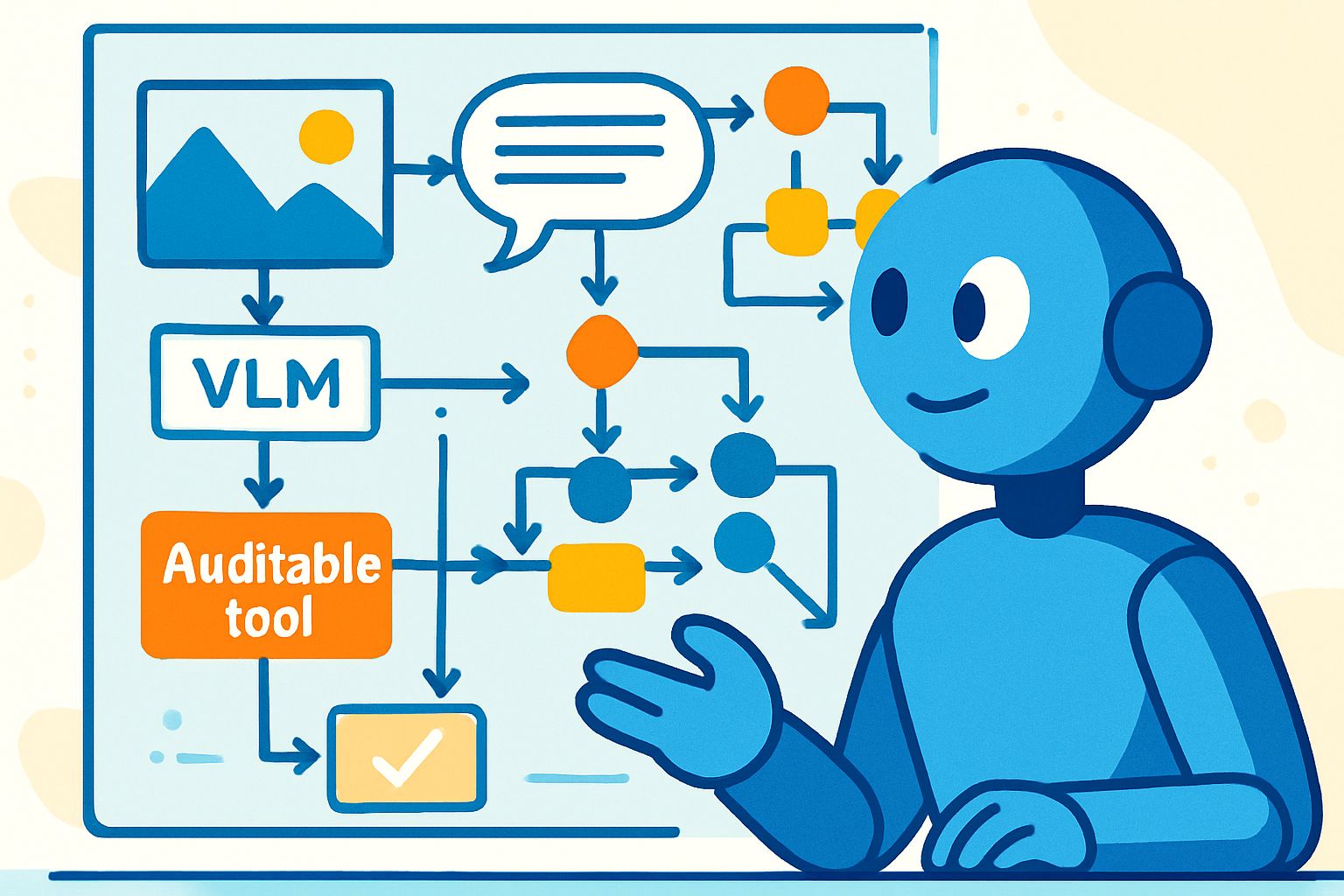
This article surveys recent Research, benchmarks, and open questions. Readers will learn how VAGEN frameworks, Multi-Turn planning, and tool verification redefine workplace automation. Finally, we outline skills and certifications that prepare teams for the coming wave.
Visual Agents Evolve Quickly
Academic Research accelerated after the Visual Thoughts paper introduced a taxonomy for visual Chain-of-Thought. Moreover, Apple demonstrated that synthetic rationales boost VLM performance when fine-tuned with two distinct stages. Meanwhile, RSVP combined segmentation with CoT, lifting benchmark scores by up to nine points.
Pilot studies showed faster annotation workflows and lower review costs. Engineers appreciated concise rationales that align with established annotation tools. Industry adoption followed quickly. Therefore, Alibaba's Qwen2.5-VL family shipped agentic features, structured JSON outputs, and grounded evidence traces.
Autonomous Systems in laboratories now plan tasks, draw boxes, and call tools within milliseconds. Furthermore, early VAGEN prototypes completed Multi-Turn dialogues about images without losing context. These advances confirm a pivot from passive captioning to interactive agency. Subsequently, grounding has emerged as the next critical frontier. Consequently, the discussion now turns toward making evidence explicit.
Grounding Drives Model Trust
Grounding links answer tokens to image regions. Moreover, this link allows auditors to inspect every claim. Qwen2.5-VL illustrates the value, emitting bounding boxes and supporting verifiers.
Visual grounding also supplies structured inputs for external checkers inside Autonomous Systems. However, aligning visual pointers with textual Reasoning remains difficult. Recent Research builds solvers plus verifiers that jointly learn through self-feedback.
Benchmarks show the payoff. RSVP achieved 49.7 mAP on SegInW in zero-shot tests. Additionally, Apple reported consistent gains after integrating synthetic visual thoughts. Regulators prefer Autonomous Systems that expose grounded evidence. Users can now trace decisions back to specific pixels during audits. Such clarity eases compliance reviews in regulated sectors.
Grounding raises transparency and quantitative performance simultaneously. Nevertheless, acting on that evidence requires robust tool orchestration. Therefore, the next section explores how agents wield tools.
Tool Use Enables Action
Early vision chatbots only answered static questions. By contrast, modern agents browse, code, and manipulate files. Moreover, VLM cores now decide which tool advances each step.
Agent0-VL and VTool-R1 frameworks formalize solver and verifier roles within Autonomous Systems. Consequently, a VAGEN controller may request an object detector, confirm coordinates, then refine its logic. Iterative supervision keeps context alive during long jobs.
- Faster evidence gathering through API calls
- Lower hallucination rates via external verification
- Reusable workflows for enterprise automation
Furthermore, OpenAI's ChatGPT Agent release proved market readiness for such capabilities. Nevertheless, orchestration introduces new security and privacy questions. Tool integration transforms passive perception into active assistance. Subsequently, benchmarks evolved to measure these richer interactions. Next, we examine those evaluation efforts.
Developers embed sandboxed browsers to limit exposure during web tool calls. In contrast, enterprise deployments opt for private data-plane execution for confidentiality.
Synthetic Data Fuels Research
Large synthetic corpora now train visual Reasoning at unprecedented scale. Generate-and-distill pipelines create millions of annotated examples with minimal labeling cost. Moreover, Apple harnessed GPT-4o to draft rationales before supervised fine-tuning.
Synthetic corpora empower Autonomous Systems training at scale. Open projects like Long Grounded Thoughts share 100K to 1M examples. Consequently, smaller teams replicate competitive VLM agents without giant proprietary sets. However, critics warn that synthetic bias can mislead evaluation.
Synthetic scale accelerates experimentation but demands careful validation. Therefore, robust benchmarks are vital. The community responded with new metric suites.
Benchmarks Track Multi-Turn Reasoning
Traditional image QA tests capture single exchanges only. Meanwhile, Research groups introduced Multi-Turn Vision QA, ReasonSeg, and SegInW datasets. Benchmarks reveal which Autonomous Systems generalize across tasks.
These tasks examine dialogue persistence, grounding quality, and final accuracy. Visual Thoughts authors highlighted improved coherence when models expose rationale tokens. Furthermore, RSVP showed six-point gIoU gains once segmentation merged with Reasoning. Industry dashboards now report scores alongside grounding coverage percentages.
Standardized tracking encourages transparent competition across labs and vendors. Nevertheless, metric fragmentation still hinders direct comparisons. Risks extend beyond benchmarking, as the next section explains.
Open Challenges And Risks
Agentic power brings safety trade-offs. Autonomous Systems may access private files, websites, or IoT devices if misconfigured. Therefore, permission layers and human confirmations remain essential.
Faithfulness also troubles evaluators. In contrast, a model can fabricate Reasoning traces that merely justify answers post-hoc. Tool-integrated verification mitigates some issues yet expands attack surfaces.
Compute and data demands still limit open replication. Moreover, VAGEN models with billions of parameters need specialized hardware. Community efforts continue but funding gaps persist.
Attackers may craft adversarial images that mislead both solver and verifier. Therefore, red-team exercises increasingly accompany launch checklists.
Challenges underline the importance of rigorous governance and shared testing. Consequently, upskilling talent will ensure safe deployment. Professionals now ask how to prepare.
Upskilling For Applied Autonomy
Talent shortages threaten adoption roadmaps. Therefore, technical leaders prioritize continuous education programs. Professionals can strengthen skills through the AI+ Everyone™ certification.
Hiring managers already seek Autonomous Systems experience. Moreover, curriculum covers VLM architecture, Multi-Turn planning, and governance frameworks. Workshops also dissect VAGEN deployment patterns for Autonomous Systems.
Consequently, graduates gain confidence to audit visual pipelines and manage risk. These learning paths close the capability gap. Upskilling ensures that innovation remains responsible and profitable. Subsequently, enterprises can deploy agents with greater trust.
Case studies show productivity boosts once staff understand agent orchestration patterns. Additionally, cross-functional workshops help translate model outputs into domain insights quickly.
Open Challenges And Risks
Agentic power brings safety trade-offs. Autonomous Systems may access private files, websites, or IoT devices if misconfigured. Therefore, permission layers and human confirmations remain essential.
Faithfulness also troubles evaluators. In contrast, a model can fabricate Reasoning traces that merely justify answers post-hoc. Tool-integrated verification mitigates some issues yet expands attack surfaces.
Compute and data demands still limit open replication. Moreover, VAGEN models with billions of parameters need specialized hardware. Community efforts continue but funding gaps persist.
Attackers may craft adversarial images that mislead both solver and verifier. Therefore, red-team exercises increasingly accompany launch checklists.
Challenges underline the importance of rigorous governance and shared testing. Consequently, upskilling talent will ensure safe deployment. Professionals now ask how to prepare.
Open Challenges And Risks
Agentic power brings safety trade-offs. Autonomous Systems may access private files, websites, or IoT devices if misconfigured. Therefore, permission layers and human confirmations remain essential.
Faithfulness also troubles evaluators. In contrast, a model can fabricate Reasoning traces that merely justify answers post-hoc. Tool-integrated verification mitigates some issues yet expands attack surfaces.
Compute and data demands still limit open replication. Moreover, VAGEN models with billions of parameters need specialized hardware. Community efforts continue but funding gaps persist.
Attackers may craft adversarial images that mislead both solver and verifier. Therefore, red-team exercises increasingly accompany launch checklists.
Challenges underline the importance of rigorous governance and shared testing. Consequently, upskilling talent will ensure safe deployment. Professionals now ask how to prepare.
Open Challenges And Risks
Agentic power brings safety trade-offs. Autonomous Systems may access private files, websites, or IoT devices if misconfigured. Therefore, permission layers and human confirmations remain essential.
Faithfulness also troubles evaluators. In contrast, a model can fabricate Reasoning traces that merely justify answers post-hoc. Tool-integrated verification mitigates some issues yet expands attack surfaces.
Compute and data demands still limit open replication. Moreover, VAGEN models with billions of parameters need specialized hardware. Community efforts continue but funding gaps persist.
Attackers may craft adversarial images that mislead both solver and verifier. Therefore, red-team exercises increasingly accompany launch checklists.
Challenges underline the importance of rigorous governance and shared testing. Consequently, upskilling talent will ensure safe deployment. Professionals now ask how to prepare.
Open Challenges And Risks
Agentic power brings safety trade-offs. Autonomous Systems may access private files, websites, or IoT devices if misconfigured. Therefore, permission layers and human confirmations remain essential.
Faithfulness also troubles evaluators. In contrast, a model can fabricate Reasoning traces that merely justify answers post-hoc. Tool-integrated verification mitigates some issues yet expands attack surfaces.
Compute and data demands still limit open replication. Moreover, VAGEN models with billions of parameters need specialized hardware. Community efforts continue but funding gaps persist.
Attackers may craft adversarial images that mislead both solver and verifier. Therefore, red-team exercises increasingly accompany launch checklists.
Challenges underline the importance of rigorous governance and shared testing. Consequently, upskilling talent will ensure safe deployment. Professionals now ask how to prepare.
Agentic vision technology progressed from lab curiosity to production reality within months. Moreover, grounded visual thoughts, tool orchestration, and robust benchmarks now define competitive edges. Autonomous Systems stand poised to automate research, compliance, and analytics across industries. Nevertheless, governance gaps and data demands persist. Therefore, leaders must balance ambition with rigorous verification and user oversight. Teams that build transparent pipelines will earn trust sooner. Meanwhile, professionals should secure domain skills and ethical fluency. Consider advancing your knowledge through recognized certifications. Visit the AI+ Everyone program today and lead the next wave. Consequently, early adopters will capture efficiency savings before rivals respond. Finally, stay informed as regulatory guidance evolves quickly.
Disclaimer: Some content may be AI-generated or assisted and is provided ‘as is’ for informational purposes only, without warranties of accuracy or completeness, and does not imply endorsement or affiliation.


